
Form D
Category: Form D
Before a company can submit any document to the U.S. Securities and Exchange Commission, it must first obtain authorization to access the SEC’s electronic filing system. This authorization takes the form of EDGAR access codes, which serve as credentials that allow a filer to submit disclosures to the SEC.
For companies preparing their first SEC filing, obtaining these codes is one of the earliest and most important steps in the compliance process. Whether a business is planning a public offering, submitting periodic reports, or making ownership disclosures, EDGAR access credentials are required before any filing can be transmitted to the SEC.
Because this process involves specific application procedures and authentication requirements, many companies work with professionals or filing agents to help obtain and manage their EDGAR credentials. Understanding how EDGAR access codes work can help companies avoid delays and ensure their filings proceed smoothly.
The CIK identifies the filer within the EDGAR system, while the CCC confirms that the filer is authorized to submit documents. The EDGAR password and passphrase allow authorized users to log into the system and manage filing credentials.
Under the SEC’s updated access framework, EDGAR users also authenticate through Login.gov, which provides identity verification and secure login capabilities.
In practice, many companies work with filing agents or designated EDGAR account administrators who manage system access and submission credentials on their behalf. In those cases, the administrators may handle Login.gov authentication and credential management, allowing issuers to focus on preparing the required disclosures while the filing process is handled by experienced professionals.
Because these credentials are required for every submission, companies should maintain accurate records and ensure that authorized personnel or administrators have secure access to the necessary EDGAR credentials.
What Is the SEC EDGAR System?
The SEC’s EDGAR system is the electronic platform used to collect, store, and distribute corporate disclosures filed with the Commission. EDGAR stands for Electronic Data Gathering, Analysis, and Retrieval, and it serves as the central database for regulatory filings submitted by public companies, investment funds, and other regulated entities. Through EDGAR, companies submit a wide range of documents that are then made publicly available to investors and market participants. These filings allow the public to review financial reports, offering documents, and other disclosures that are required under federal securities laws. The EDGAR system accepts many types of filings, including annual reports, quarterly reports, registration statements, and ownership disclosures. To ensure that only authorized entities can submit filings, the SEC requires each filer to obtain secure access credentials before using the system.Why Companies Need EDGAR Access Codes
Companies need EDGAR access codes because the SEC requires proof that a filing is coming from the right company (or an approved representative). Without these credentials, a company can’t log into EDGAR or submit filings. These codes are used to:- Confirm identity and permission to file by linking each submission to a specific filer and allowing only approved companies or agents to submit.
- Secure access and ensure accountability by preventing unauthorized submissions and creating a trackable record of filing activity (who filed what, and when).
What Is Form ID?
To obtain EDGAR access codes, a company or individual must complete and submit a document known as Form ID. This form serves as the official application for EDGAR access and is required for any entity that intends to submit filings through the SEC’s electronic system. Form ID collects key identifying information about the applicant, including details about the organization or individual seeking EDGAR access. Once the form is completed and submitted, the SEC reviews the application and, if approved, generates the necessary authentication codes.What Are EDGAR Access Codes?
Once the SEC approves a Form ID application, the filer receives a set of authentication credentials known as EDGAR access codes. These codes allow the filer to log into the EDGAR system and submit documents electronically. Each code plays a specific role in the filing process. Together, they provide both identification and authorization for electronic submissions. These credentials must be stored securely because they provide access to the company’s EDGAR account. Unauthorized access to these codes could allow someone to submit filings on behalf of the company. Maintaining control over EDGAR credentials is an essential part of SEC compliance.Key EDGAR Access Codes and Login Credentials
The SEC assigns several authentication credentials to each EDGAR filer. These credentials work together to allow secure access to the EDGAR system and authorize the submission of filings. Each credential plays a specific role in identifying the filer and verifying that a submission is authorized. Together, they form the authentication framework used by the SEC to protect the integrity of electronic filings. The most important EDGAR access credentials include the following:| Access Code | Purpose |
| CIK (Central Index Key) | Unique identifier assigned to each EDGAR filer |
| CCC (CIK Confirmation Code) | Authentication code used when submitting filings |
| EDGAR Password / Passphrase | Credentials used to access the EDGAR filing system |
| Login.gov Account | Secure identity verification is used to access EDGAR online services |
EDGAR Access Codes and Form ID Support
Before any entity can submit filings to EDGAR, it must first obtain access credentials from the SEC. These credentials are issued after the company completes and submits a Form ID application. The EDGAR access process typically generates several authentication codes used for filing submissions. These include the Central Index Key (CIK), the CIK Confirmation Code (CCC), and other secure credentials required for system access. Managing these codes and maintaining access to the EDGAR system is another area where filing agents often assist companies. They may help prepare Form ID applications, maintain code records, and assist with code regeneration if credentials are lost or need to be updated. Because EDGAR credentials are required for every submission, maintaining accurate access information is an important part of the filing processCommon EDGAR Access Code Problems for First-Time Filers
Obtaining EDGAR access codes is usually the first step before a company can submit any filing to the Securities and Exchange Commission. While the process is straightforward in theory, many first-time filers encounter issues either during the Form ID application process or later when managing their credentials. Because these codes are required for every submission to the EDGAR system, even small administrative mistakes can interrupt the filing process. Understanding where problems typically occur helps companies avoid delays.Where do EDGAR access issues usually happen—Form ID or after approval?
Most EDGAR access problems occur at two stages. The first is during the Form ID application process, when companies submit their request for EDGAR credentials and the SEC reviews and approves it. The second stage occurs later, after approval, when companies need to use, manage, or recover their access codes. Because the SEC approval step sits between submission and access, even a single error in the Form ID can delay the SEC’s processing and push an expected approval back by about 1–2 weeks. By contrast, after approval, the most common issues are internal: credentials are misplaced, improperly stored, or tied to a departing employee—problems that can still block EDGAR access right when a filing deadline approaches.Why can EDGAR access code issues delay SEC filings?
EDGAR access codes are required to log into the system and transmit filings. Without them, companies cannot submit regulatory disclosures to the SEC. If a company loses its credentials or cannot retrieve them quickly, the filing process may stop entirely until the issue is resolved. In time-sensitive situations such as periodic reporting deadlines or transaction filings, this delay can create compliance risks.Why does the SEC reject a Form ID application?
The SEC may reject a Form ID submission if required information is missing or if documentation does not meet the application requirements. Common issues include:- Incomplete company information
- Missing POA (Power of Attorney)
- Errors in the applicant’s name or organizational information
- Job title mismatches
- Documents signed by non-officers
- Missing signatures
- Improperly prepared notarized documents
EDGAR Access Code Management, Recovery, and Security
Once the SEC issues EDGAR access codes, companies need to manage them carefully. These codes provide access to the EDGAR filing system and are required for submitting SEC filings. To avoid last-minute filing disruptions, companies should store codes securely, limit and document internal access, and maintain a clear recovery process to restore access quickly if credentials are lost or personnel change.What should you do if EDGAR access codes are lost or misplaced?
Companies occasionally lose EDGAR codes, especially when filing responsibilities shift or an employee leaves the organization. When that happens, the company typically needs to use the SEC’s recovery or regeneration process—often by submitting an EDGAR codes recovery filing/request to the SEC—to reset or replace the necessary credentials. Because recovery can take time, it’s best to maintain secure backup records and a clear internal handoff process, so authorized staff can regain access quickly. Blue Sky Comply can help prepare and submit the recovery request to the SEC, keeping the process moving. Contact us to learn more.How should companies manage and secure EDGAR access codes to prevent disruptions?
EDGAR credentials should be treated as sensitive access information because they allow users to submit filings on behalf of the company. To avoid filing disruptions and reduce risk, limit access to authorized personnel, store codes in a secure centralized location with controlled permissions, and document procedures for transferring access when roles change. Strong access controls and clear internal processes help prevent unauthorized filings and ensure the company can file on time, even as personnel change.How the EDGAR Access Process Works
Obtaining EDGAR access credentials involves several steps, beginning with submitting a Form ID. Once the application is reviewed and approved by the SEC, the applicant receives the necessary authentication codes to access the EDGAR system. The general process typically follows these steps:- The applicant prepares and submits Form ID to the SEC
- Authentication documentation is provided as part of the application
- The SEC reviews the submission for completeness and accuracy
- Access codes, such as the CIK and CCC, are issued
- The filer can begin submitting documents through EDGAR
How Filing Agents Help with EDGAR Codes
Edgar Filing agents are service providers that assist companies with preparing and submitting documents through the EDGAR system. Many companies use filing agents to prepare and submit documents through EDGAR and to manage the EDGAR access codes required for filing. This is especially helpful for companies that don’t regularly file with the SEC. Filing agents can assist with Form ID applications, keeping records of access credentials, and regenerating codes if they’re lost or expire. Their familiarity with SEC technical requirements also helps reduce mistakes and keep filings on track.Getting Started with an EDGAR Account
Obtaining EDGAR access codes is one of the first steps in the SEC filing process. By completing Form ID and obtaining the necessary authentication credentials, companies can submit regulatory disclosures through the EDGAR system. Understanding how these credentials work helps companies prepare for their first filings and avoid unnecessary delays. From the initial Form ID application to ongoing credential management, each step plays an important role in maintaining smooth access to the SEC’s electronic filing platform. As regulatory reporting continues to evolve, organizations that understand the EDGAR access process will be better positioned to manage their filings efficiently and maintain compliance with SEC requirements.
Companies that raise capital or operate in the public markets must comply with strict reporting obligations under U.S. securities laws. These disclosures are submitted to the U.S. Securities and Exchange Commission through a system known as EDGAR. For many organizations, preparing and submitting these filings can quickly become a highly technical and time-sensitive process.
SEC filings often involve complex formatting requirements, strict deadlines, and detailed disclosure standards. Even a small technical mistake can result in a filing rejection or cause SEC validation errors, which prevent filings from meeting proper EDGAR technical formats in EDGAR HTML and iXBRL. For this reason, many companies rely on filing agents who manage the technical side of regulatory submissions.
This is where EDGAR filing agents play an important role. An EDGAR filing agent is a professional service provider that prepares and submits SEC filings on behalf of companies and other filers, helping ensure that documents are properly formatted, compliant, and submitted on time.
Each of these filings must comply with strict formatting rules before it can be accepted by the EDGAR system. Filing agents help ensure that these requirements are met before submission.
What Is an EDGAR Filing Agent?
An EDGAR filing agent is an individual or organization that submits required electronic SEC reports and filings to the SEC’s EDGAR system on behalf of another entity. The SEC recognizes filing agents as service providers that assist companies and other filers in meeting their disclosure obligations. In practice, filing agents often include financial printers, compliance service firms, or specialized regulatory filing providers. These firms have the technical expertise and software tools necessary to prepare documents for electronic submission through EDGAR. Although the filing agent handles the submission process, the legal responsibility for the filing remains with the company or filer itself. The agent acts as a technical and operational partner, ensuring the filing is properly formatted and transmitted to the SEC. The primary role of a filing agent is to simplify the technical and procedural aspects of SEC compliance.Understanding the SEC EDGAR System
To understand the value of an EDGAR filing agent, it helps to first understand the system itself. EDGAR stands for Electronic Data Gathering, Analysis, and Retrieval. It is the SEC’s digital platform for receiving, processing, and publishing filings submitted by companies, investment funds, and other regulated entities. The system allows investors, regulators, analysts, and the public to access corporate disclosures online. When companies submit filings to EDGAR, those documents become part of the public record and are typically available on the SEC website shortly after submission. EDGAR accepts a wide variety of filings related to corporate disclosures, securities offerings, and ownership reporting. These documents must follow specific formatting and technical rules, including the use of structured data formats such as HTML, XML, and iXBRL. Because of these formatting requirements, preparing EDGAR filings often requires specialized knowledge and software tools. Many companies, therefore, rely on filing agents who regularly work with these formats and understand the SEC’s submission protocols.Who Needs an EDGAR Filing Agent?
Technically, any company or individual with EDGAR access can submit filings directly to the SEC. However, the process can be complex and time-consuming, especially for organizations that do not regularly manage regulatory filings. As a result, a wide range of market participants rely on EDGAR filing agents to manage their submissions. Companies and professionals who commonly use these services include:- Public companies submitting periodic reports
- Companies preparing registration statements or public offerings
- Investment funds and asset managers are making regulatory filings
- Corporate insiders reporting ownership transactions
- Private companies raising capital under certain SEC exemptions
What Services EDGAR Filing Agents Provide
EDGAR filing agents typically offer a broad set of services designed to help companies prepare, format, and submit their regulatory filings. These services combine technical expertise with regulatory knowledge. At a basic level, filing agents convert company documents into the electronic formats required by the EDGAR system. They also review filings to ensure they meet SEC formatting standards before submission. Common services offered by EDGAR filing agents include:- Converting documents into EDGAR-compliant formats such as HTML, XML, and iXBRL
- Managing EDGAR Form ID applications and filers’ SEC account information
- Preparing and submitting SEC forms through the EDGAR system
- Reviewing documents for formatting issues and technical errors
- Managing EDGAR access codes and updating these as necessary
- Monitoring filing deadlines and submission schedules
- Providing regulatory updates related to SEC filing requirements
Key SEC Filings That Filing Agents Handle
Companies that interact with the SEC must submit a variety of filings throughout the year. Filing agents often assist with many of the most common disclosure documents required under federal securities laws. Below are several filings that filing agents frequently help prepare and submit:| Filing Type | Purpose |
| Form 10-K | Annual report containing audited financial statements and business disclosures |
| Form 10-Q | Quarterly report updating financial performance |
| Form 8-K | Current report announcing major corporate events |
| Form S-1 | Registration statement used for public offerings |
| Form 1-A | Offering statement used for Regulation A securities offerings |
| Form D | Notice filing for certain private securities offerings |
| Form ID | EDGAR Form ID Application for EDGAR codes |
| Form 4 | Insider transaction reporting for company executives and directors |
Why Companies Use EDGAR Filing Agents
SEC reporting requirements can be complex and time-sensitive. Companies often need to prepare multiple filings each year while complying with strict formatting rules and submission deadlines. For many organizations, working with an EDGAR filing agent simplifies this process and helps ensure that filings are submitted accurately and on time. Some of the key reasons companies rely on EDGAR filing agents include:- Reducing compliance risk by ensuring filings meet SEC formatting and submission standards
- Avoiding technical submission errors, such as incorrect tags, formatting issues, or missing metadata that could cause EDGAR rejections
- Meeting strict filing deadlines for reports such as Form 10-K, Form 10-Q, Form 8-K, or Form D filings
- Access to specialized technical expertise, including EDGAR HTML, XML, and iXBRL formatting
- Improving efficiency by outsourcing the technical preparation and submission process
- Allowing internal teams to focus on core business activities, including financial reporting, strategy, and investor relations
How Filing Agents Support the SEC Compliance Workflow
EDGAR filing agents typically work alongside corporate legal teams, accountants, and compliance professionals. Their role fits within the broader disclosure-preparation process that occurs before each SEC filing. In many organizations, the internal team prepares the disclosure content while the filing agent manages the technical submission process. A typical workflow may look like this:- The company prepares its disclosure documents and financial statements
- The filing agent converts the documents into EDGAR-compliant formats
- The company reviews the proof and makes changes as necessary
- Auditors and legal counsel typically can sign off on the filing as needed (typically annual and quarterly reports)
- The agent performs technical validation checks on the filing
- The filing is submitted through the EDGAR system
- Confirmation is received once the filing is accepted by the SEC
Choosing the Right EDGAR Filing Agent
Selecting an EDGAR filing agent is an important decision for companies that rely on regular regulatory filings. Because filings often occur under tight deadlines, reliability and technical expertise are critical factors. When evaluating potential filing partners, companies typically consider several important factors, including:- Experience with SEC filings and familiarity with the EDGAR submission process
- Technical expertise in EDGAR formats, including HTML, XML, and iXBRL
- Responsiveness and turnaround time, especially during time-sensitive filing periods
- Ability to support a wide range of SEC forms, such as Form 10-K, Form 10-Q, Form 8-K, and Form 1-A
- Additional services, including XBRL tagging, document formatting, financial printing, or newswire distribution
- Reliability during last-minute revisions, when updates may be required shortly before submission deadlines
The Role of Filing Agents in Modern SEC Compliance
The SEC’s EDGAR system has transformed how corporate disclosures are submitted and accessed by the public. While the system improves transparency and investor access to information, it also introduces technical requirements that can be difficult for companies to manage on their own. EDGAR filing agents help bridge this gap by providing specialized expertise in preparing and submitting electronic filings. Their services help companies meet regulatory deadlines, avoid technical errors, and maintain accurate public disclosures. As securities regulations and reporting standards continue to evolve, many organizations rely on experienced filing agents to manage the operational side of SEC compliance while internal teams focus on business strategy and financial reporting.
Companies raising capital under Regulation D often focus on the initial filing requirements. The most widely known rule is that a Form D must be filed with the Securities and Exchange Commission within 15 days after the first sale of securities. However, compliance obligations do not end once that initial notice is submitted.
Form D filings need to be amended when the company renews the filing for another 12 months, or when there are changes to offering terms, issuer details, or other material information. If these updates are not made in a timely manner, issuers risk regulatory scrutiny and potential compliance deficiencies.
Understanding when a Form D amendment is required is essential for maintaining compliance throughout the life of a private securities offering.
The key concept is that changes must be evaluated cumulatively. If multiple smaller adjustments together exceed the ten percent threshold compared with the last filed notice, an amendment must be filed.
This rule is one of the most misunderstood aspects of Form D compliance. Companies often assume that each small change is irrelevant, without realizing that the combined impact may trigger an amendment requirement.
What Is a Form D Amendment?
A Form D amendment is an updated version of a previously filed Form D notice. Companies preparing their initial filing or amendment often review the SEC’s Form D instructions to understand the required information and how to submit the notice through the EDGAR system. The amendment is filed electronically through the SEC’s EDGAR system and must clearly indicate that it is an amendment to an earlier filing rather than a new notice. Form D amendments serve several purposes. They allow issuers to correct errors in the original filing, update information that has changed since the initial submission, and confirm that an ongoing offering continues to comply with Regulation D reporting expectations. Because Form D filings are publicly available through EDGAR, amendments ensure that regulators and investors have access to current and accurate information about an offering.When Is a Form D Amendment Required?
Amendments are required when certain changes occur after the initial filing. These triggers generally fall into three categories. Understanding these categories helps issuers determine when a previously filed Form D must be updated to remain compliant. The most common amendment triggers include:- Correcting material mistakes or errors discovered in a previously filed Form D notice
- Updating material changes to information disclosed in the original filing, such as changes in issuer details or offering terms
- Filing an annual amendment when an offering continues beyond the one-year anniversary of the most recent Form D filing
Correcting Material Mistakes or Errors
One of the most straightforward triggers for a Form D amendment occurs when the original filing contains an error. If an issuer discovers a material mistake in the previously filed notice, the rules require that an amendment be filed as soon as practicable after the error is discovered. This ensures that the public record accurately reflects the details of the offering. Errors can occur for many reasons. Information may have been entered incorrectly during the EDGAR submission process, or details may have changed shortly after the initial filing. Typical examples include incorrect issuer information, inaccurate offering amounts, or mistakes related to related persons such as directors or executive officers. Therefore, it’s critical to file the updated amendment promptly—it isn’t optional. Partnering with an experienced EDGAR filing agent to manage the process, catch issues early, and reduce the risk of errors is essential.Changes to Information Previously Disclosed
Another major trigger for amendments occurs when key information in the original Form D changes during the offering. Private placements often evolve over time. New executives may join the company, offering structures may change, or compensation arrangements for promoters or placement agents may be adjusted. When these changes affect information that was previously disclosed in the Form D, the issuer must file an amendment reflecting the updated details. Examples of changes that typically require an amendment include:- Addition of executive officers, directors, or promoters
- Changes to the exemption being relied upon
- Changes in the issuer’s identity or organizational structure
- Address/contact information for the company is updated
- Increases in compensation to related parties beyond certain thresholds
The 10 Percent Threshold Rule
Form D rules recognize that offerings often change slightly as capital raises progress. To avoid unnecessary amendments for minor adjustments, the SEC established a threshold rule for certain financial changes. In many situations, changes within a ten percent range do not require an amendment. However, once a change exceeds that threshold, an amendment becomes mandatory. The following table illustrates how the threshold typically applies to common Form D disclosures.| Disclosure Item (Form D) | Change Within 10% | Change Exceeding 10% |
| Item 13 — Total offering amount (Offering and Sales Amounts) | Amendment not required (based on the 10% test) | Amendment required |
| Item 16 — Total sales commissions / total finders’ fees (Sales Compensation) | Amendment not required (based on the 10% test) | Amendment required |
Annual Amendments for Continuing Offerings
Another important trigger for amendments relates to the duration of the offering. Many issuers refer to these required annual updates as Form D renewals because they confirm that an offering reported in a previous Form D filing remains active. If a private offering continues beyond one year after the original Form D filing, the issuer must submit an annual amendment. This update confirms that the offering remains active and provides an updated snapshot of the offering’s status. The annual amendment must be filed on or before the 12-month mark of the most recent Form D filing or amendment. If the offering is still ongoing at that time, the filing is mandatory even if no other changes have occurred. This requirement is particularly relevant for private investment funds, venture capital raises, and other offerings that remain open for extended periods. An ongoing offering requires periodic confirmation through annual Form D amendments.Changes That Do Not Require an Amendment
While certain events trigger amendment requirements, not every change to an offering requires updating the filing. The SEC allows issuers flexibility for minor changes that do not materially alter the disclosure record. Common changes that generally do not require a Form D amendment include:- Changes in the total number of investors
- Updates to the amount of securities sold or remaining to be sold
- Adjustments to issuer revenue or asset value
- Address changes for related persons
- Small changes to offering amounts within the 10 percent threshold
Timing Considerations for Filing Amendments
Timing is a critical element of Form D amendment compliance. Unlike the initial filing rule, which establishes a clear 15-day deadline after the first sale, amendment timing is typically based on the concept of filing as soon as practicable. This standard means that once an issuer becomes aware of a triggering event, the amendment should be prepared and submitted promptly. Waiting too long after discovering an error or material change can create compliance issues. The EDGAR system also imposes technical limitations. Filers can utilize Blue Sky Comply for these amendments.State-Level Implications of Form D Amendments
Although the Form D is a federal notice filing, its implications extend to state-level securities regulation as well. Do States require Amendment Filings? Yes, when a Form D amendment is filed with the SEC, corresponding amendment filings with the states must be filed. State regulators may request amended filings, updated fees, or additional documentation reflecting the change. Because each state maintains its own rules, issuers must review state requirements carefully when submitting amendments. Failing to update state filings can create compliance gaps even if the federal amendment is properly filed.Common Mistakes That Trigger Amendment Issues
Despite the clarity of the amendment rules, many issuers encounter compliance problems due to simple administrative oversights. These issues often arise when companies fail to monitor how changes to an offering affect previously filed disclosures. Some of the most common mistakes include:- Forgetting the annual amendment requirement when an offering continues beyond the one-year anniversary of the most recent Form D filing
- Adding executive officers, directors, or promoters without updating the Form D to reflect the change in related persons
- Failing to track cumulative increases in the offering amount that exceed the ten percent threshold and trigger an amendment
- Assuming no amendment is required simply because no new investors have joined the offering
- Lack of internal monitoring systems to track changes in offering terms, management, or compensation structures
Best Practices for Managing Form D Amendment Triggers
Because private placements often evolve over time, managing amendment triggers requires an organized compliance process. Companies that treat Form D filings as a one-time task often miss important updates later in the offering. A structured approach usually includes several elements:- Monitoring offering changes throughout the capital raise
- Maintaining a compliance calendar that tracks annual amendment deadlines
- Reviewing compensation arrangements and offering amounts regularly
- Assigning responsibility for regulatory filings to an external filing provider.
Conclusion: Staying Ahead of Form D Amendments
Form D amendments are an essential part of Regulation D compliance. They ensure that the SEC and state regulators have accurate information about private securities offerings as they evolve. While the initial filing requirement is widely understood, amendment triggers are often overlooked even more. Material corrections, changes in offering details, and annual updates can all require additional filings. The most effective compliance strategy is proactive monitoring. By tracking offering developments carefully and updating filings when required, issuers can maintain transparency with regulators and avoid unnecessary compliance issues.
Raising capital under Regulation D or another federal exemption often feels straightforward once the SEC filing is complete. But many issuers learn the hard way that state compliance is where small procedural errors turn into formal notices from regulators. A Blue Sky deficiency letter can interrupt your offering, create unnecessary legal expense, and raise avoidable questions about your compliance controls.
Most deficiency letters are not issued due to fraud. They are triggered by preventable mistakes. Understanding the patterns behind these errors is the first step toward avoiding them.
The difference between smooth compliance and regulatory correspondence is often just a few days.
What Is a Blue Sky Deficiency Letter?
A Blue Sky deficiency letter is a formal communication from a state securities regulator identifying a problem with your notice filing, timing, documentation, or compliance posture. It is typically issued when a regulator believes your filing is incomplete, late, inaccurate, or inconsistent with state requirements. In many cases, the regulator will request corrective action within a defined timeframe. In more serious cases, the deficiency may escalate into late fees, administrative penalties, or even a temporary suspension of offering activity in that state. A deficiency letter is a warning sign. It is not yet enforcement, but it signals regulatory attention. Responding quickly and accurately matters, which Blue Sky Comply can help with. But preventing the letter altogether is far better.Mistake #1: Assuming Federal Exemption Eliminates State Obligations
One of the most common triggers of deficiency letters is the assumption that a federal exemption solves everything. Issuers often rely on Rule 506 under Regulation D and believe that because the offering is federally exempt from registration, no additional state action is required. While Rule 506 offerings are considered covered securities and are preempted from state registration, they are not exempt from state notice filing requirements. States still require:- A copy of Form D
- Payment of the required state filing fee
- Consent to service of process
Mistake #2: Missing the 15 Day Filing Deadline
Timing is one of the most frequent causes of deficiencies. Most states require that a Blue Sky notice filing be made either before the first sale in the state or within 15 calendar days after the first sale. The problem arises when companies accept investor funds and only later confirm which states require filing. Once the 15-day window has passed, the filing is considered late even if it is eventually submitted. Late filings can trigger:- Monetary late fees
- Administrative penalties
- Unregistered sale designation and penalty
- Formal deficiency notices
| Scenario | Filing Timing | Regulatory Outcome |
| Notice filed before first sale | Pre-filing compliance | No deficiency |
| Notice filed within 15 days | Timely compliance | No deficiency |
| Notice filed after 15 days | Late filing | Deficiency letter likely and possibly late fees |
| No filing submitted | Ongoing violation | Enforcement risk |
Mistake #3: Accepting Investors From States Where No Filing Exists
Blue Sky obligations are triggered by the investor's residency, not the issuer's location. An issuer may be headquartered in Texas, but if an investor resides in California, New York, or Illinois, a filing is required in that investor’s state. Online capital raises make this even more complex because investors can participate from anywhere. A common error occurs when:- An investor commits funds from a state where no notice has been filed
- The company processes the investment before completing the state filing
- The filing is rushed after the fact
Mistake #4: Incomplete or Incorrect State Filings
Not all deficiencies are about timing. Many involve documentation errors. State filings often require more than simply uploading Form D. Common administrative mistakes include:- Incorrect fee amount
- Missing correct state-specific forms
- Incorrectly completed filings and forms
- Filing in the wrong system
- Omitting other requirements
Mistake #5: Improper General Solicitation in Rule 506(b) Offerings
Marketing conduct can also trigger Blue Sky scrutiny. Rule 506(b) prohibits general solicitation and advertising. While this is a federal rule, states also enforce anti-fraud and solicitation restrictions under their Blue Sky statutes. Examples that create problems include:- Public social media posts promoting the offering
- Open demo day presentations
- Broad email campaigns without pre-existing relationships
Mistake #6: Failing to File Amendments or Annual Renewals
Compliance does not end after the initial filing. Certain states require annual renewal filings if the offering remains open for more than 12 months. Others require amendments if there are material changes to the offering. Detailed guidance on what constitutes a material change and when updates are required can be found in our Form D Amendment Triggers Explained guide. Issuers sometimes forget that these events automatically trigger updated filings at both the SEC and state level. A regulator who notices outdated information may issue a deficiency letter requesting correction. Ongoing compliance requires structured calendar management, not just initial submission.The True Cost of a Deficiency Letter
While a deficiency letter may seem procedural, the consequences can extend beyond administrative correction. Potential impacts include:- Late fees that range from hundreds to thousands of dollars
- Legal fees for response and remediation
- Enforcement action, including prior offering rescission in the state, a temporary ban from doing offerings in the state, and civil legal judgments
- Reputational concerns with future regulators
How to Prevent Blue Sky Filing Deficiencies
Preventing deficiency letters requires a structured approach. While each offering differs, effective compliance programs typically include the following elements:- Conducting a state-by-state analysis before launch
- Identifying potential investor states during marketing planning
- Filing proactively where marketing is expected
- Implementing investor residency screening during onboarding
- Maintaining a centralized compliance calendar
- Monitoring amendment triggers
Building a Sustainable Blue Sky Compliance Framework
Blue Sky compliance becomes more complex as offerings expand across multiple states. What begins as a single Form D filing quickly turns into multiple state filings. A sustainable compliance framework includes:- Clear assignment of responsibility within the organization
- Standardized documentation processes
- Regular internal compliance reviews
- Coordination between legal, finance, and investor relations teams
Precision Prevents Problems
State regulators are not looking for perfection, but they do expect precision. Most Blue Sky deficiency letters stem from inadequate legal support. Blue Sky Comply’s team of experts works with state regulators on a regular-basis and knows each of them well, which helps prevent such compliance issues discussed in this article. By tracking investor sales carefully and maintaining proper compliance, issuers can avoid unnecessary regulatory scrutiny.
Raising capital in the United States often involves navigating both federal and state securities laws. Many issuers focus on federal exemptions such as Regulation D or Regulation A, only to discover that state-level requirements still apply. One of the most common of these state obligations is the Blue Sky notice filing.
Although it is generally more streamlined than full state registration, a Blue Sky notice filing is not optional. It plays a critical role in ensuring compliance with state securities regulators and protecting investors from fraud. Understanding what it is, when it is required, and how it works is essential for any issuer conducting a securities offering.
What Is a Blue Sky Notice Filing?
A Blue Sky notice filing is a state-level securities filing required when an issuer relies on certain federal exemptions from registration. While federal law may preempt full state registration, states often retain the authority to require a notice filing, payment of a filing fee, and submission of specified documents. In practical terms, a Blue Sky notice filing typically involves submitting a copy of Form D, paying a state fee, and providing additional state-specific information and documents. The filing signifies to state regulators that securities are being offered to residents of their state under a federally exempt offering. Even when an offering is exempt from federal registration, it may still require state notice filings.What Are Blue Sky Laws?
Blue Sky laws are state securities laws designed to protect investors against fraudulent sales practices and deceptive offerings. Every state has its own securities statutes, regulatory agency, and enforcement authority. The term “blue sky” dates back to early 20th-century efforts to curb speculative schemes that had little substance behind them. These laws aim to prevent the sale of securities backed by nothing more than “blue sky.” Although the Securities Act of 1933 and subsequent federal legislation established national standards, state laws were never eliminated. Instead, they operate alongside federal regulations. In many cases, federal law preempts state registration requirements, but states retain anti-fraud authority and the ability to require notice filings. Blue Sky laws generally regulate:- The registration of securities offerings
- The licensing of brokers and investment advisers
- Anti-fraud provisions related to securities sales
Why Is a Blue Sky Notice Filing Required?
To understand why notice filings exist, it helps to distinguish between state registration and federal preemption. In 1996, Congress enacted the National Securities Markets Improvement Act, which created the concept of “covered securities.” Covered securities, including those sold under Rule 506 of Regulation D, are exempt from substantive state registration requirements. This means states cannot require a full merit review or registration process for these offerings. However, federal preemption does not eliminate all state authority. States may still:- Enforce anti-fraud provisions
- Require notice filings
- Collect filing fees
When Is a Blue Sky Notice Filing Required?
Blue Sky notice filing requirements depend on the type of offering and where investors are located.Regulation D Offerings
Most private offerings are conducted under Rule 506(b) or Rule 506(c) of Regulation D. These offerings qualify as covered securities and are exempt from state registration. However, issuers must still make notice filings in each state where a purchaser resides. In many states, the notice filing must be made within 15 days after the first sale of securities in that state. Some states require filings before the first sale. Timing varies by jurisdiction.Regulation A Offerings
Regulation A offerings are divided into two tiers. Tier 1 offerings generally require compliance with state registration requirements, which means issuers may need to qualify their offerings at the state level. Tier 2 offerings benefit from federal preemption of state registration. However, almost all states still require notice filings or fees.Regulation Crowdfunding
Regulation Crowdfunding offerings are also generally preempted from state registration. Nevertheless, the state anti-fraud authority remains intact, and notice and state filing fee obligations may apply in limited circumstances. The key factor is investor location. If you sell securities to residents of multiple states, you may trigger notice filing requirements in each of those states.What Information Is Included in a Blue Sky Notice Filing?
Although requirements vary, most Blue Sky notice filings are relatively straightforward. A typical notice filing may include:- A copy of Form D filed with the SEC
- A consent to service of process
- State-specific filing forms
- Payment of the required filing fee
The Regulatory Function and Consequences of Blue Sky Non-Compliance
While the National Securities Markets Improvement Act of 1996 (NSMIA) preempts states from reviewing the merits of Rule 506 Regulation D offerings, it explicitly preserves state authority to require notice filings and collect fees. These filings are not administrative suggestions; they are the mechanism by which an issuer perfects its federal preemption at the state level. Failure to timely file a Blue Sky notice jeopardizes the issuer’s exemption and exposes the company to three distinct categories of risk:Statutory Rescission Rights (Civil Liability)
The most significant material risk of a missed filing is the possibility of specific performance in the form of rescission. If a filing is missed, the sale may be legally categorized as an unregistered securities transaction. This grants investors a statutory "put option"—the right to demand the return of their principal investment plus statutory interest and attorney fees. This potential liability remains on the balance sheet regardless of the company’s financial health.State Enforcement and Administrative Penalties
State securities divisions retain jurisdiction to enforce compliance. Regulators typically respond to failures to file with a graduated scale of enforcement actions, including:- Monetary Penalties: Assessment of retroactive late fees and civil fines.
- Stop Orders: Summary suspension of the offering within that jurisdiction.
- Consent Orders: Public settlement agreements that may label the issuer or its officers as "bad actors," effectively disqualifying them from utilizing Rule 506 safe harbors in future capital raises.
Impediments to Future Financing and Exits
Non-compliance creates a strict liability defect in the company’s capitalization. Institutional investors and acquirers routinely conduct diligence on Blue Sky compliance manifests. A pattern of missed filings serves as a diligence "red flag," often compelling the issuer to undertake costly "clean-up" filings and typically delaying the closing of subsequent financing rounds or exits. For an analysis of the correlation between filing deficiencies and federal regulatory scrutiny, including specific instances where Form D errors have triggered SEC enforcement actions, please refer to Compliance Failures: Form D and Blue Sky Filings.Common Misunderstandings About Blue Sky Notice Filings
There are several persistent misconceptions surrounding Blue Sky notice requirements. Clarifying these misunderstandings can prevent avoidable compliance and regulatory issues.- “Filing Form D with the SEC satisfies all requirements.” Filing Form D is only the federal component of the compliance process. State Blue Sky notice filings are separate obligations and must be made individually in each state where investors reside.
- “Federal preemption eliminates all state involvement.” While federal law may preempt state registration requirements for covered securities, states retain authority to enforce anti-fraud laws and to require notice filings and the submission of state fees.
- “Only the issuer’s home state matters.” Blue Sky notice obligations are triggered by investors' residency, not the issuer's location. If securities are sold to investors in multiple states, filings may be required in each jurisdiction.
Yes, Rule 504 permits advertising, but only if the offering is structured to meet specific conditions tied directly to state securities regulations. In other words, Rule 504 is not a blanket permission to market a private raise publicly. Rule 504 is a limited federal exemption with a practical reality: your ability to advertise often depends on how you comply with state Blue Sky laws.
Many founders and issuers ask this question because marketing is how most modern fundraising happens. A LinkedIn post, a pitch page, a targeted ad, or a simple “we are raising” email can quickly become public-facing. Under many private offering exemptions, such outreach can create immediate compliance issues. Rule 504 is unusual because, in certain cases, it can accommodate broader marketing, but only if the rest of the compliance structure supports it.
Rule 504 is within Regulation D, which generally imposes restrictions on “general solicitation” and “general advertising.” Those restrictions are famously strict under Rule 506(b), less strict under Rule 506(c), and conditional under Rule 504. Understanding those differences is the key to answering the advertising question correctly.
The big takeaway: with Rule 504, advertising is not a standalone choice. It is a consequence of the regulatory pathway you select.
Under Rule 504, marketing and state compliance strategies must be designed together.
What is Rule 504, and when do issuers use it?
Rule 504 is a Regulation D exemption that allows eligible issuers to offer and sell up to $10 million in a 12-month period without registering the offering with the SEC. This offering limit was increased from $5 million to $10 million through SEC amendments effective March 15, 2021. Rule 504 is generally available only to certain non-reporting issuers and excludes certain categories of issuers, such as investment companies. A key point for issuers is that Rule 504 also requires intensive compliance with state securities laws in the states where offers and sales occur. That last point is what makes Rule 504 highly relevant to advertising questions. Unlike Rule 506 offerings, Rule 504 generally does not come with the same broad federal preemption of state registration requirements. As a result, state-level compliance often becomes the gating factor for how the offering can be conducted, including whether and how it can be marketed.What counts as “advertising” or “general solicitation” in Reg D?
In Regulation D, “general solicitation” and “general advertising” are not defined by a single modern checklist, but the rules do provide examples. Rule 502(c) covers communications such as newspaper and magazine advertisements, broadcast media, and public seminars at which attendees were invited through general advertising. In today’s context, issuers usually think about general solicitation more practically: if you are communicating offering information to people you do not have a pre-existing, substantive relationship with, and you do it publicly or broadly, you are likely in solicitation territory. Here are common activities that are typically treated as general solicitation in practice:- Public social media posts announcing the raise or offering terms
- Online ads targeting broad audiences
- Mass email blasts to lists where recipients do not have a prior relationship with the issuer
- Public-facing offering pages that invite anyone to invest
When is advertising permitted in Rule 504 offerings?
Rule 504 does not automatically allow advertising. Instead, the rule limits the circumstances in which general solicitation is permitted. The SEC’s framework is designed to prevent Rule 504 from becoming a backdoor public offering while still allowing certain smaller raises to market more broadly when appropriate investor protections are in place at the state level. In plain terms, advertising under Rule 504 is typically possible when the offering is either:- Registered in at least one state with a substantive review process that includes public filing and delivery of a disclosure document to investors before sale (with delivery to all purchasers), or
- Conducted exclusively under state law exemptions that permit general solicitation and general advertising, but only if sales are made to accredited investors.
| Rule 504 approach | Can you advertise? | What you generally must do to support it |
| State registration pathway | Often yes | Register in at least one state with substantive disclosure requirements; make offers and sales in that state in compliance with the state process; deliver the required disclosure document to all purchasers before sale |
| State exemption pathway that permits solicitation | Sometimes yes | Rely exclusively on state exemptions that allow solicitation; limit sales to accredited investors (where required by the exemption structure) |
| No state structure that supports solicitation | Usually no | Avoid public advertising; shift to a more controlled outreach strategy or consider a different exemption that fits your marketing plan |
How does Rule 504 advertising compare to Rule 506(b) and Rule 506(c)?
Founders often hear that “Reg D means no advertising,” which is only partly true. The rules depend on which exemption you rely on and how you handle investor eligibility. At a high level:- Rule 506(b): general solicitation is not permitted, and issuers generally rely on pre-existing relationships.
- Rule 506(c): general solicitation is permitted, but sales must be to accredited investors, and issuers must take reasonable steps to verify accredited status.
- Rule 504: general solicitation may be permitted only in the limited circumstances described above, often tied to state registration or state exemptions, and it generally does not provide the same state preemption dynamics as Rule 506.
What should issuers do before promoting a Rule 504 raise?
Before you publish a post, run ads, or direct traffic to an offering page, treat the offering as a structured compliance project rather than a marketing campaign. In Rule 504, the most common problems arise when communication moves faster than planning. Here is a short, practical set of steps issuers typically consider before they promote:- Confirm you are eligible for Rule 504 and remain within the $10 million 12-month cap
- Decide whether your plan involves true public marketing or controlled outreach
- Identify where your prospective investors are located, since state obligations follow investor residency
- Choose the pathway that supports advertising (state registration route or state exemption route that permits solicitation)
- Keep offering communications consistent, documented, and aligned with the exemption you are relying on
Final Words
Rule 504 can be a useful exemption for smaller capital raises and may permit advertising in limited circumstances. But the permission to advertise is not the default. It is conditional, and those conditions often connect directly to how the offering is being handled under state Blue Sky laws. If you approach Rule 504 with the mindset that “advertising is allowed,” you risk building the wrong process. If you approach it with the mindset that “advertising must be earned by structure,” you are far more likely to stay within the exemption and avoid surprises later. Blue Sky Comply helps companies coordinate the state Blue Sky requirements that often determine whether and how a Rule 504 offering can be advertised.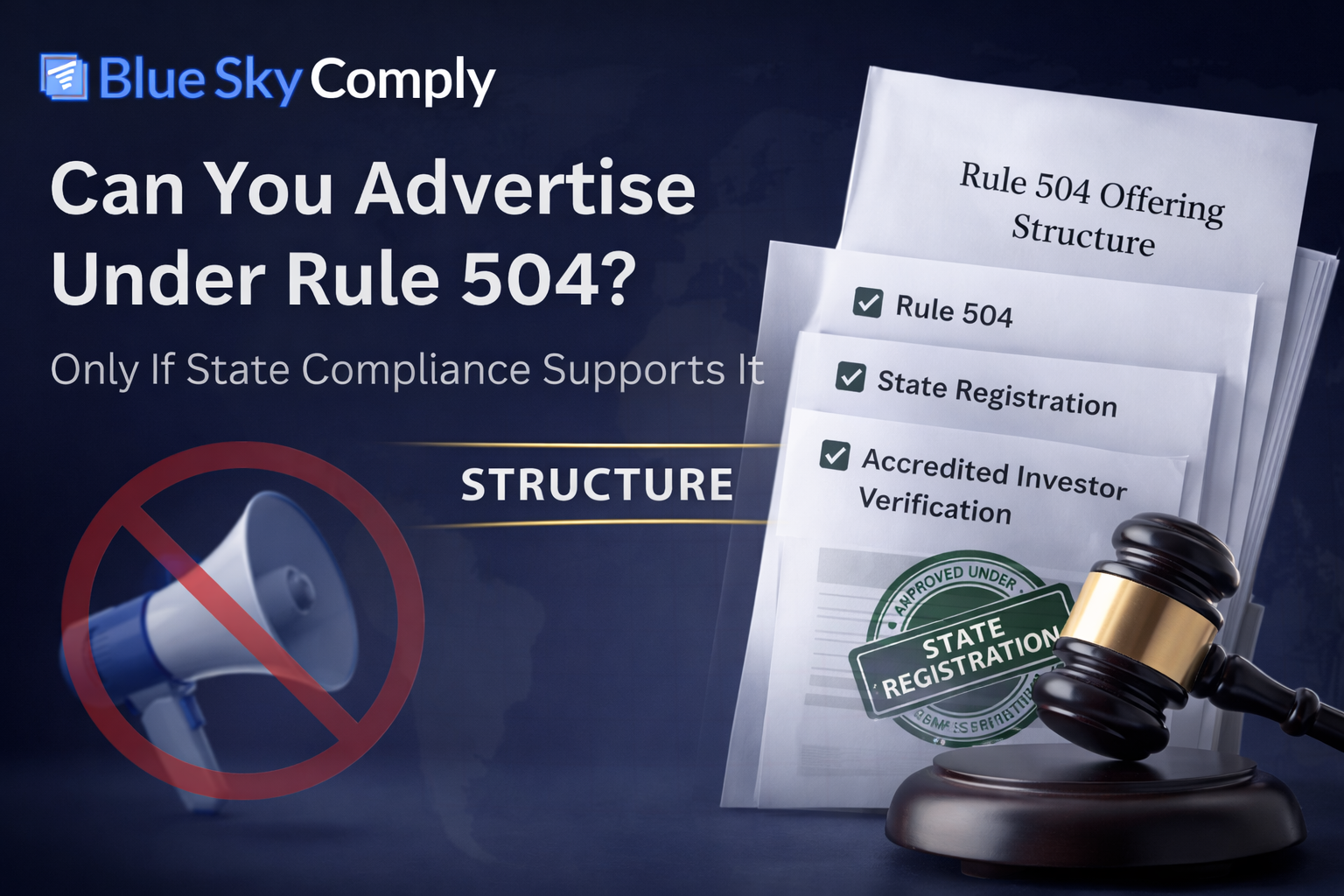
Choosing a path for your early capital raise is less about buzzwords and more about fit. Rule 504 sits inside Regulation D and can be a practical option when you want a lighter lift for a smaller offering, especially if your investor base is close to home. The decision often hinges on a few grounded realities:
- Size of the round
- Who your investors are
- How widely you plan to market
- Whether you can embrace state-level steps.
What Rule 504 Is and How It Works
Rule 504 supports smaller offerings with a comparatively simple structure. Broadly speaking, it can allow certain flexibility when the offering is registered at the state level, and it permits sales to both accredited and non-accredited investors, subject to state rules. Documentation and disclosure/filing requirements for Reg D 504 are simple on the federal-filing side to the SEC, but more complicated on the state level. Further, you will spend most of your energy coordinating state requirements, since federal preemption is not the default advantage. Contact us to learn more. State review and registration are what make 504 feel different in practice. Your marketing leeway often flows from what a specific state has reviewed and allowed. If you plan to sell only in a handful of states, you can right-size the process and move faster. If you plan to market broadly across many states, the complexity can add up. Rule 504 could be fast and flexible for small rounds, but varying state requirements will likely determine your true cost and timeline.When Rule 504 Is a Good Fit
Rule 504 tends to click for companies that already have a defined local or regional audience and want to raise a modest amount without building a national marketing campaign. Imagine a consumer brand with loyal customers in two or three states, or a real estate vehicle focused on one metro area. The practical benefits are speed, familiarity with the investor base, and fewer moving parts than a larger retail pathway. If your investors are not all accredited or you have more than 35 non-accredited investors, a state-registered 504 can offer a compliant on-ramp where 506(c) and (b) would not fit your plan. A founder with a strong email list and in-market events might find 504 especially appealing. The existing relationships compress the marketing cycle, and the alignment between your intended investors and the states you choose to register in keeps the filing work proportional to the raise.When Rule 504 Might Not Be the Best Choice
Rule 504 will struggle to keep pace if your strategy looks national, your investor mix is primarily accredited, and you want to openly advertise online. In that scenario, 506(c) can deliver general solicitation with federal preemption on state law, which simplifies the filing posture and helps you move faster across state lines. If your vision is a truly retail-friendly offering at a larger scale with broad reach, Regulation A Tier 2 is often the correct framework, even though it brings ongoing reporting and audited financials. If you expect to run a platform-based, community-centric campaign, Regulation CF may be a better match than 504. The portal infrastructure can be worth the tradeoffs when your goal is to grow your audience from the crowd. If your plan is to market broadly to accredited investors nationwide, 506(c) is usually more efficient than Rule 504.Rule 504 Compared to 506(b) and 506(c)
The differences between these Reg D routes come down to solicitation, investor eligibility, and how much state-level coordination you want. With 506(b), you can avoid general solicitation and raise funds from accredited investors and up to 35 sophisticated non-accredited investors, leveraging preexisting relationships. It is quiet and controlled. With 506(c), you gain the right to generally solicit, but you must verify accreditation status. In both cases, federal preemption lightens the state burden. With Rule 504, you can gain more flexibility via state registration, but the tradeoff is the filing and review workload that sits with those states. If your raise is concentrated where you already do business, that tradeoff can be worth it.Rule 504 vs Regulation CF
Crowdfunding under Reg CF formalizes the public campaign format. You will work through a registered portal, follow disclosure templates, and accept investment caps and limits that come with the territory. The upside is access to a broad retail audience and platform tools designed for conversion. You can raise from unlimited non-accredited investors up to $5mm. By contrast, Rule 504 is most compelling if you can focus on a few states, tailor your messaging to what those states have reviewed, and lean on existing customer affinity. If your plan already involves a portal and national outreach, you will likely be better served by Regulation CF.Rule 504 vs Regulation A Tier 2
Reg A Tier 2 is the heavyweight retail exemption suitable for larger raises with a wide audience, which allows non-accredited investors and free-trading shares suitable for trading. It introduces audited financials, offering circular review and ongoing reporting, all of which support a durable investor relations posture. That structure brings credibility and reach, but it also brings time and budget commitments. Rule 504 is the smaller, faster option for local raises where the goal is to get to a close efficiently without building the infrastructure of a national retail offering. If your strategy anticipates scaling marketing and investor count significantly, a Reg A Offering deserves a serious look.Can You Advertise a Rule 504 Offering?
The short answer is yes, but only under specific conditions tied to state law. Rule 504 by itself does not grant a blanket right to advertise. Public solicitation is permitted when your offering is registered in the states where you intend to solicit or when you use a state exemption that expressly allows general solicitation and requires a public filing and delivery of a disclosure document. In these situations, your ads and public statements should be consistent with what the state reviewed and permitted. If you are not pursuing a path that allows general solicitation under state law, treat communications like a traditional private placement and avoid public promotion. Many issuers that want broad public outreach choose 506(c) instead, because it permits general solicitation with federal preemption. When in doubt, align your plan with state-reviewed materials and keep copies of everything you publish.State Compliance Realities Under Rule 504
The mechanics of 504 are won or lost in the details of state coordination. Each state may have its own form of review (merit-based or disclosure-based reviews), comment cycles, and timelines. Fees also vary. Because your marketing claims should match the filed terms that a state has approved, you will want your marketing and legal teams to communicate closely. For issuers working across a handful of states, it can help to sequence filings based on expected investor demand and processing speed. Select the states where your investor list is strongest, start there, and avoid overextending your filing footprint until you see conversion. When you need a reference point for what these filings entail, it is useful to look at the broader category of State Reg D filings so you can budget time and resources. The core idea is the same:- Plan for state and legal fees
- Filing documents and paperwork
- Examiner comments
- Align your calendar accordingly
Costs, Timelines, and Documentation
Issuers sometimes underestimate the time and attention required to align marketing with state-reviewed materials. A realistic plan includes a calendar for filing and comment resolution in each state, time for drafting and revising offering documents, and a playbook for what your team can and cannot say during the campaign. It also includes recordkeeping and post-close filings, particularly if you accept investments in tranches. To avoid surprises, map your budget to state fees and core drafting tasks. Documentation usually includes subscription agreements, investor questionnaires, disclosure materials that mirror state filings, and carefully reviewed communication materials. Here is a simple view that helps set expectations without drowning in details:| Topic | What to expect under Rule 504 | Practical tip |
| State reviews | Vary by state, with possible comment cycles | Sequence filings by expected demand and speed |
| Fees | Vary by state and can compound across jurisdictions | Build a per-state fee model and track actuals |
| Marketing | Tied to what has been filed or approved | Keep marketing aligned with filed terms and disclosures |
| Investor mix | Can include non-accredited investors with state registration | Pre-plan investor communications and FAQs |
| Timeline | Often faster for a few states, longer for many | Pilot in core states before expanding |
Marketing and Communications Under Rule 504
Good messaging respects what you have filed. If a state has reviewed and cleared specific claims, lean on that approved language. Do not improvise on terms, and do not make performance promises. Your investor communications should be templated, and your team should know which materials are greenlit and which need legal review before use. A well-run 504 campaign often looks and feels like a focused product launch. You address a known audience with clear, consistent materials, and you measure response state by state. That discipline keeps the raise clean and shortens your path to closing.Case Snapshots: Where Rule 504 Works
Consider a consumer food brand with a devoted regional following. The company has strong sales in two neighboring states and wants to invest in customers who ask about participating. Registering under Rule 504 in those states allows the brand to market within a known footprint. Because the audience already trusts the product, the message lands, and the brand can focus its budget on filings instead of national advertising. Another example is a small business services firm whose clients are concentrated within one metropolitan area. Their investors are primarily customers and partners. A targeted 504 effort allows the firm to share the opportunity ethically and coherently without scaling up a national compliance structure. A third scenario is a community real estate vehicle that aggregates investment into local projects. The value proposition is local knowledge and visibility. That is a natural use case for a state-registered offering that stays close to its base.Common Pitfalls and How to Avoid Them
Even well-prepared teams can stumble if they treat 504 like a generic Reg D raise. The most common missteps include drifting off script in marketing materials, underbudgeting state and filing fees, and assuming every state processes at the same pace. You can avoid those risks by setting internal controls for content, tracking a state-specific calendar, and making sure subscription, disclosure, and investor updates reflect the same set of terms. A short checklist can help you stay on track after you choose Rule 504:- Confirm which states you will file in and why those states align with your investor list.
- Lock approved language for marketing and investor communications and train the team.
- Map state timelines to your campaign calendar and hold to a weekly review cadence.
- Track commitments and funds by state, so post-close filings are complete and timely.
Choosing Rule 504 With Clarity
Rule 504 shines when your raise is modest, your investors are concentrated in a few states, and you can align marketing with state-reviewed materials. If you value speed, simplicity, and access to non-accredited investors in a focused footprint, 506(b) or Reg CF may be a better option. If your plan involves nationwide outreach, general solicitation, or a larger retail audience, you will usually find a better fit in 506(c), Reg CF, or Reg A. Match the exemption to your audience, geography, and timeline to avoid friction and rework. For tailored support with state securities filings and Reg D strategies, Blue Sky Comply can be contacted for related support.
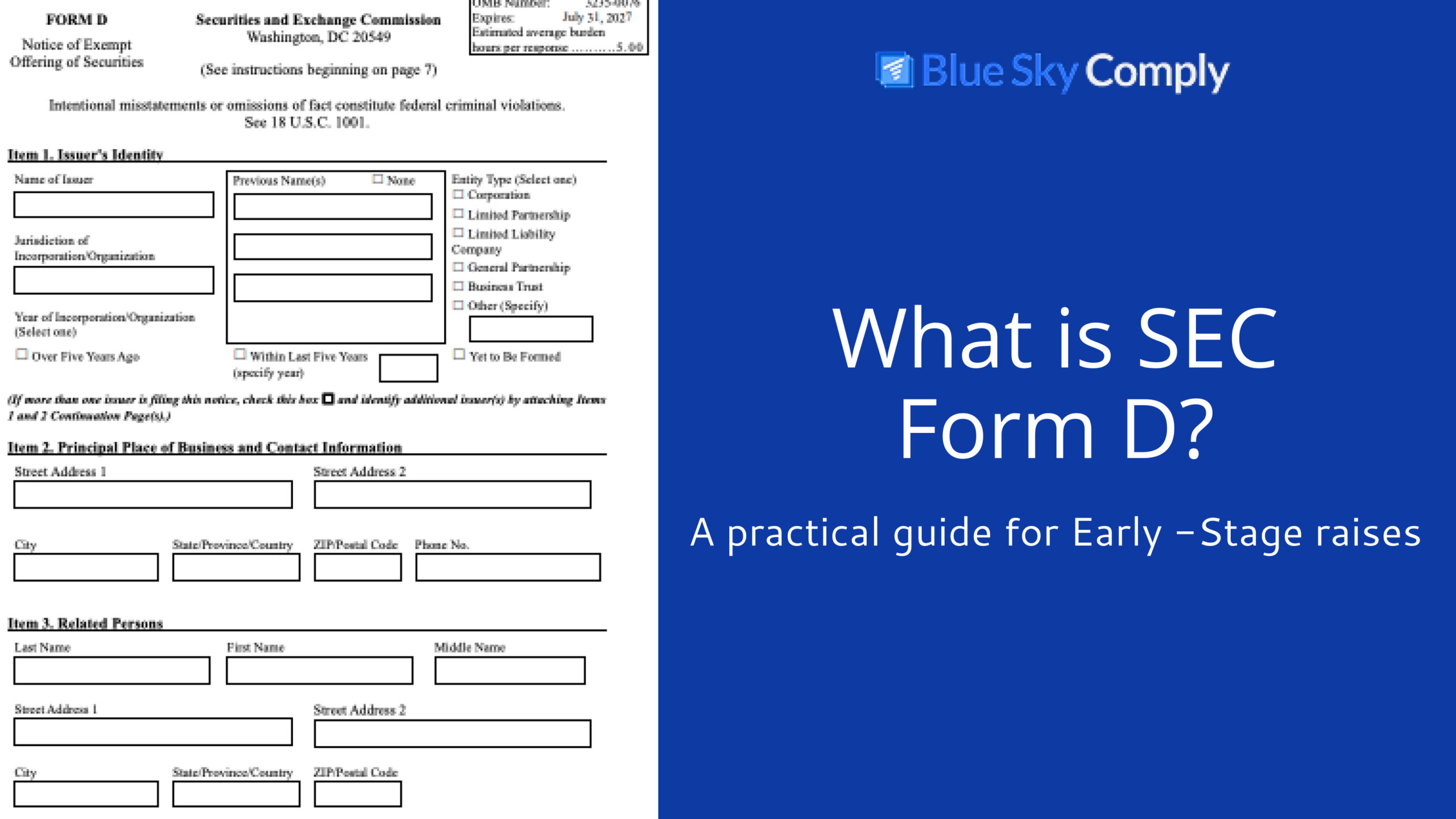
If you’re raising private capital in the U.S., there’s a good chance you’re relying on Regulation D. That’s where SEC Form D comes in, a short notice filing for private offerings conducted by any companies in the United States - yes, this means all companies in the US who sell securities to investors must file a Form D to the SEC with the accompanying Blue Sky filings.
The SEC Form D doesn’t get you “approval,” but it does provide basic disclosure of key details of your exempt offering and starts the 15-day filing window for your state-level “blue sky” obligations. In other words, it’s a notice form with consequences for compliance, investor confidence, and your fundraising momentum.
What Is SEC Form D?
SEC Form D is a notice filing submitted to the SEC for certain exempt offerings of securities, most commonly under Regulation D. It’s a concise disclosure about the issuer, the exemption relied upon, the size of the offering, sales to date, and basic information about investors and sales compensation. Form D is not a merit review or an approval process; it’s a formal notice that you are conducting a private offering under an exemption. Form D is typically associated with:- Rule 506(b) and 506(c) offerings
- Rule 504 offerings (smaller raises with burdensome filing requirements)
Who Must File Form D and When?
Issuers relying on Regulation D generally must file Form D with the SEC. This includes U.S. and foreign issuers selling securities in the United States. The filing deadline is within 15 calendar days after the “date of first sale.” Practically, the “first sale” occurs when an investor becomes irrevocably committed to invest, often when the subscription documents are signed, and funds are not subject to a unilateral right of withdrawal. A few operational points matter:- You need an EDGAR account, which can be obtained through a Form ID filing. That means your company (or the issuing vehicle) needs a CIK number and EDGAR filing codes before submitting. Getting these in place early avoids a deadline crunch.
- The deadline is short. Fifteen calendar days can pass quickly if you close over an SEC federal holiday or don’t have process ownership assigned.
What Information Does Form D Require?
Form D collects high-level offering and issuer details. Expect to provide:- Issuer identity and principal place of business, plus related persons (executive officers, directors, promoters).
- The exemption relied upon (e.g., 506(b), 506(c), or 504).
- Offering size: total amount, amount sold, minimum investment accepted.
- Investor mix: number of investors, and how many are accredited versus non-accredited (if applicable for your exemption).
- Sales compensation: whether you are paying placement agents, brokers, or finders, including names and CRD numbers where relevant.
- Offering jurisdictions: the states (and sometimes territories) where securities are being offered or sold.
How to File Form D on EDGAR (Step-by-Step)
The process is straightforward but benefits from preparation:- Obtain/confirm EDGAR credentials: Secure your CIK, CCC, and create appropriate filing roles in your system.
- Prepare the form: You can complete Form D directly on your blueskycomply.com account.
- Validate and submit: After completing the form with our validation checks and instructions providing guidance, you can submit a test filing to ensure you don’t have validation errors. You can then live file the document. If you prefer, we can handle all of this for you.
- Align the data: Make sure the data on your Form D matches your private placement memorandum, subscription documents, and investor list. Inconsistencies or inaccurate data could result in State or SEC fines.
Form D Amendments: When Are Updates Required?
You must amend Form D to correct material mistakes or reflect significant changes as the offering progresses. There’s also an annual amendment requirement if your offering is still ongoing on the first anniversary of the original filing. Common amendment triggers include:- A change in executive officers or directors
- A significant change in offering size or amount sold
- New sales compensation arrangements
- A change to issuer identity details or industry group - Additional selling jurisdictions that materially alter the picture
Blue Sky 101: State Notice Filings After Form D
Form D is federal. Most states still require notice filings and fees if you sell in their jurisdiction. While many states follow a similar structure, specifics vary—deadlines can be 15 days after the first sale in that state, and fee schedules can differ widely. States typically ask for multiple documents, including a copy of the Form D and payment of state fees. For multi-state raises, complexity ramps up quickly. You’re juggling deadlines, annual renewals, amendments, and changing requirements. If you’re getting oriented, our overview of the key requirements for Reg D offerings can help you understand where state notice filings fit into the broader compliance process.Common Mistakes and How to Avoid Them
Even seasoned teams can stumble on logistics. The most frequent issues include:- Missing the 15-day SEC deadline or state notice deadlines
- Starting the Form ID application process too late
- Inconsistencies between PPMs/sub docs, Form D, and state filings
- Forgetting to file or renew state notices in every jurisdiction where you’re selling
- Not amending Form D after material changes (or failing to update states accordingly)
- Overlooking disclosures about sales compensation or finders
Consequences of Non-Compliance
While a late or missing Form D won’t usually blow up your exemption by itself, it can create real problems. States may impose penalties, issue stop orders, assess additional late fees, or ask for corrective filings. You can heighten rescission risk if investors argue the offering wasn’t properly conducted, and you can create roadblocks during future diligence. **Non-compliance is costly, not just in fees, but also in lost time and possible legal trouble.**FAQs
- Do SPVs and funds need to file? Typically, yes, if relying on Reg D, the issuer (whether an SPV, fund, or operating company) is responsible for Form D and subsequent state notices.
- 506(b) vs. 506(c) vs. 504 506(b) doesn’t allow general solicitation and permits up to 35 non-accredited investors (with information requirements); 506(c) allows general solicitation but requires accredited investor verification; 504 is capped and subject to additional state considerations.
- If no sales occur, do you need to file? No first sale = no SEC Form D filing. But check any state-specific triggers if you conducted pre-filing activities or paid fees.
- How public is the information? EDGAR is public. Be thoughtful about what’s disclosed within the form’s structure and coordinate with counsel on investor optics.
Quick Comparison of Reg D Pathways
Before we jump into specifics, it helps to frame how the main Regulation D pathways differ in practice. Rule 506(b) is the traditional private placement; no general solicitation, with room for a limited number of non‑accredited investors if you provide robust disclosures. Rule 506(c) opens the door to public marketing, but only if every investor is verified as accredited. Rule 504 is typically used for smaller raises and involves more state‑level variation. The table below highlights the operational trade‑offs so you can choose the route that best fits your fundraising strategy.| Requirement | Rule 506(b) | Rule 506(c) | Rule 504 |
| General Solicitation | Not permitted | Permitted | Not permitted (with limited exceptions) |
| Investor Eligibility | Unlimited accredited; up to 35 non-accredited (with disclosures) | Accredited investors only (verification required) | Varies; generally open to non-accredited, subject to caps |
| Verification Requirement | Not required | Required (reasonable steps to verify) | Not required |
| Offering Cap | No SEC cap | No SEC cap | SEC cap applies (subject to change by rule) |
| Form D + State Notices | Yes + state notices as applicable | Yes + state notices as applicable | Yes + state notices as applicable, with more state variation |
Checklist: Getting Form D and Blue Sky Right
Pre-raise:- Secure your CIK and EDGAR codes.
- Confirm your exemption (e.g., 506(b) vs. 506(c)), align on investor eligibility and marketing plan.
- Draft PPM and other offering documents
- Calendar the 15-day SEC deadline and all state deadlines per jurisdiction.
- Ensure Form D data matches offering documents and internal records.
- Confirm EDGAR acceptance, save the filing receipt, and use it to support state Form D filings.
- Track amendments, renewals, and state responses until the offering is closed and all states are fully compliant.
How Blue Sky Comply Streamlines Form D and State Filings
Coordinating SEC and state filings for Reg D can be a full-time job, especially when your offering spans multiple closings, annual renewals, or several jurisdictions. Blue Sky Comply centralizes the data and timelines so you don’t have to chase scattered spreadsheets or emails.- Centralized workflow: We maintain a single source of truth for offering details, jurisdictions, deadlines, and fee schedules, and mirror these across federal and state requirements.
- Deadline and amendment tracking: Automated reminders help ensure your annual amendments and state renewals aren’t missed.
- Full-service support: From aligning sale dates and investor data with filings, our team supports counsel, funds, SPVs, and operating companies. For a deeper dive on the Reg D landscape, see our overview of a Reg D offering.
- Cost clarity: If you’re figuring out costs, our breakdown of Reg D State fees can help avoid surprises.
Getting the SEC Form D filing right isn’t about memorizing acronyms; it’s about entering the simple components to conducting a Reg D private offering.
In this article, we provide a field-by-field walkthrough that is designed for company executives/founders, CFOs, in-house counsel, and fund managers who want practical “how to complete Form D” guidance without the sales fluff. We’ll cover what you need before you start, how to move through each section with confidence, and the timing rules that trip teams up.
Form D is brief by SEC standards, but it touches on all critical points of your offering. Small inconsistencies can cascade into state-level issues later, such as:
- The wrong industry
- Investor count totals and amount sold discrepancies
- Incomplete related persons
- Inadequate commissions and finder's fees disclosures
- Proper Use of Proceeds disclosure.
What Form D Is, and When It’s Required
Form D is a notice filing with the SEC for certain private offerings. It makes basic details public: issuer identity, exemption claimed, offering size, and limited sales data. If you’re raising under the Regulation D framework, you should file within 15 days of the first sale. For a refresher on the exemption details and requirements, see Regulation D. Because Form D is public, coordinate your investor messaging and website language. You don’t need to over-share in the form, but everything must be accurate, consistent, and timely across federal and state submissions.How Companies Use Form D in Practice
Real-world filings make the mechanics tangible. The companies below illustrate common Form D patterns you will likely encounter, including rolling closes that require timely amendments, disciplined tracking of investor counts and jurisdictions, and tight alignment between issuer identity, related persons, and any sales compensation. Use these as mental models to pressure test your own process before and after each close.- SpaceX: Amending as Large Rounds Progress: SpaceX has filed multiple Form Ds across successive equity rounds. As funds accumulate through rolling closes, filings reflect updated “amount sold” and added jurisdictions. The practical takeaway: for staged capital collection, build a rhythm of checking amendment triggers after each close so federal and state records stay aligned.
- Stripe: Rolling Closes and Timing Discipline: Stripe’s Form D history illustrates how high-demand raises can proceed in increments. Investor counts and amounts sold change as allocations settle, driving timely amendments. The takeaway: pair your closing calendar with a 48-hour “amend-or-not” review to keep the public record current.
- Epic Games: Clean Issuer Identity and Compensation Alignment: Epic Games filings are a straightforward model for issuer identity, related persons, and sales compensation entries. The takeaway: match titles to your board resolutions, and ensure any cash, warrants, or success-fee equity given for placement activity is consistently reflected across agreements, the cap table, and Form D.
- Early-Stage Startups: First-Sale Date and Jurisdiction Nuance: Many seed and Series A companies trigger their first-sale date when the first wire lands under executed subscription agreements, not when soft commits arrive. The takeaway: track investor legal residence at subscription, not after funds clear; that’s what drives state notice filings and related fees.
Potential Pitfalls of the Form D (and Form ID)
Before you can file Form D, you need EDGAR access. That starts with Form ID—your application to obtain or update EDGAR credentials (CIK/CCC and related access). Since EDGAR Next changes, the SEC has frequently taken several days to approve new Form ID submissions, which can push your Form D timing if you wait until the last minute. Build this lag into your deal calendar and kick off Form ID well before first close.Why Form ID matters
- Form ID is the gatekeeper. Without it, you can’t file Form D. Approvals often take several days post–EDGAR Next, especially for first-time issuers and new signers.
- Notarized signatures are required. Plan for a notarized, correctly executed signature page. We can help coordinate notarization and submission so the package is accepted the first time.
- Waiting until the week of first close: Start Form ID 2–3 weeks before your expected first sale date. Have a backup signatory ready with a notarized page in case your primary signer is unavailable.
- Signature/notary defects: Name/title mismatch with corporate records, missing notary seal, or date issues are common rejection reasons. Align titles with board resolutions and ensure the notary block is complete and legible.
- Identity and document mismatches: The legal name on Form ID must match formation documents exactly. Avoid using DBAs. If you’re updating credentials for a new executive signer, align with your Related Persons details.
- File format and submission errors: Follow the SEC’s file type and size specs. Incorrect PDFs or corrupt attachments can trigger rejections and restart the clock.
- Role confusion: Don’t use a personal EDGAR account to file for the issuer. Establish issuer credentials and assign the proper roles so the authorized officer can sign Form D.
- Contact details that don’t resolve: Use monitored email and phone numbers; SEC confirmations and queries arrive via those channels, and timing matters.
Before You Start: Prerequisites and Setup
Before you dive into the form, set your foundation. Decide which exemption actually matches how you marketed the raise, secure EDGAR access by submitting Form ID early (approvals can take several days after EDGAR Next and require a notarized signature), assign clear internal owners for data, and pull a single, current set of records for issuer details, officers, industry/NAICS, offering terms, investor counts, jurisdictions, and any sales compensation. With that groundwork in place, you’ll file faster and avoid amendment churn. Here are the prerequisites:Confirm Your Exemption and Offering Structure
Most private issuers rely on Rule 506(b) or 506(c). The key differences affect both how you market and what you must validate for investors.- 506(b) prohibits general solicitation but allows up to 35 non-accredited investors (with disclosure requirements).
- 506(c) permits general solicitation if you take reasonable steps to verify accredited status.
- Scenario 1: You posted your deck publicly after a conference. That’s general solicitation, use 506(c), and verify accreditation before accepting funds.
- Scenario 2: You quietly raised from a known network with no public marketing. 506(b) may fit—track any non-accredited investors and deliver required disclosures.
Get Your EDGAR Credentials in Order
First, file Form D through EDGAR. Make sure you have:- CIK, CCC, and related EDGAR access codes
- Authorized personnel identified (and available on filing day)
- A secure process for sharing credentials
Gather Required Information (Working Checklist)
Form D pulls from multiple systems, including legal, finance, HR, and investor relations. Centralize:- Issuer details (legal name, entity type, jurisdiction, addresses, EIN, year of incorporation)
- Related persons (executive officers, directors, promoters; names, titles)
- Industry
- Issuer size and revenue range
- Exemption claimed (e.g., Rule 506(b), 506(c), 504)
- Offering details (total offering amount, minimum investment, date of first sale)
- Sales data (amount sold, number of investors; accredited vs. non-accredited where applicable)
- Sales compensation (agents, brokers, finders, and associated fees)
- Use of proceeds
- Jurisdictions of sales (this drives state notice filings)
- Authorized signatory for submission
The Form D Instructions: Field-by-Field Guide
Before you open EDGAR, pull up your latest corporate records, board resolutions, subscription trackers, and cap table. This field-by-field guide explains what each Form D item is asking for, how to enter it correctly the first time, and which details commonly trigger corrections. Keep names, titles, NAICS, offering amounts, investor counts, jurisdictions, and any sales compensation aligned to the same single source of truth; when facts change during rolling closes, amend promptly so your federal and state records stay in sync.- Issuer Information: Enter the issuer’s full legal name exactly as it appears in formation documents. Specify the entity type and jurisdiction of incorporation/organization. The primary business address should reflect where the company operates; the mailing address can differ. Include your EIN if requested. This section sets the identity anchor for everything else. Mismatches here can ripple into state systems.
- Related Persons (Executive Officers, Directors, Promoters): List each relevant individual with full name and title. Title accuracy matters; use official titles that match your corporate records and any prior disclosures. If leadership changes during the raise, you may trigger an amendment to keep Form D current.
- Industry Group and NAICS: Pick the most accurate industry possible that aligns with your NAICS code. Don’t guess. Cross-check with your tax and payroll records. When in doubt, select the industry that best reflects primary revenue generation, not a future roadmap. A mismatched industry can cause follow-up questions from states and investors.
- Revenue Range and Size of Issuer: Choose the category that best reflects your most recent fiscal-year figures or current state, per the form’s instructions. Be consistent with what you disclose elsewhere (offering materials, investor communications, and state filings). Note that you can decline to disclose.
- Exemption/Exclusion Claimed: Select Rule 506(b) or 506(c) based on your actual marketing and verification practices (we recommend avoiding Rule 504). If you generally solicit, 506(c) is the typical path, and you must verify accredited status. If you didn’t solicit, 506(b) is common, with limits and disclosure obligations for any non-accredited investors. This field influences what you must track and how states may review your filing.
- Offering Details: Report the total offering amount (even if you don’t intend to sell every dollar immediately). If the amount is open-ended, follow the form’s “indeterminate” conventions. Enter the amount sold to date, the minimum investment (if any), and the date of first sale. This date starts your federal and state due date requirements of filings being done within 15 days of the first sale.
- Sales Commissions and Finder’s Fees: Disclose compensation to placement agents, broker-dealers, finders or anyone receiving sales commission of any kind, including amounts or ranges. Identify the recipients where required. If you have success fees or warrants for intermediaries, ensure they’re reflected accurately. Underreporting here is a common audit and regulator sore spot.
- Use of Proceeds: Describe the general categories, working capital, product development, acquisitions, debt repayment, etc. Keep it aligned with your offering materials. If any proceeds compensate executive officers or directors, follow the form’s instructions on disclosure.
- Investor and Sales Data: Enter the number of investors admitted to date. For 506(b) offerings, the count of non-accredited investors (if any) must be tracked with care. For 506(c), ensure your accreditation verification records are in order, even if you don’t upload them here. If you’re doing rolling closes, you may need to amend investor counts and amounts sold as the raise progresses.
- Jurisdictions: If you are paying commissions (from above), please list the states (and, if applicable, territories) where sales occurred. This section is pivotal for your state notice filings. Many states require notice filings and fees shortly after the first sale in that state, independent of the SEC clock.
- Signatures and Submission: Form D should be signed by an authorized person, typically an executive officer. Double-check name/title alignment with the Related Persons section. Once filed, EDGAR will time-stamp the submission and make it publicly accessible.
Form D Deadlines: Initial Filing, Amendments, and Closing Out
Your initial Form D is due within 15 calendar days after the date of first sale, which generally means the date you have a binding investment commitment and receive consideration (or are irrevocably committed to receive it). If your first sale happens on a weekend or holiday, count forward; the 15-day clock doesn’t pause. You must amend Form D for certain material changes, such as:- A significant change in the offering amount or the amount sold
- A change in the exemption claimed (e.g., switching 506(b) to 506(c))
- Changes to issuer identity details or related persons
- New jurisdictions where sales occur
- Other possible changes that we can guide you through at Blue Sky Comply.
After You File: State Notice Filings and Fees
Filing Form D federally doesn’t complete your compliance. Most states require their own notice filings and fees when you sell to investors in that state, often tied to the first sale date in that jurisdiction. The data you enter on Form D (issuer details, exemption, offering size, sales) should match what you submit to the states. Inconsistency can create back-and-forth and late fees. If you’re budgeting your raise, scan typical costs with Reg D state fees and plan submissions by jurisdiction. For the broader landscape of what states expect, see state securities filings. Keeping a single source of truth for amounts sold, investor counts, and dates will make multi-state maintenance much smoother.FAQ: Practical Questions About Form D Instructions
- Do I need a Form D before accepting soft commitments? No. The Form D can be filed after the first sale, when the investor has signed the purchase or subscription agreement, the clock is typically started.
- Can I pre-file the Form D to the SEC and States before I make any sales? Yes, you can pre-file to the SEC before making any sales, and to the states as well to ensure you are cleared and ready in advance.
- Do I have to do a Renewal filing after 1 year to keep my offering open? Yes, you have to file a Form D renewal filing each year before the 12-month mark. State filings may be required depending on the state, which we can help with.
- What if my offering amount changes mid-raise? If the total offering amount shifts materially, amend the Form D and align state notices. Keep your offering documents synchronized.
- How public is my Form D? Very. It’s accessible on the SEC EDGAR Search. Plan investor communications and PR with that visibility in mind.
Bottom Line
Form D is straightforward when you prepare your inputs and keep your records reconciled. The flow is simple: assemble clean issuer and offering data, complete the fields carefully, file on time, amend when facts change, and finish strong with state notices. Your raise moves faster when your filings tell a single, consistent story. And, lastly, don’t forget annual renewal obligations. Blue Sky Comply can help you with Form D filings and Reg D blue Sky filings.
Form D is filed federally with the SEC, but most issuers also submit state “notice filings” before offering to residents of those states. A renewal is the state’s way of keeping that notice current when your Rule 506 offering remains open beyond the initial 12-month period. The specifics, whether a renewal is required, when it’s due, and how it’s submitted, vary by jurisdiction, so the practical rule is simple: if you’re still offering or selling in a state after the initial notice period, expect to check that state’s renewal rule and timeline.
What counts as a renewal, and what doesn’t
A state renewal extends the effectiveness of your notice filing in that state so you can continue offers/sales. This is different from an SEC Form D amendment, which updates and renews the federal filing with the SEC. In other words, a federal amendment does not “cover” state renewals, as states require their own filings.When renewals are typically required
As a general pattern, states either:- Tie annual renewals to the original notice filing date; or
- Use a fixed calendar or fiscal-year cycle, requiring renewals by a set date each year, which is typical with issuer dealer/sales agent filings.
Common scenarios and actions
Many teams grapple with the same timing questions: does the clock run from filing date or effectiveness, and do we need to renew if sales paused? The practical answer is to confirm each state’s trigger and then work backward with reminders and budgeted fees. Here’s a quick decision aid you can adapt to your own calendar:|
Scenario |
Renewal expected? |
Typical timing |
Recommended action |
|---|---|---|---|
| Offering continues in a state beyond the initial 12 months | Usually yes | Filing before the 12-month anniversary date or fixed date | Set calendar reminders or utilize blue sky software that can do that for you |
| No recent sales, but the offering is still open | Sometimes | Depends on the state | Confirm rule; renew if required, or terminate if you won’t sell there |
| Offering closed in a state | No (after closure) | N/A | File termination/withdrawal to stop obligations |
| States that don’t require renewals | No | N/A | Confirm status; retain proof and monitor for rule changes |
Practical compliance tips
Start by mapping each jurisdiction’s renewal trigger and timing at the outset of your raise, or use a Blue Sky software that can track that. Track the initial filing date, the state’s renewal cadence, and applicable fees. Set reminders 30–60 days ahead of deadlines to allow for approvals and payment logistics, and file terminations as soon as sales end in a state. Keep confirmations and receipts organized; those records make audits and investor diligence straightforward. For cost planning, reviewing expected fees for your footprint is helpful; see the Reg d state fees for typical schedules and ranges.Risks of missing renewals
Missed or late renewals can lead to late fees or administrative penalties, force a pause on sales into that state, and increase rescission risk. They also create friction with counsel and investors that’s easily avoided with disciplined tracking. Proactive renewal management protects the raise and preserves credibility.Quick Recap
If you’re wrapping up your planning, a quick gut-check helps: confirm which states actually require a renewal, note each renewal clock (12-month anniversary or fixed-date), and decide whether to renew or terminate where sales have ended. A lightweight calendar plus proof of filings will prevent last‑minute scrambles and unnecessary fees. Planning a mixed offering program? Blue Sky Comply can help you budget and forecast renewals alongside Reg D state fees as needed. Contact us to learn more.


Let Us Simplify Compliance for You
Partner with Blue Sky Comply to unlock seamless compliance, efficient filings, and access to expertise that lets you focus on your growth.
Schedule A Free Demo