
Category: Blue Sky Requirements
Closing a capital raise feels like a finish line, but for issuers operating under federal exemptions, it is really just the starting point of an ongoing responsibility. Annual Blue Sky compliance maintenance is the process of meeting continuing state-level securities obligations after your initial offering is complete. It covers everything from renewing notice filings and paying state fees to tracking jurisdiction-specific deadlines that change from year to year.
If you raised capital through Reg D, Reg A, or Reg CF, the states where your investors reside may require you to file paperwork, pay renewal fees, or submit updated disclosures on a recurring basis. Missing these obligations is not a technicality. It can expose your business to regulatory penalties, disrupt future fundraising, and erode the trust of the investors you worked hard to bring on board.
This guide explains what annual Blue Sky compliance maintenance involves, how requirements vary by offering type and state, and what issuers can do right now to stay on track.
What Is Annual Blue Sky Compliance Maintenance?
Annual Blue Sky compliance maintenance refers to the ongoing state-level filing and renewal obligations that issuers must fulfill after completing a securities offering. Each U.S. state has its own securities laws, commonly known as Blue Sky laws, and many require issuers to take action on a recurring basis, not just at the time of the initial offering. These ongoing obligations can include renewing notice filings, paying annual fees, submitting updated investor disclosures, and notifying state regulators of material changes in the offering. The specific requirements vary widely depending on the state, the type of exemption used, and whether the offering is still active or has closed. It is important to understand that compliance does not end when the last investor check clears. State regulators expect issuers to remain current throughout the life of the offering and, in many cases, for a period following its close. Issuers who treat Blue Sky compliance as a one-time task often find themselves out of compliance without realizing it. The annual maintenance process is also distinct from the initial filing requirements under Reg A, Reg D, and Reg CF. Initial filings establish the right to offer securities in a given state. Annual maintenance preserves that right and satisfies the state's ongoing regulatory expectations.Why Ongoing State Compliance Matters for Issuers
The consequences of failing to maintain annual state filings are more serious than many issuers expect. State securities regulators have the authority to issue cease-and-desist orders, impose fines, and require rescission of securities sold to investors in their jurisdiction. In some states, selling securities without proper registration or a maintained exemption is a criminal offense. While state regulators do monitor compliance, enforcement across all 50 states and U.S. territories involves distinct roles for federal and state authorities. The SEC enforces federal securities laws at the national level, while individual state regulators enforce local "Blue Sky" laws. To maintain compliance, state examiners regularly audit issuer records, review portal filings, and cross-reference federal disclosures with state records. Consequently, an issuer that falls behind on annual Blue Sky filings may not receive an early warning, remaining unaware of the oversight until a formal notice of violation arrives. Consistent compliance also signals credibility. Investors in Reg A and Reg D offerings are often retail investors who rely on the regulatory framework for protection. Maintaining your Blue Sky filings shows those investors that your business takes its legal obligations seriously, which matters when building long-term relationships in capital markets.Key Annual Filing Requirements by Offering Type
Annual Maintenance for Reg D Issuers
Reg D offerings rely on Form D filed with the SEC, but that federal filing is only part of the picture. Most states require issuers to submit a separate state notice filing, often called a Blue Sky notice filing or state Form D, to qualify the offering in each jurisdiction where investors reside. Many of those state filings are not one-time submissions. A significant number of states require annual renewal of Reg D notice filings as long as the offering remains active. Some states, including California and New York, have specific renewal timelines and associated fees that must be tracked carefully. California, for example, requires issuers to renew their exemption filings annually and charges fees tied to the amount raised in that state, and New York is typically every 4 years. Form D amendments at the federal level are required when material information changes, such as a new first sale date or a significant increase in the total offering amount. At the state level, some jurisdictions require issuers to file an amendment whenever the federal Form D is amended, while others have independent triggers. Tracking these state-specific deadlines manually is one of the most common sources of compliance gaps for Reg D issuers. A practical approach is to build a compliance calendar at the start of the offering that maps every state filing, renewal date, and fee payment to a specific deadline. Updating that calendar whenever a new investor is added from a previously unrepresented state is equally important.Annual Maintenance for Reg A Issuers
Reg A offerings come in two tiers, and that distinction directly affects annual state compliance obligations. Tier 1 offerings, which allow issuers to raise up to $20 million in a 12-month period, are subject to full state review and registration in each state where securities are sold. Tier 2 offerings, which allow up to $75 million, preempt most state registration requirements but do not eliminate all state obligations. For Tier 1 issuers, annual compliance can be substantial. Each state where you have registered the offering may require annual renewal filings, updated financial disclosures, and fee payments. These obligations continue for as long as the offering remains qualified in that state. Managing multi-state compliance calendars for a Tier 1 Reg A offering can involve dozens of active jurisdictions at any given time. Tier 2 issuers face fewer state filing requirements, but they are not exempt from all Blue Sky obligations. Some states still require notice filings and fees even for Tier 2 offerings. Issuers also must continue to meet federal ongoing disclosure requirements under Regulation A, including annual reports on Form 1-K and semiannual reports on Form 1-SA. These federal filings often trigger parallel state notice obligations. For issuers managing multi-state Reg A compliance, building a jurisdiction-by-jurisdiction calendar with clear renewal windows, contact information for state regulators, and fee schedules is the most reliable way to avoid gaps, which can be a very complicated process. This is an area where working with a specialized compliance partner can significantly reduce both administrative burden and legal risk. While the specific requirements ultimately depend on the state, the table below highlights the general compliance responsibilities issuers can expect under Reg D, Reg A, and Reg CF.| Compliance Requirement | Reg D | Reg A Tier 1 | Reg A Tier 2 | Reg CF |
| Initial state filing required | Yes | Yes | Notice filings in certain states | Notice filings where applicable |
| Annual state renewals | Often required for active offerings | Commonly required | May apply in certain states | Limited and state-dependent |
| Ongoing SEC reporting | No | No | Yes (Forms 1-K, 1-SA, 1-U) | Yes (Form C-AR while reporting obligations continue) |
| State filing fees | Yes | Yes | May apply | May apply |
| State-specific amendments | May be required | Commonly required | May be required | May be required where notice filings apply |
| Multi-state compliance complexity | High | High | Moderate | Low to Moderate |
Annual Maintenance for Reg CF Issuers
million from the public through SEC-registered funding portals. Because these offerings are conducted through registered intermediaries, many issuers assume that the portal handles every state compliance obligation. That assumption is only partly correct. Federal law generally preempts states from requiring full registration of a qualifying Reg CF offering. However, a state notice filing may be triggered when the issuer’s principal place of business is located in a state that requires such a filing. A filing may also be triggered in another state if residents of that state purchase more than 50% of the aggregate amount of the offering. The requirement applies only where the relevant state has adopted a Reg CF notice filing requirement. These filings are generally coordinated with the issuer’s Form C submission. Issuers should therefore identify any triggered states before launch, prepare the required notice forms and fees, and submit the applicable state filings at the same time as the Form C. Ongoing state obligations are usually lighter than those associated with Reg D or Reg A, but they may still include amendments, renewals, sales reports, or closing notices in certain jurisdictions. Issuers should also maintain accurate offering records, monitor material changes, and confirm whether any follow-up filing is required while the offering remains active. Small businesses using Reg CF often do not have dedicated legal or compliance staff. In that case, working with a compliance service that tracks state-specific Reg CF requirements can help prevent filing gaps and ensure that both initial and ongoing obligations are handled properly.State-by-State Variations in Annual Compliance Requirements
One of the most common misconceptions about Blue Sky compliance is that it works the same way in every state. It does not. Each state has its own securities division, its own fee schedule, and its own renewal timeline. What counts as an active offering that requires annual renewal in one state may be treated differently by another. States like California, Texas, and New York are known for stricter annual renewal requirements. California's Department of Financial Protection and Innovation requires Reg D issuers to renew their notice filings annually and submits detailed instructions on the required documentation and fees. Texas requires separate state notice filings for certain exempt offerings and has its own filing portal through the Texas State Securities Board. On the other end of the spectrum, some states have more streamlined processes. Several states accept the federal Form D filing as sufficient notice without requiring a separate state-level filing or annual renewal. However, even in those states, issuers must stay informed about any regulatory changes that could affect their obligations from one year to the next. The practical takeaway is that issuers cannot apply a single compliance template across all states. The only reliable approach is to treat each state as its own compliance jurisdiction with its own rules, deadlines, and contact points. Working with a compliance partner that has deep knowledge of state-specific requirements is not just convenient. For multi-state offerings, it is often the only realistic way to maintain accurate, timely compliance across the board.Common Mistakes Issuers Make With Annual Blue Sky Filings
Even well-intentioned issuers can run into annual Blue Sky compliance issues. Most problems fall into a few predictable categories — and they’re often avoidable with the right process.1. Missed Deadlines
Missed renewal deadlines are the most common issue. Renewal windows vary by state, and many states do not send reminders. An issuer may complete its initial filing, move on, and later discover it is out of compliance simply because no one was tracking the renewal date. Why it matters: Missing a renewal deadline can create immediate compliance risk and lead to added cost, delay, and regulatory issues.- Late fees may apply.
- Some states may require a new filing.
- The issuer can fall out of compliance without warning.
2. Filing Under the Wrong State Classification
Another common mistake is using the wrong filing category or exemption. This can happen when an issuer:- files under the wrong classification
- fails to update the filing after the offering changes
- relies on an exemption that does not actually apply in a particular state
3. Submitting Incomplete Documentation
Incomplete renewal packages are another frequent source of problems. Some states require supporting materials as part of the annual filing, such as:- audited financial statements
- officer certificates
- copies of the offering circular
- Renewal can be delayed.
- The issuer may remain in a compliance gap while the issue is resolved.
4. Overlooking New States
Many issuers treat Blue Sky compliance as a one-time task tied only to the initial offering. That creates risk. If investors later come in from a state not covered by the original filing, the issuer may need to make a notice filing in that state — sometimes retroactively. Why it matters: Failing to account for new states can create additional filing obligations and increase the risk of compliance gaps as the offering expands.- New investor activity can trigger new state filing obligations.
- Investor address tracking needs to be ongoing, not a one-time review.
How a Blue Sky Compliance Partner Supports Annual Maintenance
Managing annual Blue Sky compliance across multiple states is time-consuming, technically complex, and high-stakes. A specialized compliance partner provides the infrastructure, expertise, and ongoing attention that most issuers cannot replicate internally without significant investment. At the core of what a compliance service provides is deadline management. A good partner maintains a live compliance calendar for each client that tracks renewal windows, fee payment dates, and documentation requirements by state. When a renewal deadline approaches, the partner prepares the required filings, calculates the applicable fees, and submits everything on time without requiring the issuer to monitor each state independently. Beyond deadline tracking, compliance partners also manage fees, prepare state-specific filing packages, and stay current with regulatory changes that could affect their clients' obligations. State securities laws change regularly. Fee schedules are updated, new notice requirements are introduced, and procedural rules shift. A compliance partner focused entirely on Blue Sky requirements is far more likely to catch those changes quickly than an in-house team managing compliance as one of many responsibilities. The cost comparison between in-house management and outsourcing is straightforward for most issuers. Building the internal knowledge base, hiring staff with state securities expertise, and maintaining subscriptions to state regulatory updates represents a significant ongoing investment. For most small and mid-sized issuers, the cost of a specialized compliance service is substantially lower than replicating that capability internally, and the risk of error is significantly reduced. Blue Sky Comply provides exactly this kind of support. With expertise across Reg D, Reg A, and Reg CF state compliance, the team manages annual maintenance obligations for law firms, private companies, public companies, funds, and crowdfunded entities, delivering precise, timely filings so issuers can focus on growing their business.How Do You Know If Your Annual Blue Sky Filings Are Up to Date?
Many issuers are not sure whether their annual Blue Sky filings are current. This is more common than you might expect, especially when compliance responsibility has shifted between team members or outside counsel over time. The following checklist provides a practical starting point for auditing your current compliance status. Annual Blue Sky compliance audit checklist:- List every state where you have investors and confirm whether a notice filing was made in that state.
- Review your initial filing records to identify which states required annual renewals and what the renewal timelines are.
- Check the expiration or anniversary dates on all active state filings and confirm whether renewals have been submitted.
- Verify that all required fees have been paid and that no deficiency notices are outstanding with any state securities division.
- Confirm that your Form D at the SEC level is current and that any required amendments have been filed.
- Review investor addresses for any new states that entered your offering after the initial filing period and assess whether new notice filings are needed.
- Check whether any states where you have filed have updated their requirements, fees, or renewal procedures since your last filing.
Frequently Asked Questions
What is annual Blue Sky compliance maintenance and who needs it? Annual Blue Sky compliance maintenance refers to the ongoing state-level filing, renewal, and fee obligations that securities issuers must fulfill after completing an offering under Reg D, Reg A, or Reg CF. Any issuer who has sold securities to investors in one or more U.S. states under a federal exemption may have continuing state compliance obligations that recur on an annual or periodic basis. How often do issuers need to renew their state Blue Sky filings? Renewal frequency varies by state and offering type. Many states require annual renewals for Reg D notice filings and Reg A registrations. Some states tie renewal deadlines to the anniversary of the initial filing, while others operate on a calendar-year cycle. Issuers should review each state's specific requirements to determine the correct renewal schedule for their offering. What happens if an issuer misses an annual Blue Sky filing deadline? Missing a deadline can result in late fees, deficiency notices, or a lapse in the exemption or registration in that state. In more serious cases, state regulators may require the issuer to re-file entirely, or they may initiate an enforcement inquiry. Selling securities in a state without a valid registration or maintained exemption can expose the issuer to civil and, in some cases, criminal liability. Are annual maintenance requirements the same in every state? No. Each state has its own securities laws, renewal procedures, fee schedules, and documentation requirements. Some states require detailed annual renewal packages with financial updates and officer certifications. Others accept a simple fee payment or no renewal at all. Issuers must track requirements on a state-by-state basis. Do Reg D issuers need to file annual amendments in all states where they sold securities? Not necessarily in all states, but many states do require annual renewal of Reg D notice filings for active offerings. The obligation depends on whether the offering is still open and on each state's specific rules. Issuers should review the requirements for every state where they have investors and maintain a filing calendar accordingly. How does annual Blue Sky maintenance differ for Reg A versus Reg CF offerings? Reg A offerings, especially Tier 1, involve more extensive state compliance obligations because they require state-level registration or notice filings in each investor jurisdiction. Tier 2 offerings preempt most state registration requirements but may still require state notice filings in certain jurisdictions. Reg CF offerings benefit from federal preemption of state registration requirements, but some states still assert notice filing rights, making ongoing monitoring necessary even for crowdfunding issuers. Both offerings also allow capital raises from non-accredited investors. And, Reg A allows issuance of free-trading shares. Can small businesses or startups handle annual Blue Sky compliance without outside help? It is technically possible but carries significant risk. Annual Blue Sky compliance involves tracking multiple state deadlines, preparing jurisdiction-specific filings, and staying current with regulatory changes across many states. Small businesses without dedicated compliance staff frequently miss deadlines or make filing errors that create legal exposure. Partnering with a specialized compliance service like Blue Sky Comply is a cost-effective way for smaller issuers to maintain accurate, timely compliance without building that capability internally. This content is for informational purposes only and does not constitute legal, financial, investment, or tax advice, or a recommendation to buy or sell any security. No attorney-client relationship is created by your use of this blog. Please consult qualified professionals regarding your specific situation.
If you're raising capital through crowdfunding, federal rules are only part of the picture. Blue Sky laws, state-level securities regulations, add another layer of compliance that many issuers overlook until it's too late. Understanding how these laws interact with your Reg CF campaign can be the difference between a smooth fundraise and a legal headache.
This guide breaks down everything you need to know about Blue Sky laws for crowdfunding: what they are, which states require notice filings, what documents you need, and how to stay compliant from launch to close.
What Are Blue Sky Laws and Why Do They Matter for Crowdfunding?
Blue Sky laws are state-level securities regulations designed to protect investors from fraud. Each state has its own set of rules governing how securities can be offered and sold within its borders. The name dates back to early 20th-century efforts to stop speculative schemes that had "no more substance than so many feet of blue sky." For crowdfunding issuers, these laws matter because raising capital doesn't happen in a vacuum. When you launch a Reg CF campaign on a funding portal, your investors can come from any state in the country. That means you're potentially subject to the securities laws of all 50 states plus U.S. territories. The relationship between federal securities law and state law creates what's known as a dual regulatory framework. You need to satisfy both SEC requirements at the federal level and state-specific obligations where your investors are located. Ignoring either side of that equation puts your entire offering at risk. State-by-state variations matter more than most issuers expect. Filing fees, deadlines, required documents, and even the definition of qualifying exemptions differ from state to state. What flies in one jurisdiction may trigger a notice requirement in another.Understanding Regulation Crowdfunding (Reg CF) Basics
Regulation Crowdfunding, commonly called Reg CF, is a federal exemption under the JOBS Act that allows companies to raise up to $5 million from the public in a 12-month period. It opened the door for everyday investors, not just accredited ones, to participate in early-stage company fundraising. To use Reg CF, issuers must file Form C with the SEC before the offering begins. This form includes detailed disclosures about the company's business, financials, use of proceeds, and risk factors. The level of financial disclosure required scales with the size of the raise, which is designed to keep compliance manageable for smaller issuers. All Reg CF offerings must be conducted through a registered funding portal or broker-dealer. These intermediaries play an important role in investor education, anti-fraud compliance, and maintaining the overall integrity of the offering. You cannot run a Reg CF campaign directly from your own website. Investors are subject to annual investment limits based on their income and net worth. This protects less sophisticated investors from overcommitting to high-risk ventures. Issuers, in turn, have ongoing disclosure obligations, including annual reports on Form C-AR as long as the company continues to have reporting obligations.How Do Blue Sky Laws Apply to Reg CF Offerings?
The Securities Act of 1933, as amended by the JOBS Act, provides federal preemption for Reg CF offerings. In plain terms, this means that states generally cannot require a full securities registration for a qualifying Reg CF offering. They cannot block the offering or demand merit review at the state level. However, federal preemption does not mean states are completely out of the picture. Many states have preserved their right to require notice filings even for preempted federal offerings. These are not full registrations; they are notices that inform the state regulator that an offering is taking place within its borders. The specific states that require these notice filings, the fees they charge, and the timing they expect vary significantly. Some states want filings before you accept a single dollar from investors. Others allow a short grace period after the offering begins. Getting the timeline wrong can expose you to penalties even if your federal compliance is perfect. Timeline is genuinely critical here. If your campaign launches on a Monday and you have investors in a state that requires pre-offering notice, you need to file before Monday. Building state filing timelines into your pre-launch checklist is not optional; it's a core part of your compliance strategy.Which States Require Notice Filings for Crowdfunding?
States With Reg CF Notice Filing Requirements
Regulation Crowdfunding offerings benefit from federal preemption, but issuers may still need to submit state notice filings and pay applicable fees. These obligations are generally tied to the issuer’s principal place of business and any state where more than 50% of the securities are sold. A Reg CF state notice filing is triggered when the issuer’s principal place of business is located in a state that requires the filing. A filing may also be triggered in another state if residents of that state purchase 50% or more of the aggregate amount of the offering. The requirement applies only where the relevant state has adopted a notice filing requirement, so issuers should confirm both the statutory trigger and the state’s filing rules before submitting. Filing fees and procedures vary considerably from one jurisdiction to another. Examples include:- Florida: $200
- Texas: $70 plus 0.1% of the offering amount
- New York: $300
- California: $600
- Washington: $100 plus 0.05% of the amount exceeding $100,000
- Pennsylvania: No filing fee
- Maryland: $100
- Georgia: $250
What Documents Are Needed for Blue Sky Crowdfunding Filings?
In this article, the terms Reg CF filings, Regulation Crowdfunding filings, and crowdfunding filings refer to the same type of offering. Reg CF is the federal crowdfunding exemption discussed here, although issuers using other exemptions may face different state filing requirements. Readers considering private placements or larger public offerings may also want to review the separate requirements for Regulation D and Regulation A offerings. The specific documents required for Reg CF Blue Sky filings vary by state, but most notice filing requirements rely on a similar group of materials. Preparing these documents before the Form C is submitted can make it easier to complete applicable state filings at the same time. The core documents typically required include:- Uniform Notice for Reg CF: your primary offering document, which most states want as part of or alongside the Form C
- Consent to service of process: a legal document appointing a registered agent within the state to accept legal notices on your behalf
- Filing fees and payment confirmation: fees must usually accompany the filing; confirm accepted payment methods (some states only accept checks or specific electronic payment systems)
- Copies of offering materials and disclosures: including your pitch deck, offering page, and any supplemental investor materials
- Payment instructions and receipts: keep records of every submission for your compliance file
Step-by-Step Process for Blue Sky Crowdfunding Compliance
Pre-Launch Compliance Planning
Effective Blue Sky compliance starts weeks before your campaign goes live. The first step is identifying which states your investors are likely to come from. If you have an existing customer base, email list, or social media following, you can use that data to anticipate geographic distribution. If you're starting from scratch, assume national reach and plan accordingly. Once you know your target states, research each one's specific requirements. Look at whether a notice filing is required, what forms are needed, the applicable fee, and, critically, when the filing must be submitted relative to your launch date. Document everything in a compliance tracker spreadsheet. Finally, establish a timeline that coordinates the state notice filings with the Form C submission. For Reg CF offerings, applicable state filings are generally submitted at the same time the issuer files Form C with the SEC. Issuers should identify the required states, prepare the notices, and arrange payment of the applicable fees in advance so the federal and state submissions can be completed together without delaying the campaign launch.Filing and Submission Process
Once your Form C is filed with the SEC, you can begin preparing your state filings. Gather all required documents, complete state-specific forms, and ensure your consent to service of process is properly executed. Many states require original signatures, so don't wait until the last minute to track down the right person. Coordinate your federal and state filing timelines carefully. Your SEC filing creates a public record that states can access, which is part of why many states tie their notice filing requirements to the SEC filing date. Work with your funding portal early in the process; many experienced portals have compliance checklists and relationships with state regulators that can smooth the process. As you submit filings, track every confirmation. Utilize Blue Sky Comply or create a blue sky database with the state, submission date, filing method (electronic vs. mail), fee paid, and expected processing time. Follow up if you don't receive confirmation within the stated processing window.Ongoing Compliance and Maintenance
Blue Sky compliance doesn't end when your campaign closes. Several states require annual reporting or filing renewals for ongoing or extended campaigns. If your offering remains open for more than 12 months, you may need to renew state filings before they expire. When material changes occur, such as a significant change in your business plan, use of proceeds, or financial condition, you must update your Form C with the SEC and potentially notify state regulators as well. Staying on top of these update obligations protects you and maintains investor trust. Maintain accurate records of which investors came from which states and how much they invested. This information is essential for state compliance reporting and could be critical in any regulatory inquiry. Build a record-keeping system that stores this data in a way that's easy to retrieve and audit.Common Blue Sky Compliance Mistakes in Crowdfunding
Many issuers run into the same problems. Knowing what they are in advance can save you significant time, money, and stress. The most frequent mistake is assuming complete federal preemption. Because Reg CF does provide meaningful federal preemption, some issuers assume they have zero state obligations. That's simply not true, and it leads to missed filings and unexpected penalties. Missing state filing deadlines before accepting investments is the next most common issue. Once an investor from a notice-filing state commits funds to your campaign, the clock has already run out. You needed to file before that moment. Inadequate record-keeping of investor locations is another problem that catches issuers off guard during audits or enforcement inquiries. Funding portals collect investor location data, but issuers need their own records too. Failing to budget for state filing fees is a practical but important oversight. These costs are real and can add up quickly for national campaigns. Build them into your raise from the start. Not consulting with compliance professionals for multi-state offerings is a risk that often costs more to fix than it would have cost to get right the first time. And finally, overlooking annual renewal requirements can cause you to fall out of compliance months after you thought the work was done.How Much Does Blue Sky Compliance Cost for Crowdfunding?
Reg CF Blue Sky filing costs vary by state. Fees commonly range from $0 to approximately $500 per state, although several jurisdictions use variable or capped fee structures based on the amount offered or sold within the state. Some states charge no filing fee, while others impose a flat amount. For example, California charges $600, New York charges $300, Florida charges $200, and Georgia charges $250. Other states calculate fees according to the size of the offering. Texas charges $70 plus 0.1% of the offering amount, while Washington charges $100 plus 0.05% of the amount exceeding $100,000. Nevada can be considerably more expensive than most jurisdictions. Its fee is calculated as 0.2% of the amount offered in the state, with a minimum of $700 and a maximum of $5,000. Renewals may also be required, and amendment fees can be higher than the original filing fee. The total cost of compliance therefore depends on which states are triggered, the offering amount attributable to those jurisdictions, and whether renewals, amendments, sales reports, or closing updates are required. Issuers should calculate costs based on the states that actually apply to the offering rather than assuming that notices must be filed nationwide. Beyond state fees, issuers may also incur professional service costs for researching requirements, preparing documents, submitting notices, tracking deadlines, and managing follow-up filings. These costs depend on the number of applicable states and the complexity of the campaign. Planning early can help keep expenses manageable. Issuers should identify applicable states, confirm each filing fee and deadline, prepare required documents in advance, and track any ongoing amendment or renewal obligations. This reduces the risk of rushed submissions, missed deadlines, and unexpected filing costs.What Happens If You Don't Comply with Blue Sky Laws?
Non-compliance with state Blue Sky requirements carries real consequences that go beyond a simple fine. State securities regulators have broad enforcement authority and take notice filing violations seriously. The most immediate risk is investor rescission rights. In many states, if an issuer accepts funds without making the required notice filing, investors have the legal right to demand their money back, with interest. For a fully subscribed campaign, this could mean returning the entire raise. State enforcement actions can include cease-and-desist orders, civil penalties, and referrals for criminal prosecution in egregious cases. While criminal charges are rare for honest compliance oversights, the civil penalties alone can be substantial and are issued by name, which creates public records. Non-compliance also affects your future fundraising capabilities. If you've been subject to a state enforcement action, you may be required to disclose that history in future offering documents. That's a material disclosure that can undermine investor confidence and complicate future raises. Company officers can be held personally liable in some states, not just the company itself. And beyond the legal exposure, the reputational impact of a compliance failure in a crowdfunding context, where public trust is part of the business model, can be significant and lasting.Blue Sky Compliance Tips for Successful Crowdfunding
Issuers that handle Blue Sky compliance successfully usually follow a clear and consistent process. The individual steps are not especially complicated, but they require early planning, careful tracking, and attention to state-specific requirements. A disciplined approach can help reduce last-minute costs, avoid missed filings, and give issuers better visibility into their overall compliance obligations. The following practices are especially important:- Start the compliance process well before the planned launch date.
- Build a compliance timeline alongside the marketing and fundraising timeline.
- Work with professionals who understand securities law and Reg CF state filing requirements.
- Use compliance software or tracking tools to manage requirements across multiple states.
- Keep detailed records of filing dates, confirmation numbers, fees, and regulator responses.
- Include compliance costs in the fundraising budget from the beginning.
- Communicate clearly with investors about the offering’s regulatory status and completed compliance steps.
Frequently Asked Questions
What is the difference between federal and state securities laws for crowdfunding? Federal securities laws, enforced by the SEC, set the baseline rules for how Reg CF offerings must be structured and disclosed. State securities laws, Blue Sky laws, are separate regulations that each state maintains independently. For Reg CF, federal law preempts state registration requirements, but many states still require notice filings. Both layers apply, and issuers must satisfy both. Do I need to file in every state where I have investors? You generally need to file a notice in every state that requires one where your investors are located. You don't need to file in states that fully recognize federal preemption and impose no additional requirements. The challenge is that you often don't know where all your investors will come from before the campaign launches, which is why many issuers take a proactive approach and file in likely states early. How long does it take to complete Blue Sky filings for a Reg CF campaign? Processing times vary by state. Some states process filings within a few business days. Others can take two to four weeks. When you factor in document preparation and coordination with your funding portal, planning for a three-to-four-week window before launch is a reasonable baseline. Can I start my crowdfunding campaign before completing state filings? In states that require a pre-offering notice filing, you must complete those filings before accepting investments from residents of those states. Starting your campaign nationally before any filings are done puts you at risk in those jurisdictions. Always confirm timing requirements state by state before going live. What states have the most complex Blue Sky requirements for crowdfunding? Reg CF requirements vary by state, particularly in how fees, renewals, amendments, and filing deadlines are handled. Nevada stands out because it uses a variable fee with minimum and maximum amounts, requires renewals, and imposes higher amendment fees. Texas, Alabama, and Washington also use offering-based variable fees, while California has one of the higher flat filing fees. Because filing triggers, deadlines, and follow-up requirements can change, issuers should confirm each applicable state’s current rules before filing. Are there any states that prohibit crowdfunding offerings? No state outright prohibits Reg CF offerings, given the federal preemption provisions of the JOBS Act. However, some states impose stricter notice requirements or have historically been slower to process filings, which can create practical delays. No state can block a federally compliant Reg CF offering, but they can require timely notice and appropriate fees. How do I handle Blue Sky compliance if I don't know where my investors will come from? The practical approach is to identify the states most likely to produce investors based on your existing network, marketing reach, and target audience, then prioritize those filings. Many compliance professionals recommend filing in the highest-population states and states with known requirements early, and then handling additional state filings as investor interest materializes. Working with a compliance firm that can process filings quickly is especially valuable in this scenario. This content is for informational purposes only and does not constitute legal, financial, investment, or tax advice, or a recommendation to buy or sell any security. No attorney-client relationship is created by your use of this blog. Please consult qualified professionals regarding your specific situation.
When a company decides to raise capital, one of the first decisions it faces is choosing the right SEC exemption. Two of the most commonly used options are Reg A and Reg D. Each one comes with its own rules, costs, timelines, and investor access requirements. Understanding how they differ can save companies significant time and money, and help them avoid compliance problems down the road. This guide breaks down the key differences between Reg A and Reg D offerings so you can make a more informed decision for your capital raise.
Understanding Regulation A Offerings
Regulation A gives companies a way to raise capital from the public without going through a full IPO. It offers two tiers based on how much a company wants to raise. Tier 1 allows offerings up to $20 million within a 12-month period, while Tier 2 raises that ceiling to $75 million. Both tiers require SEC qualification, but they differ significantly when it comes to state compliance and reporting obligations. Unlike a traditional IPO, Reg A offerings are generally faster to execute and require less regulatory burden. Still, they involve more preparation than most private placements. Companies need to file an offering circular with the SEC and wait for qualification before they can begin accepting investments. For many mid-sized companies, Reg A Tier 2 is particularly attractive because it offers broad investor access while staying below the full public company reporting threshold.Who Can Invest in Reg A Offerings?
One of the biggest draws of Regulation A offerings is that they are open to all investors, not just accredited ones. Any member of the public can invest, which gives issuers access to a much wider pool of potential backers. This makes Reg A a popular choice for companies that want to build community ownership or run consumer-facing fundraising campaigns. That said, Tier 2 does include some protections for non-accredited investors. Under Tier 2, non-accredited investors are limited to investing no more than 10% of the greater of their annual income or net worth in any single Reg A offering. Accredited investors are not subject to this cap. These limits are designed to protect everyday investors from putting too much of their savings into a single offering.State Blue Sky Compliance Requirements for Reg A
Blue Sky compliance is one of the more complex parts of a Reg A offering, and it varies depending on which tier you are using. Tier 1 offerings must comply with state Blue Sky laws in every state where securities are offered or sold. That means navigating separate registration requirements across multiple jurisdictions, which can be time-consuming and expensive. Tier 2 offerings are federally preempted from state registration requirements, which significantly reduces the compliance burden for issuers selling in multiple states. However, this does not mean states are completely out of the picture. Issuers still need to submit notice filings and pay filing fees in each state where they conduct their offering. Working with a Blue Sky compliance specialist can help issuers manage these requirements efficiently across all target states.Understanding Regulation D Offerings
Regulation D is the most widely used capital raising exemption in the United States. It covers several rules, but Rule 506(b) and Rule 506(c) are the ones most companies rely on. Reg D offerings are private placements, meaning they are not open to the general public in the same way that Reg A offerings are. In exchange, they come with far fewer regulatory requirements and can be completed much faster. Rule 504 also falls under Reg D but is less commonly used, as it only permits raises up to $10 million and does not carry federal preemption from state registration. For most serious capital raises, companies focus on Rule 506(b) or 506(c). Both allow unlimited capital raising with no SEC-imposed dollar cap, making them appealing to companies at various stages of growth.Accredited Investor Requirements Under Reg D
Regulation D offerings, particularly under Rule 506(b) and 506(c), are primarily designed for accredited investors. To qualify as an accredited investor, an individual must have earned more than $200,000 annually (or $300,000 jointly with a spouse) for the past two years, or hold a net worth exceeding $1 million, not counting the value of their primary residence. Rule 506(b) allows up to 35 sophisticated non-accredited investors to participate alongside accredited investors, as long as there is no general solicitation or advertising. Rule 506(c) removes that option entirely and requires all investors to be verified accredited investors. Under Rule 506(c), issuers must take reasonable steps to verify accredited status, which often means collecting tax returns, bank statements, brokerage account records, or using a third-party accredited investor verification service.Blue Sky Implications for Reg D Offerings
Rule 506(b) and 506(c) offerings benefit from federal preemption under the National Securities Markets Improvement Act (NSMIA), which means issuers do not need to register their securities at the state level. This is a major advantage for companies raising capital from investors across multiple states. However, federal preemption does not eliminate state involvement entirely. Issuers are still required to file Form D notice filings with each state where securities are sold, and they must pay the applicable filing fees. These filings are typically straightforward, but deadlines vary by state, and missed filings can result in penalties. Many issuers work with compliance professionals to track these requirements and ensure filings are submitted on time across all relevant jurisdictions.Reg A vs. Reg D at a Glance
Before exploring each exemption in more detail, it helps to see how Regulation A and Regulation D compare across the areas that matter most to issuers. The table below provides a high-level overview of their key differences, including investor eligibility, compliance requirements, fundraising limits, and typical use cases. Use this table immediately after the introduction and before “Understanding Regulation A Offerings.” It gives readers a concise overview before the article explains each exemption in detail.| Feature | Regulation A | Regulation D |
| Offering type | Exempt public offering | Private placement |
| Maximum raise | Up to $20 million under Tier 1 or $75 million under Tier 2 | No SEC-imposed limit under Rule 506(b) or Rule 506(c) |
| Eligible investors | Accredited and non-accredited investors | Primarily accredited investors |
| General solicitation | Permitted after SEC qualification | Prohibited under Rule 506(b); permitted under Rule 506(c) |
| SEC process | Form 1-A filing and SEC qualification required | Form D notice filing after the first sale |
| Blue Sky treatment | Tier 1 generally requires state qualification; Tier 2 is federally preempted but may require state notices and fees | Rule 506 offerings are federally preempted but require state notice filings and fees |
| Ongoing SEC reporting | Required for Tier 2 issuers | Generally not required |
| Financial statements | Audited financial statements required for Tier 2 | Generally not required by Regulation D |
| Typical timeline | Often several months | Often a matter of weeks |
| Typical cost | Higher due to SEC review, audits, legal work, and state compliance | Lower because qualification and periodic reporting are generally not required |
| Best suited for | Public-facing raises seeking broad investor access | Faster private raises, often from accredited investors |
Disclosure and Reporting Obligations Compared
The reporting requirements between Reg A and Reg D are significantly different, and this is one of the most important distinctions for companies to understand before choosing an exemption. Reg A Tier 2 issuers are required to file ongoing reports with the SEC, similar in structure to the obligations of smaller public companies. These include annual audited financial statements on Form 1-K, semi-annual reports on Form 1-SA, and current event disclosures on Form 1-U when material events occur. Reg D offerings, by contrast, carry minimal ongoing reporting obligations. Once the initial Form D is filed with the SEC within 15 days of the first sale, there are no mandatory periodic filings required. Some issuers voluntarily share updates with investors to maintain relationships and fulfill any information rights they have agreed to in their investor agreements, but this is not a regulatory requirement. For companies that want to avoid the administrative overhead of ongoing reporting, Reg D is clearly the lighter-lift option.Capital Raising Limits and Timeline Considerations
The difference in capital raising limits and timelines between Reg A and Reg D is one of the most practical factors companies weigh when choosing an exemption. Reg A Tier 2 allows a company to raise up to $75 million in a 12-month period, which is well-suited for mid-sized raises where the goal is to access a large number of investors. Tier 1 caps out at $20 million annually and comes with more state-level compliance complexity. Reg D offerings under Rules 506(b) and 506(c) have no statutory dollar cap. A company could raise $5 million or $500 million under the same exemption framework, which makes Reg D appealing across a wide range of deal sizes. The execution timeline is another major differentiator. Reg A offerings typically take 4 to 6 months from initial filing to qualification, including SEC review and comment periods. Reg D offerings can often be launched within a matter of weeks, making them the better choice when speed is a priority.Cost Comparison Between Reg A and Reg D
Cost is often one of the deciding factors between Reg A and Reg D, particularly for early-stage companies with limited budgets. Reg A offerings involve meaningful upfront costs. Legal fees for drafting the offering circular, SEC filing fees, independent audit fees, and state notice filing costs can collectively range from $100,000 to $500,000 depending on the complexity of the offering and how many states are involved. Reg D offerings are considerably more affordable. Total costs typically fall between $25,000 and $100,000, covering legal preparation of the private placement memorandum, SEC Form D filing, and state notice filings. Rule 506(c) offerings may add some expense for accredited investor verification services, but even with that included, Reg D remains the more budget-friendly option. For companies with tighter resources or those testing investor appetite before a larger raise, Reg D offers a more accessible entry point.Which Exemption Is Right for Your Capital Raise?
Choosing between Reg A and Reg D comes down to a few key questions: How much do you want to raise? Who do you want to raise from? How fast do you need the capital? And how much can you spend on compliance? If your goal is to reach retail investors, build community ownership, or run a public-facing campaign, Reg A is likely the better fit despite its higher costs and longer preparation time. If you are raising from a defined network of accredited investors and want to move quickly without heavy compliance overhead, Reg D is usually the smarter choice. Rule 506(b) works well for relationship-based raises where you already know your investors. Rule 506(c) opens the door to general solicitation and advertising, which is useful for broader marketing-driven campaigns targeting verified accredited investors.Combining Exemptions for Strategic Advantage
Some companies choose to use both exemptions at different stages of their growth. A common approach is to launch a Reg D offering first to raise initial operating capital, build a track record, and establish a credible valuation. Once the company has some traction and operational history to show, it then moves forward with a Reg A offering to raise a larger round from a broader investor base. This sequential strategy allows companies to generate momentum before taking on the complexity of a Reg A qualification process. It also means the company arrives at the Reg A stage with financial statements, investor materials, and a business narrative that has already been tested in the market. For companies with long-term capital raising plans, combining exemptions can be a practical and cost-effective path forward.Frequently Asked Questions
Can a company conduct both a Reg A and Reg D offering simultaneously? Generally, yes, but issuers must be careful about integration rules. The SEC may treat two concurrent offerings as a single offering if they are closely related in timing, investor base, and purpose. Companies considering running both at the same time should work with securities counsel to structure the offerings in a way that avoids integration issues. What are the financial audit requirements for Reg A Tier 2 offerings? Reg A Tier 2 issuers are required to include audited financial statements in their offering circular filed with the SEC. These must be prepared by an independent auditor. After the offering is qualified, issuers must continue filing annual audited financials on Form 1-K as part of their ongoing reporting obligations. Do Reg D Rule 506(b) offerings allow any form of public advertising? No. Rule 506(b) prohibits general solicitation and general advertising. This means companies cannot advertise the offering through social media, websites, press releases, or public events. Outreach must be limited to individuals with whom the issuer has a pre-existing and substantive relationship. How long does it typically take to complete Blue Sky filings for multi-state offerings? For Reg D offerings, state Form D notice filings are generally straightforward and can be completed within a few days to a couple of weeks per state, depending on each state's requirements and processing times. For Reg A Tier 1 offerings, where full state registration may be required, the process can take considerably longer. Working with a Blue Sky compliance service helps ensure accurate and timely filings across all target states. What happens if a Reg A offering fails to reach its minimum funding target? If a Reg A offering includes a minimum offering amount and that target is not reached by the deadline, the issuer is typically required to return all funds to investors. Offering circulars must clearly disclose the minimum threshold and the terms under which refunds will be made. Escrow arrangements are commonly used to hold investor funds until the minimum is met. Are there restrictions on reselling securities purchased through Reg A or Reg D offerings? Securities purchased through Reg A offerings are generally not restricted and can be resold freely, which is one of Reg A's key advantages over private placements. Securities purchased through Reg D offerings are restricted securities and generally cannot be resold for at least six months to one year without registration or a valid exemption, such as Rule 144. Which states have the most complex Blue Sky compliance requirements? California, New York, and Texas are generally considered among the most complex states for Blue Sky compliance due to their detailed review processes, specific filing requirements, and in some cases, merit review authority. States like California's Department of Financial Protection and Innovation (DFPI) have their own substantive standards that can add time and cost to offerings that include California residents. Working with a firm that specializes in state securities compliance can help navigate these requirements efficiently. Blue Sky Comply specializes in Blue Sky compliance for Reg A and Reg D offerings, helping issuers manage state filing requirements across all U.S. jurisdictions with accuracy and efficiency. This content is for informational purposes only and does not constitute legal, financial, investment, or tax advice, or a recommendation to buy or sell any security. No attorney-client relationship is created by your use of this blog. Please consult qualified professionals regarding your specific situation.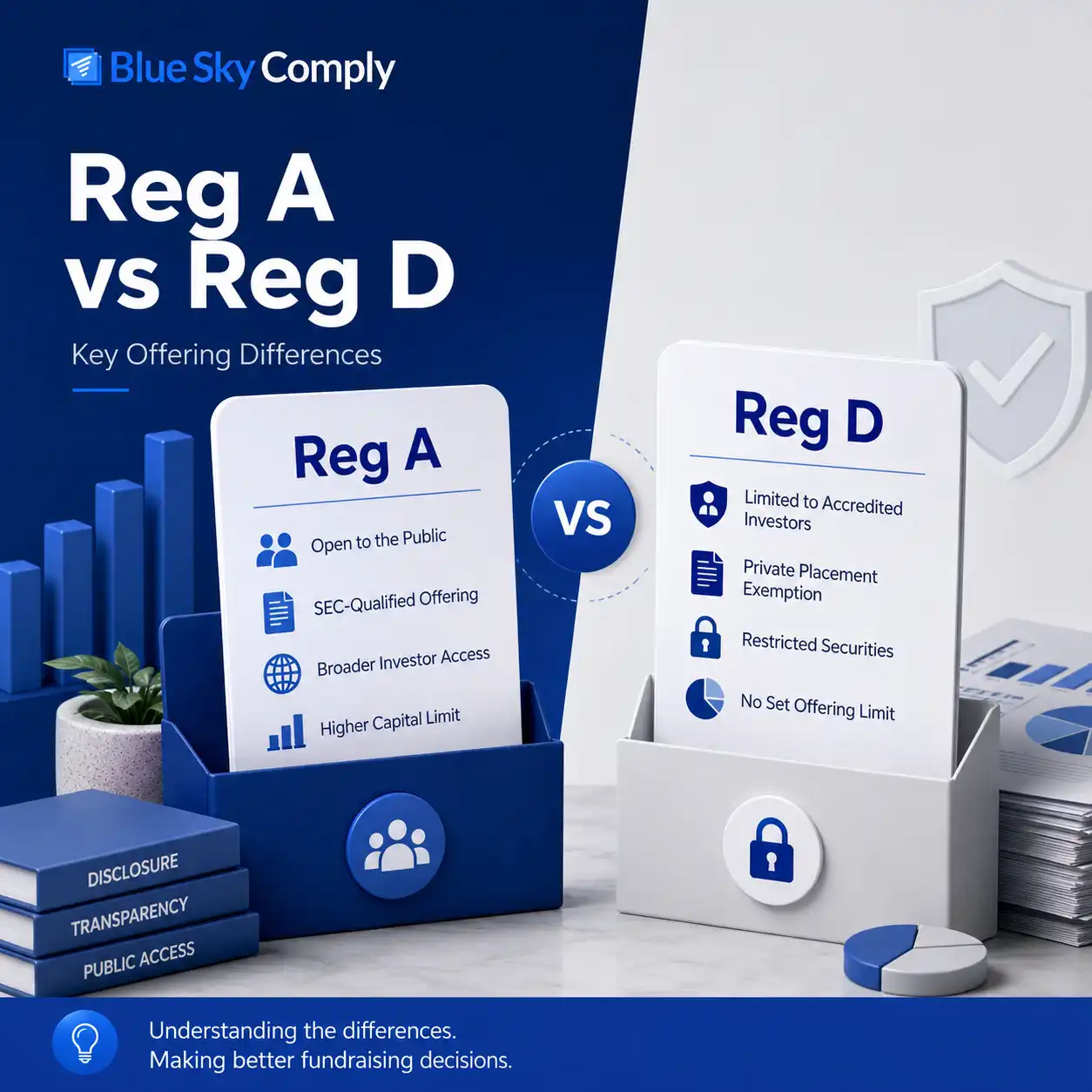
Raising capital involves more than complying with federal securities laws. While many companies focus on SEC requirements, state securities laws continue to have a greater impact on compliance, state fee exposure risks, and the timeliness of raising capital. These regulations, commonly known as Blue Sky Laws, exist alongside federal rules and often require additional filings, fees, or registrations before securities can be sold within a state.
For issuers conducting private placements, Regulation A offerings, or other exempt transactions, overlooking state requirements can lead to missed deadlines, regulatory penalties, and unnecessary delays. Understanding how Blue Sky Laws work is essential to planning a successful securities offering.
This guide explains what Blue Sky Laws are, how they interact with federal securities regulations, which offerings they affect, and why companies raising capital should pay close attention to state-level compliance.
Meeting federal SEC requirements does not necessarily eliminate state compliance obligations. Depending on the exemption used and where investors are located, issuers may still need to file and pay fees with the states.
What Are Blue Sky Laws?
Blue Sky Laws are state securities laws that regulate the offer and sale of securities within individual states, and require issuers to make certain disclosures to states whenever conducting capital raises or primary offerings. Their primary purpose is to protect investors by requiring companies to meet certain disclosure, filing, or registration requirements before offering securities to residents of a particular jurisdiction. Although every state has its own securities regulator and laws, the overall objective remains consistent: promoting transparency and reducing fraudulent investment activity.Why Are They Called Blue Sky Laws?
The phrase "Blue Sky Laws" dates back to the early twentieth century. It originated from efforts to stop speculative investment schemes that were said to have "no more substance than the blue sky." While securities markets have evolved significantly since then, the underlying purpose of these laws has remained largely unchanged. Today, they continue to provide an additional layer of investor protection alongside federal securities regulation.What Do Blue Sky Laws Regulate?
Blue Sky Laws cover far more than the registration of securities offerings. Depending on the state and the type of offering, they may also govern:- Notice filings
- Sales commissions
- Registration requirements
- State filing fees
- Broker-dealer licensing
- Other required documentation from officers
- Enforcement against securities fraud
How Blue Sky Laws Work Alongside Federal Securities Laws
One of the biggest misconceptions among first-time issuers is that complying with SEC rules automatically satisfies every legal requirement. In reality, securities offerings are often subject to both federal and state oversight. The SEC establishes nationwide rules governing securities offerings and exemptions, while each state maintains its own securities authority responsible for enforcing state-specific requirements. The relationship between the two can be summarized as follows:| Federal Securities Laws | Blue Sky Laws |
| Administered by the SEC | Administered by individual state regulators |
| Apply nationwide | Apply within each state |
| Govern federal exemptions such as Regulation D, Regulation A, and Regulation Crowdfunding | Govern state registration, notice filings, and other state-specific requirements |
| Establish federal disclosure rules | Establish state compliance obligations |
Which Securities Offerings Are Affected by Blue Sky Laws?
Blue Sky Laws apply differently depending on the type of securities offering. Some offerings receive substantial federal preemption, while others remain subject to extensive state review.Regulation D Offerings
Most private companies raising capital rely on Regulation D exemptions, particularly Rule 506(b) and Rule 506(c). Although these offerings are exempt from state registration requirements under federal law, they still require state notice filings wherever investors reside. Companies must also comply with each state's filing deadlines and applicable filing fees. For issuers raising money from investors in multiple states, managing these filings can quickly become one of the most time-consuming parts of the offering.Regulation A Offerings
Regulation A offerings are divided into two tiers, and each receives different treatment under Blue Sky Laws.- Tier 1 offerings remain subject to state securities review, meaning companies may need to register or qualify their offering separately in every state where securities will be sold.
- Tier 2 offerings benefit from federal preemption, eliminating full state registration requirements. However, many states still require state filings and fees, making state compliance an ongoing consideration even after SEC qualification, with heavy penalties for not complying.
Regulation Crowdfunding
Regulation Crowdfunding, often referred to as Reg CF, receives broader federal preemption than many other exemptions. In most situations, issuers are not required to complete state registration. However, certain states continue to require notice filings under specific circumstances, particularly when the issuer's principal place of business or investor concentration meets defined thresholds. Although the state burden is much smaller than under other exemptions, companies should still confirm whether additional state filings are required before launching an offering.Why Blue Sky Laws Vary by State
Blue Sky Laws are a state-by-state system, not a single national rulebook. While federal securities laws create an overarching framework, each state has the authority to adopt and enforce its own securities requirements. The result is a patchwork of rules that can differ meaningfully from one jurisdiction to the next. What works in one state may not be enough in another. A filing accepted without issue in one jurisdiction might trigger additional notice requirements, supplemental documents, different fee structures, or separate licensing obligations elsewhere. Even the mechanics of compliance—such as deadlines, renewal periods, and filing procedures—can change from state to state. For companies offering securities across multiple jurisdictions, that variation creates more than just administrative work. It introduces a layer of compliance planning that requires close attention to each state’s specific rules. As the number of states involved increases, so does the complexity. Multi-state offerings often require a coordinated approach to avoid missed filings, inconsistent submissions, or unnecessary regulatory risk.How Companies Stay Compliant With Blue Sky Laws
Effective Blue Sky compliance starts well before an offering reaches investors. Companies that handle state compliance successfully usually do so by building it into the offering process from the outset - not by scrambling to address it after federal documents have already been prepared or sales activity has begun. In practice, Blue Sky compliance works best when it is treated as part of the overall transaction strategy. That means identifying state-level obligations early, tracking deadlines carefully, and creating a repeatable process for filings, fees, renewals, and recordkeeping. A practical compliance process often includes:- Identifying the federal exemption relied upon for the offering
- Determining which states have jurisdiction over the transaction
- Preparing the required notice filings and supporting documents for each applicable state
- Submitting filings within each state’s deadline
- Paying the applicable filing fees
- Tracking renewal, amendment, and ongoing filing obligations
- Maintaining organized records throughout the life of the offering
When Professional Blue Sky Compliance Support Makes Sense
Not every offering requires the same level of Blue Sky compliance support. A smaller raise limited to one or two states may be fairly manageable. But once an offering expands across multiple jurisdictions, the compliance demands often become more time-consuming, more technical, and more difficult to track internally. That is typically the point when outside support becomes especially valuable. Professional Blue Sky compliance assistance is often used when companies:- Conduct offerings in multiple states
- Launch a first-time securities offering
- Manage ongoing filings and amendments
- Complete offerings with multiple state notice requirements
- Need to track renewals and jurisdiction-specific filing deadlines
Frequently Asked Questions About Blue Sky Laws
What are Blue Sky Laws?
Blue Sky Laws are state securities laws that govern how securities offerings are conducted within a state. They are designed to protect investors from fraud and misleading investment activity, while also giving states the authority to impose compliance and disclosure/filing requirements on companies raising capital.Do all states have Blue Sky Laws?
Yes. Every state has its own securities laws and regulatory authority, although the specific requirements vary considerably from one jurisdiction to another.Are Blue Sky Laws the same in every state?
No. Each state establishes its own filing procedures, fees, deadlines, and registration requirements.Do Regulation D offerings require Blue Sky filings?
In most cases, yes. Although Rule 506 offerings are exempt from state registration, they still require notice filings and applicable filing fees in states where investors purchase securities, and often in the state of incorporation.Does Regulation A Tier 2 eliminate Blue Sky compliance?
Not entirely. Tier 2 offerings benefit from federal preemption of state registration requirements, but many states continue to require notice filings and filing fees.What happens if a company violates Blue Sky Laws?
Depending on the state and the nature of the violation, consequences may include late fees, administrative penalties, restrictions on future securities sales, enforcement actions, or investor claims.Blue Sky Laws Are a Core Part of Securities Compliance
Blue Sky Laws remain an important part of securities compliance in the United States. Even when federal exemptions apply, companies often still need to meet state-level requirements. For issuers, that means understanding where filings are required, what each state expects, and when deadlines apply. Taking a proactive approach can help reduce delays, limit regulatory risk, and keep an offering moving smoothly. As offerings expand across multiple states, compliance can quickly become more complex. Blue Sky Comply helps issuers manage state filings, fees, renewals, amendments, deficiency inquiries, and filing requirements with confidence.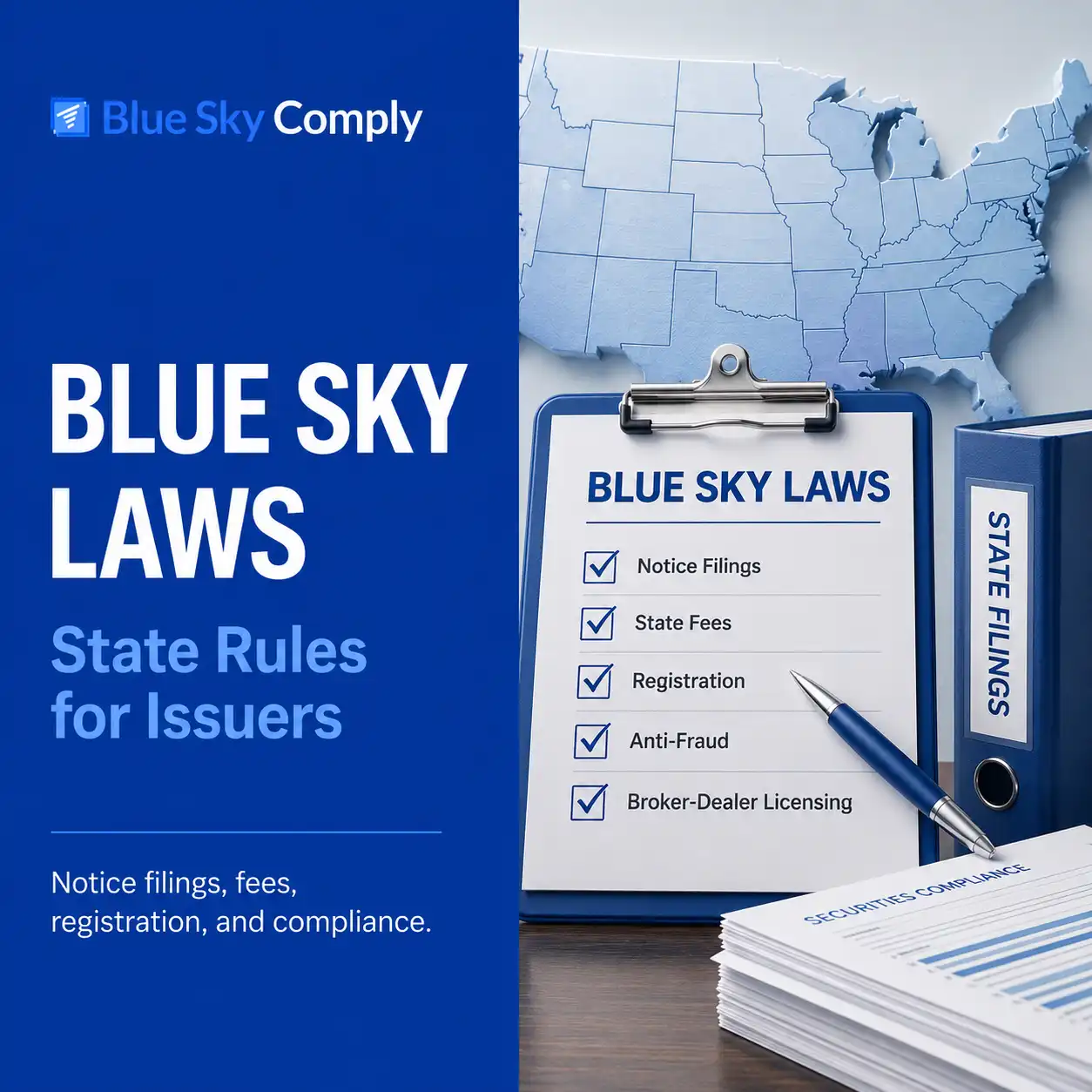
Regulation Crowdfunding is often described as a federally streamlined pathway for raising capital. Because Reg CF offerings are exempt from full SEC registration and benefit from federal preemption, many issuers assume that state-level compliance is no longer a concern.
That assumption is only partially correct.
While Reg CF significantly limits state involvement, it does not eliminate it entirely. In certain situations, issuers are still required to submit state notice filings. Understanding when those filings apply and which states require them is essential to avoiding overlooked compliance obligations.
Do Reg CF Offerings Require State Notice Filings?
Reg CF offerings benefit from federal preemption under the Securities Act. This means that states cannot require issuers to register or qualify their offerings at the state level. However, states are still permitted to require notice filings in limited circumstances. These requirements are not universal. Instead, they are tied to two specific triggers defined under Reg CF:- The issuer’s principal place of business
- The state where more than 50% of the securities are sold
When Are Reg CF State Notice Filings Required?
To understand when notice filings apply, it helps to break down the two triggering conditions in practical terms. First, the state where the company is headquartered may require a notice filing. This applies regardless of where investors are located. Second, if more than half of the total securities sold in the offering are purchased by investors in a single state, that state may also require a notice filing. In many offerings, only the issuer’s home state is relevant. However, in cases where investor concentration is high in another state, a second filing requirement can be triggered. Because these thresholds depend on how the offering unfolds, issuers must monitor investor activity throughout the campaign.States That Require Reg CF Notice Filings
Not all states have implemented notice filing requirements for Regulation Crowdfunding. Based on available regulatory guidance, the following states are known to require notice filings under Reg CF in applicable situations:- Alabama
- Alaska
- Arizona
- Arkansas
- California
- Colorado
- Connecticut
- Delaware
- Florida
- Georgia
- Hawaii
- Idaho
- Illinois
- Indiana
- Iowa
- Kansas
- Kentucky
- Louisiana
- Maine
- Maryland
- Massachusetts
- Michigan
- Minnesota
- Mississippi
- Missouri
- Montana
- Nebraska
- Nevada
- New York
- Pennsylvania
- Texas
- Utah
- Washington
What Do Reg CF Notice Filings Typically Require?
Although requirements vary slightly by jurisdiction, most Reg CF notice filings follow a similar structure. States generally request a copy of the issuer’s federal filing along with basic administrative information. In most cases, issuers should expect to provide:- A copy of the filed Form C
- A state filing fee
- A consent to service of process
- Basic issuer and offering details
Practical Example of When a Filing Is Triggered
A simple example helps illustrate how these rules work in practice. Imagine a Texas-based company launching a Reg CF offering. Because Texas is the issuer’s principal place of business, a notice filing may be required there. Now assume that 60% of the investment in the offering comes from investors located in Colorado. In this case, Colorado may also require a notice filing because it exceeds the 50% threshold. Even though investors may participate from many other states, only Texas and Colorado would be relevant for notice filing purposes under this scenario. A small oversight in one state can still create unnecessary complications, even in an otherwise streamlined offering.Final Thoughts on Reg CF State Notice Filings
Regulation Crowdfunding simplifies many aspects of securities compliance, but it does not remove state involvement entirely. Notice filings remain an important, if limited, part of the process. The key takeaway is straightforward. Most issuers will only need to consider one or two states, but identifying those states correctly is critical. By understanding the triggers and staying attentive to investor activity, companies can meet their obligations without adding unnecessary complexity to their offering.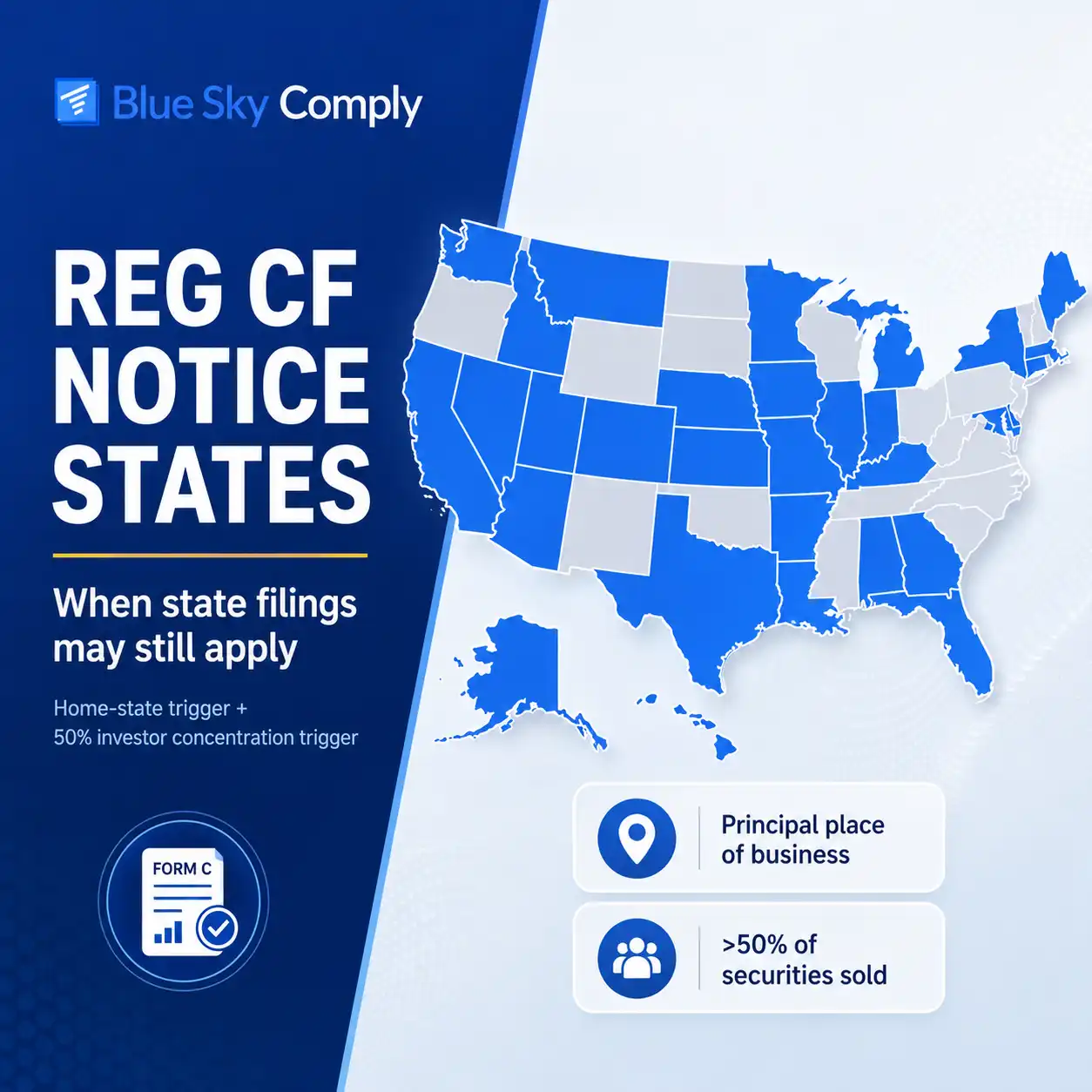
Regulation A has become a popular pathway for companies looking to raise capital from the public without going through a full IPO. It offers flexibility, access to both accredited and non-accredited investors, and a more streamlined process compared to traditional registration.
However, one of the most important decisions issuers must make early in the process is whether to pursue a Tier 1 or Tier 2 offering. While both fall under Regulation A, the differences between them are not just procedural. They fundamentally change how an offering is reviewed, approved, and managed across jurisdictions.
At the center of this distinction is a critical concept: state-level disclosure and merit review versus federal preemption.
This comparison highlights the central tradeoff between the two tiers: state-level complexity versus federal reporting obligations.
What Is Regulation A and Why the Two-Tier Structure Matters
Regulation A is an exemption under the Securities Act that allows companies to raise capital from the public with fewer requirements than a fully registered offering. To accommodate different types of issuers and capital needs, the SEC created two tiers within Regulation A. Tier 1 and Tier 2 share a common foundation. Both require filing and qualification of Form 1-A and allow companies to raise funds from a broad investor base. Where they diverge is in how regulatory oversight is applied. The choice between tiers determines whether your offering will be subject to state-by-state review under blue sky laws or primarily governed by federal law.The Core Difference: State Merit Review vs Federal Preemption
The most important distinction between Tier 1 and Tier 2 lies in how securities are regulated at the state level. Under Tier 1, offerings are not considered “covered securities.” This means issuers must comply with blue sky laws in every state where securities are offered. State regulators can require registration, impose filing fees, and, in some cases, conduct merit-based reviews of the offering itself. In contrast, Tier 2 offerings are classified as covered securities. This classification triggers federal preemption, meaning states cannot require registration or qualification of the offering. Instead, oversight is centralized at the federal level through the SEC. This distinction reshapes the entire compliance process. Tier 1 requires coordination across multiple state regulators, while Tier 2 removes that layer of review but introduces more robust federal reporting obligations. It is important to note that even under Tier 2, states may still require notice filings and fees. However, these are administrative in nature and do not involve substantive review of the offering.How Tier 1 Works: State-Level Disclosure and Approval
A Reg A Tier 1 offering is often viewed as the more traditional approach from a regulatory perspective. After filing Form 1-A with the SEC and receiving qualification, issuers must navigate each state in which they intend to sell securities. This process involves submitting filings to state regulators, paying applicable fees, and in some cases responding to comments or questions from those regulators. Because each state operates independently, the process can require careful coordination and sequencing. In certain jurisdictions, regulators may conduct a merit review. This means they evaluate whether the terms of the offering are fair to investors, not just whether disclosures are complete. While intended to protect investors, this layer of review can extend timelines and increase complexity. As a result, many Tier 1 offerings are limited to a smaller number of states. Expanding into additional jurisdictions can significantly increase the compliance burden. Read more on our Reg A Tier 1 Merit vs Disclosure review guide.How Tier 2 Works: Federal Preemption and Scaled Compliance
Reg A Tier 2 offerings take a different approach by centralizing regulatory oversight at the federal level. Once the SEC qualifies the Form 1-A offering statement, issuers can offer securities nationwide without undergoing state-by-state registration. This is possible because Tier 2 securities are treated as covered securities under federal law. As a result, state regulators are preempted from requiring qualification or merit review of the offering. This structure allows issuers to scale their capital raise across multiple states more efficiently. Instead of coordinating with individual state regulators, companies can focus on meeting federal requirements and managing a single qualification process. However, this streamlined state framework comes with additional federal obligations. Tier 2 issuers must comply with ongoing reporting requirements, including annual, semi-annual, and current reports. Financial statements must also be audited, adding another layer of preparation and cost.Key Differences Between Tier 1 and Tier 2
While the regulatory framework differs significantly, it is helpful to view the distinctions side by side. The table below summarizes the most important differences between the two tiers.| Category | Tier 1 | Tier 2 |
| Offering Limit | Up to $20 million | Up to $75 million |
| State Review | Required under blue sky laws | Preempted |
| Merit Review | Possible in certain states | Not applicable |
| SEC Reporting | Limited | Ongoing reporting required |
| Financial Statements | Not always audited | Audited required |
| Investor Limits | No limits | Limits for non-accredited investors |
| Geographic Reach | Often limited by state approvals | Nationwide offering |
Why Blue Sky Laws Matter in Tier 1 Offerings
Blue sky laws play a defining role in Tier 1 offerings. These state regulations are designed to protect investors by ensuring that securities offerings meet certain standards of fairness and transparency. In practice, this means issuers must engage directly with state regulators, who may request additional disclosures or impose specific requirements before allowing the offering to proceed. This process can introduce variability into the timeline, as each state may review the offering at a different pace. It can also increase costs through filing fees, legal coordination, and administrative overhead. For companies seeking to raise capital across multiple states, these factors can become significant constraints. Managing compliance across jurisdictions requires careful planning and often specialized expertise.When Tier 1 May Still Make Sense
Despite its complexity, Tier 1 can still be a viable option in certain scenarios. Companies that plan to raise smaller amounts of capital or focus on a limited geographic area may find Tier 1 to be sufficient. Because Tier 1 does not impose ongoing federal reporting requirements, it can also appeal to issuers looking to minimize post-offering compliance obligations. In situations where the investor base is concentrated in one or two states, the burden of state-level compliance may be manageable and aligned with the company’s goals.Why Most Issuers Choose Tier 2
In practice, many issuers gravitate toward Tier 2 because of its scalability. The ability to raise capital nationwide without navigating individual state approvals is a significant advantage. Tier 2 also supports broader marketing and investor outreach strategies, allowing companies to engage with a wider audience. This is particularly important for offerings that rely on public visibility and investor participation across multiple regions. While the ongoing reporting requirements add complexity, many issuers view this as a reasonable tradeoff for the efficiency and reach that Tier 2 provides.Compliance Tradeoffs: Simplicity vs Scale
Choosing between Tier 1 and Tier 2 ultimately comes down to a strategic decision about how to balance compliance and growth. Tier 1 offers simplicity at the federal level but introduces complexity at the state level. Tier 2 removes state barriers but requires a more structured and ongoing federal reporting framework. There is no one-size-fits-all answer. The right choice depends on factors such as the size of the raise, the target investor base, and the company’s capacity to manage ongoing compliance. Understanding these tradeoffs early in the process allows issuers to align their regulatory approach with their broader capital-raising strategy.Final Thoughts: Choosing Between Tier 1 and Tier 2
Regulation A provides a flexible pathway to raise capital, but the decision between Tier 1 and Tier 2 shapes how that process unfolds in practice. At its core, the distinction is straightforward:- Tier 1 operates within the framework of state disclosure and blue sky review, while
- Tier 2 relies on federal preemption and centralized oversight while only requiring notice filings and fees.
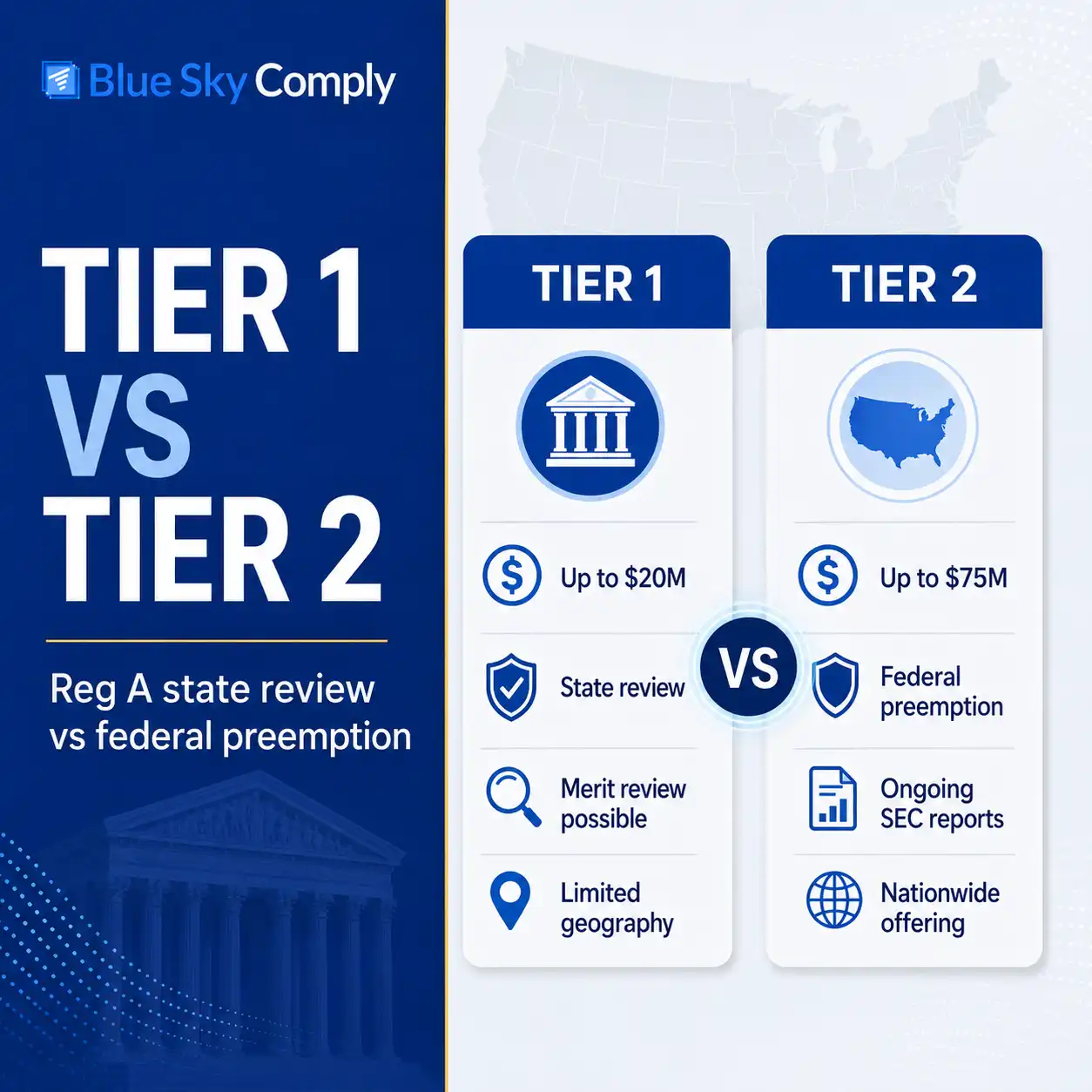
Raising capital through Regulation Crowdfunding offers companies a powerful way to access a broad base of investors. However, before any campaign can go live, issuers must complete one of the most important regulatory steps in the process: filing SEC Form C.
Form C is more than just a filing requirement. It is the primary disclosure document that investors rely on to evaluate your offering. It tells your company’s story, outlines the terms of the raise, and explains the risks involved. Done properly, it can support both compliance and investor confidence. Done poorly, it can create delays, confusion, or even regulatory issues.
Understanding how Form C works, what it requires, and how it fits into the broader Reg CF process is essential for any issuer planning a crowdfunding offering.
Understanding these additional filings is important because compliance obligations often continue after the initial raise is complete.
What Is SEC Form C?
SEC Form C is the required offering statement for companies raising capital under Regulation Crowdfunding. It must be filed electronically with the SEC through the EDGAR system before an offering can be launched. At its core, Form C is designed to ensure transparency. It provides potential investors with standardized, structured information about the company, the securities being offered, and the risks associated with the investment. Think of Form C as the foundation of your crowdfunding campaign. It is the document that regulators review, and investors rely on when deciding whether to participate. Unlike informal pitch materials, Form C must follow specific disclosure rules set by the SEC. Every statement included in the filing must be accurate, complete, and consistent with the rest of the offering materials.When Is Form C Required in a Reg CF Offering?
Timing is critical when it comes to Form C. The SEC requires issuers to file the form before taking any steps to promote or launch a crowdfunding offering. This means Form C must be submitted before:- A campaign goes live on a funding portal
- Any public solicitation or advertising begins
- Investors are allowed to review or commit funds
What Information Must Be Included in Form C?
Preparing Form C involves gathering a wide range of information about the company and the offering. The goal is to provide investors with a complete and balanced view of the opportunity. While the structure is standardized, the content reflects the specifics of each issuer. Most Form C filings include the following core components:- Company background and legal structure
- Information about directors, officers, and significant shareholders
- Details about the intermediary or funding portal
- Terms of the offering, including pricing and target amounts
- Intended use of proceeds
- Financial statements and financial condition
- Risk factors associated with the business and investment
Key Sections of Form C Explained
Although Form C follows a structured format, several sections are particularly important. These sections provide the narrative and financial context that investors use to evaluate the offering.Business and Company Overview
This section introduces the company and explains what it does, how it operates, and what it aims to achieve. It is often the first place investors look to understand a business's fundamentals.- Offering Details: Here, issuers describe the securities being offered, including the price, type of security, and the minimum and maximum target raise. This section defines the economic terms of the investment.
- Financial Disclosures: Financial information is a central component of Form C. Depending on the size of the offering, issuers may be required to provide reviewed or audited financial statements. These disclosures help investors evaluate the company’s financial health.
- Risk Factors: Risk disclosures are among the most detailed sections of the filing. Companies must clearly outline the potential risks associated with the business, the industry, and the investment itself.
- Use of Proceeds: This section explains how the company plans to use the funds raised. It often includes different scenarios based on whether the minimum or maximum offering amount is achieved.
How to File Form C with the SEC
Filing Form C requires both substantive preparation and technical execution. Issuers must not only compile the required disclosures but also ensure that the filing meets the SEC’s electronic submission standards. The process typically involves preparing the content, formatting it for EDGAR submission, and filing it through the SEC’s system. Many companies choose to work with funding portals, legal advisors, or EDGAR filing agents to manage the technical aspects of submission. These professionals can assist with formatting requirements, document conversion, and submission accuracy, helping reduce the risk of filing errors or delays. Because Form C must be filed before the offering goes live, companies often build their entire campaign timeline around this step.What Happens After Filing Form C?
Once Form C is filed, the offering can move into the live phase. The campaign is published on the funding portal, and investors gain access to the full set of disclosures. However, filing Form C is not the end of the compliance process. Issuers are responsible for ensuring that the information remains accurate throughout the offering period. If material changes occur, such as updates to offering terms or business conditions, the issuer must update the filing accordingly. This ongoing responsibility ensures that investors continue to receive accurate and current information.Related Form C Filings You Should Know
Form C is only one part of the broader Regulation Crowdfunding reporting framework. Several related filings may be required depending on how the offering progresses. The table below summarizes the most common Form C variants and when they are used:| Form Type | Purpose | Trigger |
| Form C | Initial offering statement | Before campaign launch |
| Form C/A | Amendment to Form C | Material changes to the offering |
| Form C-U | Progress update | Reaching 50% and 100% of the target amount |
| Form C-AR | Annual report | Ongoing reporting after the offering |
| Form C-TR | Termination of reporting | Ending reporting obligations |
Why Form C Matters for Investors and Issuers
Form C plays a central role in the Regulation Crowdfunding process because it serves both regulatory and practical purposes. For regulators, it ensures that issuers provide standardized disclosures that protect investors. For investors, it offers a transparent view into the company and the offering. For issuers, Form C represents as much an opportunity as a requirement. A well-prepared Form C can build credibility, strengthen investor trust, and support a successful fundraising campaign. Because the document is publicly available, it often becomes one of the first points of reference for anyone evaluating the opportunity.Final Thoughts on SEC Form C Filing
SEC Form C is the cornerstone of any Regulation Crowdfunding offering. It brings together the legal, financial, and strategic elements of a raise into a single disclosure document that must meet strict regulatory standards. While the process can be detailed, it also provides issuers with a structured way to communicate their business, their vision, and their offering to potential investors. In addition to federal requirements, companies should remain aware of how blue sky laws may influence their broader compliance strategy, especially when engaging investors across multiple states. For many issuers, working with experienced advisors or filing professionals can simplify the process and help ensure that filings are completed efficiently and correctly.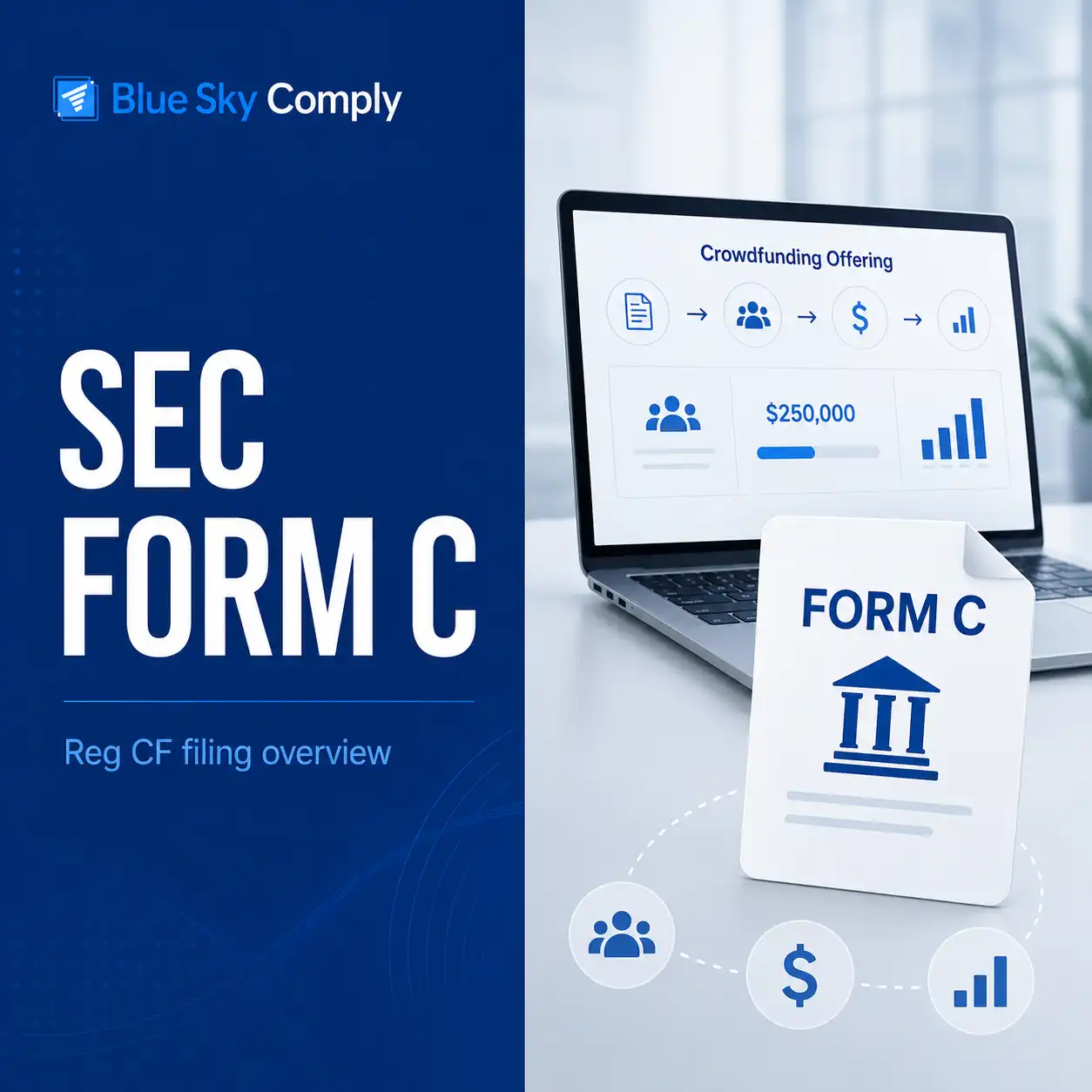
Regulation Crowdfunding is often described as one of the more accessible securities exemptions for small and growing companies. It allows issuers to raise capital online through a registered intermediary and, in many cases, reduces the burden of state-by-state securities registration. That relative simplicity, however, can create a false sense that compliance ends once the initial offering statement is filed and the campaign goes live.
In practice, Reg CF compliance continues well beyond launch. Issuers need to monitor whether changes to the offering trigger amendments, whether investors must reconfirm their commitments, and whether ongoing federal reporting remains required after the raise closes. Reg CF offerings benefit from federal preemption, but they still exist within the broader framework of blue sky laws, which are state-level securities regulations that govern the offer and sale of securities.
This is where companies often get tripped up. They assume Reg CF is “one and done,” when in reality it is a live compliance framework that continues as the offering evolves and after it ends.
As shown above, most Reg CF “renewal” obligations are actually tied to federal reporting, while state involvement is typically limited and varies by jurisdiction.
Does Regulation CF Require State Renewals or Amendments?
The short answer is that Reg CF is generally exempt from full state securities registration, which is one of the reasons it is attractive to startups and small businesses. In most cases, that means issuers do not go through the kind of state-by-state qualification or merit review that applies to other offering structures. That does not mean every state is entirely out of the picture. States still retain anti-fraud authority, and depending on the facts, some may expect notice filings, fees, or issuer-specific follow-up in limited situations. The practical takeaway is that Reg CF issuers should not assume federal preemption eliminates every possible state-level obligation. It is also important to separate state renewals from federal reporting. In Reg CF, what many issuers think of as a “renewal” is often actually an ongoing federal reporting requirement, particularly the annual report on Form C-AR. Likewise, what people call an “amendment” is usually an update to the federal offering statement when material changes occur, rather than a classic state Blue Sky amendment. So when analyzing Reg CF renewal and amendment requirements by state, the real answer is layered. The primary compliance framework is federal, but the state backdrop still matters. To make this easier to understand, it helps to separate Reg CF obligations into categories. The table below breaks down how amendments, ongoing reporting, and limited state involvement fit into the overall compliance framework.| Requirement Type | When It Applies | What Needs to Be Filed | State Involvement |
| Amendment (Form C update) | When a material change occurs during the offering | Updated Form C disclosure | Generally, none, but states retain anti-fraud authority under blue sky laws |
| Annual Reporting | After the offering closes and until reporting is terminated | Form C-AR is filed annually | No state renewal required |
| Termination of Reporting | When the issuer qualifies to end reporting obligations | Form C-TR | No state filing required |
| State Notice (if applicable) | Limited cases depending on issuer location or investor distribution | Notice filing or fee (varies by state) | Varies by state under blue sky laws |
What Changes Trigger a Reg CF Amendment?
A Reg CF offering is not static. As the case develops, important facts can change. When those changes are material, the issuer generally needs to update its offering disclosures. The core principle is straightforward: investors must have accurate, up-to-date information when deciding whether to invest. If the information in the offering statement is no longer accurate in a meaningful way, the issuer should not continue relying on outdated disclosure. Material amendment triggers can include changes such as:- a revised target offering amount or maximum offering amount
- a change to the offering deadline
- a significant change in the use of proceeds
- new risk factors or business developments
- material changes in management, operations, or financial condition
What Are the Ongoing Federal Reporting Requirements After a Reg CF Offering?
For many issuers, the most significant “renewal-like” obligation under Reg CF is not a state filing at all. It is the federal annual reporting requirement that follows a completed offering. After selling securities in a Regulation Crowdfunding offering, the issuer is generally required to file an annual report on Form C-AR with the SEC. This filing keeps investors informed and extends the disclosure framework beyond the closing of the raise. It is also typically posted on the issuer’s website. The annual report is due within 120 days after the end of the issuer’s fiscal year. That filing obligation continues until one of the permitted termination events occurs. Depending on the issuer’s circumstances, reporting may end when, for example, the company becomes subject to Exchange Act reporting, has filed the required number of annual reports and falls below specified holder or asset thresholds, repurchases all Reg CF securities, or dissolves. When the issuer becomes eligible to stop annual reporting, it can generally file Form C-TR to terminate those obligations. This ongoing reporting framework is among the most commonly misunderstood aspects of Reg CF. Companies often concentrate heavily on launching the offering and underestimate the importance of the reporting obligations that follow. In practice, Form C-AR is the closest thing many Reg CF issuers will experience to a recurring compliance cycle.How Do State Requirements Differ for Reg CF Offerings?
The phrase “by state” can be misleading in the Reg CF context because Regulation Crowdfunding is built around federal preemption. That means the main body of the offering process is not supposed to turn into fifty separate state registration exercises. Still, state treatment is not identical in every practical respect. Some states take a lighter-touch view and treat Reg CF as broadly preempted except for fraud enforcement. Others may still maintain notice or fee expectations in narrower circumstances, especially depending on where the issuer is based or where investors are located. In addition, the real-world handling of Reg CF compliance often depends on the funding portal or intermediary, which may build certain state-specific practices into its process. That is why companies should avoid overly simple assumptions. Saying “Reg CF is preempted” is directionally correct, but it is not the same as saying “there is never any state-related compliance issue.” State regulators still exist, state anti-fraud rules still apply, and state-specific follow-up can still matter. For issuers, the practical lesson is to confirm early whether the intermediary is handling any state-level notices or coordination and whether any state-specific follow-up applies to the offering.Reg CF Renewal and Amendment Checklist
The easiest way to stay organized is to treat Reg CF compliance as a sequence of checkpoints rather than a single filing event. The checklist below is designed to help issuers identify the most common points where follow-up obligations arise.Before making changes to a live Reg CF offering
Before revising a live offering, issuers should pause and evaluate whether the change is material and whether investors or the intermediary need updated disclosure. A practical amendment checklist includes:- Confirm whether the change affects information that investors would reasonably consider important
- Update the Form C disclosures if the change is material
- Coordinate the update with the funding portal or intermediary
- Determine whether existing investors must reconfirm their commitments
- Confirm that the revised disclosure is consistent across the platform and issuer materials
After the Reg CF offering closes
Once the offering closes, the focus shifts from active offering updates to ongoing reporting and recordkeeping. A practical post-offering checklist includes:- Track the due date for the annual Form C-AR
- Confirm whether any state notice, fee, or follow-up requirement applies
- Maintain offering records, investor information, and portal communications
- Monitor whether a termination event has occurred that would allow filing Form C-TR
- Review whether any subsequent business change affects prior disclosures or investor communications
What Mistakes Do Companies Make With Reg CF Amendments and Renewals?
Most Reg CF compliance problems do not come from complicated legal theories. They come from assumptions. One frequent mistake is assuming federal preemption means there are no state-related issues to think about at all. Another is failing to update offering disclosures after a material change because management views the change as operational rather than regulatory. Some issuers also forget that annual reporting on Form C-AR is not optional simply because the raise has ended. There is also a process problem that recurs: companies do not coordinate closely enough with the intermediary. Reg CF offerings are conducted through a registered portal or broker, and changes to the offering should not be handled informally or off-platform. A few of the most common mistakes include:- Treating Reg CF as a one-time filing rather than an ongoing compliance process
- Failing to amend disclosure after a material offering change
- Overlooking investor reconfirmation requirements
- Missing the annual Form C-AR deadline
- Assuming the intermediary is handling every compliance detail without confirmation
Why Reg CF is Important
Regulation Crowdfunding is often marketed as a simpler path to raising capital, and in many respects, it is. But simpler does not mean maintenance-free. A Reg CF offering creates a disclosure relationship with investors and regulators that continues after the initial Form C is filed. Material changes require attention. Annual reports require tracking. State-related issues may still need to be confirmed. And the involvement of the intermediary means coordination has to remain consistent from launch through post-offering reporting. That is why the most successful Reg CF issuers do not treat compliance as a launch task. They treat it as an operating process. If there is one principle to remember, it is this: Reg CF compliance does not end when the offering goes live, and it does not necessarily end when the raise closes.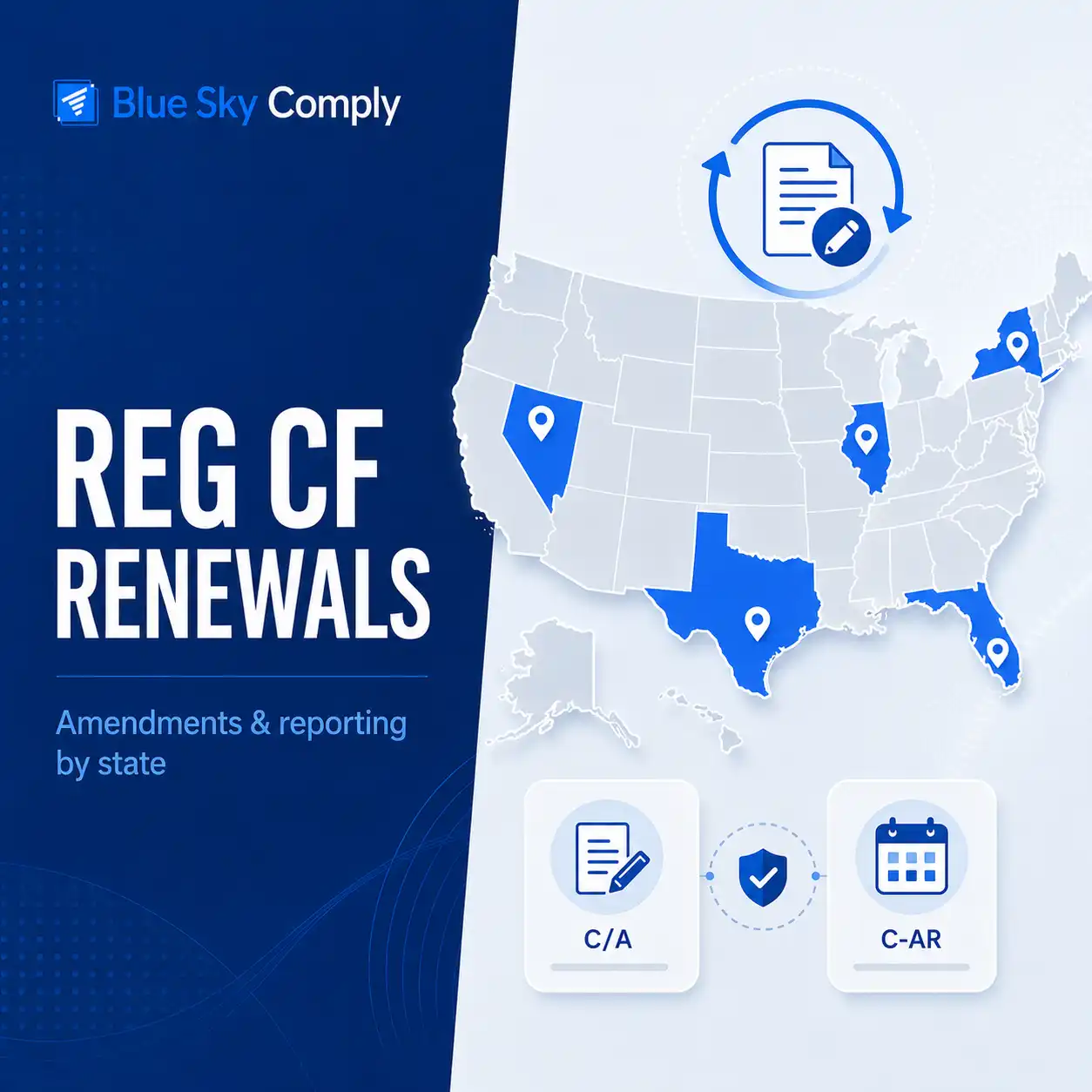
Raising capital in the United States often requires more than just federal compliance. While many companies focus on SEC filings such as Form D, state-level requirements under Blue Sky laws still apply whenever investors are located in different jurisdictions.
The challenge is not understanding that filings are required. The challenge is tracking what needs to be filed, where, and when across multiple states. Missing even one requirement can lead to penalties, delays, or additional filings.
This guide focuses on one thing: a clear and practical Blue Sky filing checklist you can use to stay organized and avoid common compliance mistakes.
Blue Sky Filing Checklist
Blue Sky compliance works best when approached as a structured process rather than a last-minute task. Breaking the process into stages helps ensure that nothing is overlooked, especially when dealing with multiple states and filing requirements. Below is a simplified checklist that companies use to manage Blue Sky filings from preparation through submission and ongoing compliance.Pre-Filing Checklist
Before any state filings are submitted, companies need to confirm that the offering structure and documentation are aligned with both federal and state requirements. This preparation stage is where most compliance issues can be prevented. A typical pre-filing checklist includes the following steps:- Confirm the federal exemption being used, such as Regulation D, Regulation A, or Regulation Crowdfunding
- Submit Form D with the SEC when required
- Identify all states where investors are located
- Review state-specific notice filing requirements for each jurisdiction
- Prepare offering documents and disclosures
- Verify investor residency information
State Filing Checklist
Once preparation is complete, the next step is to submit the required filings to each applicable state. This stage requires careful coordination, as each jurisdiction may have different procedures and fee structures. Companies typically complete the following actions during the filing stage:- EDGAR setup: File the Form ID application with the SEC and create the EDGAR account (depending on SEC timeframes, this can take 1–2 weeks).
- Offering documents: Finalize the PPM and other offering materials, including the subscription agreement.
- Subscription workflow: Ensure the subscription process is fully set up, including document signing, escrow arrangements, and payment collection/processing.
- Investor roster and sales tracking: Prepare and maintain an investor roster, and track investors and sales by state (including first sale dates and amounts) to ensure deadlines aren’t missed (often within 15 days after the first sale for many notice filings).
- State filing requirements: Determine the state-specific requirements and prepare filings**
- State notice filings: Submit state filings and fees, and record confirmations**
Post-Filing Checklist
After the initial filings are submitted, compliance responsibilities continue. Changes in the offering or investor base can create new filing obligations that must be addressed promptly. To maintain compliance, companies will need to monitor the following:- Sales to investors in new states
- File amendments if offering details change
- Answer state regulator inquiries and deficiency requests
- File annual renewals before the 12-month mark to the SEC and states
- Maintain records of all filings and confirmations
A Simple Checklist Prevents Costly Issues
Blue Sky filings are not inherently complicated, but they require attention to detail and consistent tracking across multiple jurisdictions. Without a structured process, it becomes easy to miss deadlines or overlook state-specific requirements. A clear checklist allows companies to stay organized, reduce administrative errors, and maintain compliance throughout the offering process. For companies managing multi-state offerings, having a reliable filing process in place is often the difference between smooth compliance and costly delays.
Before a company can submit any document to the U.S. Securities and Exchange Commission, it must first obtain authorization to access the SEC’s electronic filing system. This authorization takes the form of EDGAR access codes, which serve as credentials that allow a filer to submit disclosures to the SEC.
For companies preparing their first SEC filing, obtaining these codes is one of the earliest and most important steps in the compliance process. Whether a business is planning a public offering, submitting periodic reports, or making ownership disclosures, EDGAR access credentials are required before any filing can be transmitted to the SEC.
Because this process involves specific application procedures and authentication requirements, many companies work with professionals or filing agents to help obtain and manage their EDGAR credentials. Understanding how EDGAR access codes work can help companies avoid delays and ensure their filings proceed smoothly.
The CIK identifies the filer within the EDGAR system, while the CCC confirms that the filer is authorized to submit documents. The EDGAR password and passphrase allow authorized users to log into the system and manage filing credentials.
Under the SEC’s updated access framework, EDGAR users also authenticate through Login.gov, which provides identity verification and secure login capabilities.
In practice, many companies work with filing agents or designated EDGAR account administrators who manage system access and submission credentials on their behalf. In those cases, the administrators may handle Login.gov authentication and credential management, allowing issuers to focus on preparing the required disclosures while the filing process is handled by experienced professionals.
Because these credentials are required for every submission, companies should maintain accurate records and ensure that authorized personnel or administrators have secure access to the necessary EDGAR credentials.
What Is the SEC EDGAR System?
The SEC’s EDGAR system is the electronic platform used to collect, store, and distribute corporate disclosures filed with the Commission. EDGAR stands for Electronic Data Gathering, Analysis, and Retrieval, and it serves as the central database for regulatory filings submitted by public companies, investment funds, and other regulated entities. Through EDGAR, companies submit a wide range of documents that are then made publicly available to investors and market participants. These filings allow the public to review financial reports, offering documents, and other disclosures that are required under federal securities laws. The EDGAR system accepts many types of filings, including annual reports, quarterly reports, registration statements, and ownership disclosures. To ensure that only authorized entities can submit filings, the SEC requires each filer to obtain secure access credentials before using the system.Why Companies Need EDGAR Access Codes
Companies need EDGAR access codes because the SEC requires proof that a filing is coming from the right company (or an approved representative). Without these credentials, a company can’t log into EDGAR or submit filings. These codes are used to:- Confirm identity and permission to file by linking each submission to a specific filer and allowing only approved companies or agents to submit.
- Secure access and ensure accountability by preventing unauthorized submissions and creating a trackable record of filing activity (who filed what, and when).
What Is Form ID?
To obtain EDGAR access codes, a company or individual must complete and submit a document known as Form ID. This form serves as the official application for EDGAR access and is required for any entity that intends to submit filings through the SEC’s electronic system. Form ID collects key identifying information about the applicant, including details about the organization or individual seeking EDGAR access. Once the form is completed and submitted, the SEC reviews the application and, if approved, generates the necessary authentication codes.What Are EDGAR Access Codes?
Once the SEC approves a Form ID application, the filer receives a set of authentication credentials known as EDGAR access codes. These codes allow the filer to log into the EDGAR system and submit documents electronically. Each code plays a specific role in the filing process. Together, they provide both identification and authorization for electronic submissions. These credentials must be stored securely because they provide access to the company’s EDGAR account. Unauthorized access to these codes could allow someone to submit filings on behalf of the company. Maintaining control over EDGAR credentials is an essential part of SEC compliance.Key EDGAR Access Codes and Login Credentials
The SEC assigns several authentication credentials to each EDGAR filer. These credentials work together to allow secure access to the EDGAR system and authorize the submission of filings. Each credential plays a specific role in identifying the filer and verifying that a submission is authorized. Together, they form the authentication framework used by the SEC to protect the integrity of electronic filings. The most important EDGAR access credentials include the following:| Access Code | Purpose |
| CIK (Central Index Key) | Unique identifier assigned to each EDGAR filer |
| CCC (CIK Confirmation Code) | Authentication code used when submitting filings |
| EDGAR Password / Passphrase | Credentials used to access the EDGAR filing system |
| Login.gov Account | Secure identity verification is used to access EDGAR online services |
EDGAR Access Codes and Form ID Support
Before any entity can submit filings to EDGAR, it must first obtain access credentials from the SEC. These credentials are issued after the company completes and submits a Form ID application. The EDGAR access process typically generates several authentication codes used for filing submissions. These include the Central Index Key (CIK), the CIK Confirmation Code (CCC), and other secure credentials required for system access. Managing these codes and maintaining access to the EDGAR system is another area where filing agents often assist companies. They may help prepare Form ID applications, maintain code records, and assist with code regeneration if credentials are lost or need to be updated. Because EDGAR credentials are required for every submission, maintaining accurate access information is an important part of the filing processCommon EDGAR Access Code Problems for First-Time Filers
Obtaining EDGAR access codes is usually the first step before a company can submit any filing to the Securities and Exchange Commission. While the process is straightforward in theory, many first-time filers encounter issues either during the Form ID application process or later when managing their credentials. Because these codes are required for every submission to the EDGAR system, even small administrative mistakes can interrupt the filing process. Understanding where problems typically occur helps companies avoid delays.Where do EDGAR access issues usually happen—Form ID or after approval?
Most EDGAR access problems occur at two stages. The first is during the Form ID application process, when companies submit their request for EDGAR credentials and the SEC reviews and approves it. The second stage occurs later, after approval, when companies need to use, manage, or recover their access codes. Because the SEC approval step sits between submission and access, even a single error in the Form ID can delay the SEC’s processing and push an expected approval back by about 1–2 weeks. By contrast, after approval, the most common issues are internal: credentials are misplaced, improperly stored, or tied to a departing employee—problems that can still block EDGAR access right when a filing deadline approaches.Why can EDGAR access code issues delay SEC filings?
EDGAR access codes are required to log into the system and transmit filings. Without them, companies cannot submit regulatory disclosures to the SEC. If a company loses its credentials or cannot retrieve them quickly, the filing process may stop entirely until the issue is resolved. In time-sensitive situations such as periodic reporting deadlines or transaction filings, this delay can create compliance risks.Why does the SEC reject a Form ID application?
The SEC may reject a Form ID submission if required information is missing or if documentation does not meet the application requirements. Common issues include:- Incomplete company information
- Missing POA (Power of Attorney)
- Errors in the applicant’s name or organizational information
- Job title mismatches
- Documents signed by non-officers
- Missing signatures
- Improperly prepared notarized documents
EDGAR Access Code Management, Recovery, and Security
Once the SEC issues EDGAR access codes, companies need to manage them carefully. These codes provide access to the EDGAR filing system and are required for submitting SEC filings. To avoid last-minute filing disruptions, companies should store codes securely, limit and document internal access, and maintain a clear recovery process to restore access quickly if credentials are lost or personnel change.What should you do if EDGAR access codes are lost or misplaced?
Companies occasionally lose EDGAR codes, especially when filing responsibilities shift or an employee leaves the organization. When that happens, the company typically needs to use the SEC’s recovery or regeneration process—often by submitting an EDGAR codes recovery filing/request to the SEC—to reset or replace the necessary credentials. Because recovery can take time, it’s best to maintain secure backup records and a clear internal handoff process, so authorized staff can regain access quickly. Blue Sky Comply can help prepare and submit the recovery request to the SEC, keeping the process moving. Contact us to learn more.How should companies manage and secure EDGAR access codes to prevent disruptions?
EDGAR credentials should be treated as sensitive access information because they allow users to submit filings on behalf of the company. To avoid filing disruptions and reduce risk, limit access to authorized personnel, store codes in a secure centralized location with controlled permissions, and document procedures for transferring access when roles change. Strong access controls and clear internal processes help prevent unauthorized filings and ensure the company can file on time, even as personnel change.How the EDGAR Access Process Works
Obtaining EDGAR access credentials involves several steps, beginning with submitting a Form ID. Once the application is reviewed and approved by the SEC, the applicant receives the necessary authentication codes to access the EDGAR system. The general process typically follows these steps:- The applicant prepares and submits Form ID to the SEC
- Authentication documentation is provided as part of the application
- The SEC reviews the submission for completeness and accuracy
- Access codes, such as the CIK and CCC, are issued
- The filer can begin submitting documents through EDGAR
How Filing Agents Help with EDGAR Codes
Edgar Filing agents are service providers that assist companies with preparing and submitting documents through the EDGAR system. Many companies use filing agents to prepare and submit documents through EDGAR and to manage the EDGAR access codes required for filing. This is especially helpful for companies that don’t regularly file with the SEC. Filing agents can assist with Form ID applications, keeping records of access credentials, and regenerating codes if they’re lost or expire. Their familiarity with SEC technical requirements also helps reduce mistakes and keep filings on track.Getting Started with an EDGAR Account
Obtaining EDGAR access codes is one of the first steps in the SEC filing process. By completing Form ID and obtaining the necessary authentication credentials, companies can submit regulatory disclosures through the EDGAR system. Understanding how these credentials work helps companies prepare for their first filings and avoid unnecessary delays. From the initial Form ID application to ongoing credential management, each step plays an important role in maintaining smooth access to the SEC’s electronic filing platform. As regulatory reporting continues to evolve, organizations that understand the EDGAR access process will be better positioned to manage their filings efficiently and maintain compliance with SEC requirements.


Let Us Simplify Compliance for You
Partner with Blue Sky Comply to unlock seamless compliance, efficient filings, and access to expertise that lets you focus on your growth.
Schedule A Free Demo