
State Fees
Category: State Fees
Choosing a path for your early capital raise is less about buzzwords and more about fit. Rule 504 sits inside Regulation D and can be a practical option when you want a lighter lift for a smaller offering, especially if your investor base is close to home. The decision often hinges on a few grounded realities:
- Size of the round
- Who your investors are
- How widely you plan to market
- Whether you can embrace state-level steps.
What Rule 504 Is and How It Works
Rule 504 supports smaller offerings with a comparatively simple structure. Broadly speaking, it can allow certain flexibility when the offering is registered at the state level, and it permits sales to both accredited and non-accredited investors, subject to state rules. Documentation and disclosure/filing requirements for Reg D 504 are simple on the federal-filing side to the SEC, but more complicated on the state level. Further, you will spend most of your energy coordinating state requirements, since federal preemption is not the default advantage. Contact us to learn more. State review and registration are what make 504 feel different in practice. Your marketing leeway often flows from what a specific state has reviewed and allowed. If you plan to sell only in a handful of states, you can right-size the process and move faster. If you plan to market broadly across many states, the complexity can add up. Rule 504 could be fast and flexible for small rounds, but varying state requirements will likely determine your true cost and timeline.When Rule 504 Is a Good Fit
Rule 504 tends to click for companies that already have a defined local or regional audience and want to raise a modest amount without building a national marketing campaign. Imagine a consumer brand with loyal customers in two or three states, or a real estate vehicle focused on one metro area. The practical benefits are speed, familiarity with the investor base, and fewer moving parts than a larger retail pathway. If your investors are not all accredited or you have more than 35 non-accredited investors, a state-registered 504 can offer a compliant on-ramp where 506(c) and (b) would not fit your plan. A founder with a strong email list and in-market events might find 504 especially appealing. The existing relationships compress the marketing cycle, and the alignment between your intended investors and the states you choose to register in keeps the filing work proportional to the raise.When Rule 504 Might Not Be the Best Choice
Rule 504 will struggle to keep pace if your strategy looks national, your investor mix is primarily accredited, and you want to openly advertise online. In that scenario, 506(c) can deliver general solicitation with federal preemption on state law, which simplifies the filing posture and helps you move faster across state lines. If your vision is a truly retail-friendly offering at a larger scale with broad reach, Regulation A Tier 2 is often the correct framework, even though it brings ongoing reporting and audited financials. If you expect to run a platform-based, community-centric campaign, Regulation CF may be a better match than 504. The portal infrastructure can be worth the tradeoffs when your goal is to grow your audience from the crowd. If your plan is to market broadly to accredited investors nationwide, 506(c) is usually more efficient than Rule 504.Rule 504 Compared to 506(b) and 506(c)
The differences between these Reg D routes come down to solicitation, investor eligibility, and how much state-level coordination you want. With 506(b), you can avoid general solicitation and raise funds from accredited investors and up to 35 sophisticated non-accredited investors, leveraging preexisting relationships. It is quiet and controlled. With 506(c), you gain the right to generally solicit, but you must verify accreditation status. In both cases, federal preemption lightens the state burden. With Rule 504, you can gain more flexibility via state registration, but the tradeoff is the filing and review workload that sits with those states. If your raise is concentrated where you already do business, that tradeoff can be worth it.Rule 504 vs Regulation CF
Crowdfunding under Reg CF formalizes the public campaign format. You will work through a registered portal, follow disclosure templates, and accept investment caps and limits that come with the territory. The upside is access to a broad retail audience and platform tools designed for conversion. You can raise from unlimited non-accredited investors up to $5mm. By contrast, Rule 504 is most compelling if you can focus on a few states, tailor your messaging to what those states have reviewed, and lean on existing customer affinity. If your plan already involves a portal and national outreach, you will likely be better served by Regulation CF.Rule 504 vs Regulation A Tier 2
Reg A Tier 2 is the heavyweight retail exemption suitable for larger raises with a wide audience, which allows non-accredited investors and free-trading shares suitable for trading. It introduces audited financials, offering circular review and ongoing reporting, all of which support a durable investor relations posture. That structure brings credibility and reach, but it also brings time and budget commitments. Rule 504 is the smaller, faster option for local raises where the goal is to get to a close efficiently without building the infrastructure of a national retail offering. If your strategy anticipates scaling marketing and investor count significantly, a Reg A Offering deserves a serious look.Can You Advertise a Rule 504 Offering?
The short answer is yes, but only under specific conditions tied to state law. Rule 504 by itself does not grant a blanket right to advertise. Public solicitation is permitted when your offering is registered in the states where you intend to solicit or when you use a state exemption that expressly allows general solicitation and requires a public filing and delivery of a disclosure document. In these situations, your ads and public statements should be consistent with what the state reviewed and permitted. If you are not pursuing a path that allows general solicitation under state law, treat communications like a traditional private placement and avoid public promotion. Many issuers that want broad public outreach choose 506(c) instead, because it permits general solicitation with federal preemption. When in doubt, align your plan with state-reviewed materials and keep copies of everything you publish.State Compliance Realities Under Rule 504
The mechanics of 504 are won or lost in the details of state coordination. Each state may have its own form of review (merit-based or disclosure-based reviews), comment cycles, and timelines. Fees also vary. Because your marketing claims should match the filed terms that a state has approved, you will want your marketing and legal teams to communicate closely. For issuers working across a handful of states, it can help to sequence filings based on expected investor demand and processing speed. Select the states where your investor list is strongest, start there, and avoid overextending your filing footprint until you see conversion. When you need a reference point for what these filings entail, it is useful to look at the broader category of State Reg D filings so you can budget time and resources. The core idea is the same:- Plan for state and legal fees
- Filing documents and paperwork
- Examiner comments
- Align your calendar accordingly
Costs, Timelines, and Documentation
Issuers sometimes underestimate the time and attention required to align marketing with state-reviewed materials. A realistic plan includes a calendar for filing and comment resolution in each state, time for drafting and revising offering documents, and a playbook for what your team can and cannot say during the campaign. It also includes recordkeeping and post-close filings, particularly if you accept investments in tranches. To avoid surprises, map your budget to state fees and core drafting tasks. Documentation usually includes subscription agreements, investor questionnaires, disclosure materials that mirror state filings, and carefully reviewed communication materials. Here is a simple view that helps set expectations without drowning in details:| Topic | What to expect under Rule 504 | Practical tip |
| State reviews | Vary by state, with possible comment cycles | Sequence filings by expected demand and speed |
| Fees | Vary by state and can compound across jurisdictions | Build a per-state fee model and track actuals |
| Marketing | Tied to what has been filed or approved | Keep marketing aligned with filed terms and disclosures |
| Investor mix | Can include non-accredited investors with state registration | Pre-plan investor communications and FAQs |
| Timeline | Often faster for a few states, longer for many | Pilot in core states before expanding |
Marketing and Communications Under Rule 504
Good messaging respects what you have filed. If a state has reviewed and cleared specific claims, lean on that approved language. Do not improvise on terms, and do not make performance promises. Your investor communications should be templated, and your team should know which materials are greenlit and which need legal review before use. A well-run 504 campaign often looks and feels like a focused product launch. You address a known audience with clear, consistent materials, and you measure response state by state. That discipline keeps the raise clean and shortens your path to closing.Case Snapshots: Where Rule 504 Works
Consider a consumer food brand with a devoted regional following. The company has strong sales in two neighboring states and wants to invest in customers who ask about participating. Registering under Rule 504 in those states allows the brand to market within a known footprint. Because the audience already trusts the product, the message lands, and the brand can focus its budget on filings instead of national advertising. Another example is a small business services firm whose clients are concentrated within one metropolitan area. Their investors are primarily customers and partners. A targeted 504 effort allows the firm to share the opportunity ethically and coherently without scaling up a national compliance structure. A third scenario is a community real estate vehicle that aggregates investment into local projects. The value proposition is local knowledge and visibility. That is a natural use case for a state-registered offering that stays close to its base.Common Pitfalls and How to Avoid Them
Even well-prepared teams can stumble if they treat 504 like a generic Reg D raise. The most common missteps include drifting off script in marketing materials, underbudgeting state and filing fees, and assuming every state processes at the same pace. You can avoid those risks by setting internal controls for content, tracking a state-specific calendar, and making sure subscription, disclosure, and investor updates reflect the same set of terms. A short checklist can help you stay on track after you choose Rule 504:- Confirm which states you will file in and why those states align with your investor list.
- Lock approved language for marketing and investor communications and train the team.
- Map state timelines to your campaign calendar and hold to a weekly review cadence.
- Track commitments and funds by state, so post-close filings are complete and timely.
Choosing Rule 504 With Clarity
Rule 504 shines when your raise is modest, your investors are concentrated in a few states, and you can align marketing with state-reviewed materials. If you value speed, simplicity, and access to non-accredited investors in a focused footprint, 506(b) or Reg CF may be a better option. If your plan involves nationwide outreach, general solicitation, or a larger retail audience, you will usually find a better fit in 506(c), Reg CF, or Reg A. Match the exemption to your audience, geography, and timeline to avoid friction and rework. For tailored support with state securities filings and Reg D strategies, Blue Sky Comply can be contacted for related support.
Getting the SEC Form D filing right isn’t about memorizing acronyms; it’s about entering the simple components to conducting a Reg D private offering.
In this article, we provide a field-by-field walkthrough that is designed for company executives/founders, CFOs, in-house counsel, and fund managers who want practical “how to complete Form D” guidance without the sales fluff. We’ll cover what you need before you start, how to move through each section with confidence, and the timing rules that trip teams up.
Form D is brief by SEC standards, but it touches on all critical points of your offering. Small inconsistencies can cascade into state-level issues later, such as:
- The wrong industry
- Investor count totals and amount sold discrepancies
- Incomplete related persons
- Inadequate commissions and finder's fees disclosures
- Proper Use of Proceeds disclosure.
What Form D Is, and When It’s Required
Form D is a notice filing with the SEC for certain private offerings. It makes basic details public: issuer identity, exemption claimed, offering size, and limited sales data. If you’re raising under the Regulation D framework, you should file within 15 days of the first sale. For a refresher on the exemption details and requirements, see Regulation D. Because Form D is public, coordinate your investor messaging and website language. You don’t need to over-share in the form, but everything must be accurate, consistent, and timely across federal and state submissions.How Companies Use Form D in Practice
Real-world filings make the mechanics tangible. The companies below illustrate common Form D patterns you will likely encounter, including rolling closes that require timely amendments, disciplined tracking of investor counts and jurisdictions, and tight alignment between issuer identity, related persons, and any sales compensation. Use these as mental models to pressure test your own process before and after each close.- SpaceX: Amending as Large Rounds Progress: SpaceX has filed multiple Form Ds across successive equity rounds. As funds accumulate through rolling closes, filings reflect updated “amount sold” and added jurisdictions. The practical takeaway: for staged capital collection, build a rhythm of checking amendment triggers after each close so federal and state records stay aligned.
- Stripe: Rolling Closes and Timing Discipline: Stripe’s Form D history illustrates how high-demand raises can proceed in increments. Investor counts and amounts sold change as allocations settle, driving timely amendments. The takeaway: pair your closing calendar with a 48-hour “amend-or-not” review to keep the public record current.
- Epic Games: Clean Issuer Identity and Compensation Alignment: Epic Games filings are a straightforward model for issuer identity, related persons, and sales compensation entries. The takeaway: match titles to your board resolutions, and ensure any cash, warrants, or success-fee equity given for placement activity is consistently reflected across agreements, the cap table, and Form D.
- Early-Stage Startups: First-Sale Date and Jurisdiction Nuance: Many seed and Series A companies trigger their first-sale date when the first wire lands under executed subscription agreements, not when soft commits arrive. The takeaway: track investor legal residence at subscription, not after funds clear; that’s what drives state notice filings and related fees.
Potential Pitfalls of the Form D (and Form ID)
Before you can file Form D, you need EDGAR access. That starts with Form ID—your application to obtain or update EDGAR credentials (CIK/CCC and related access). Since EDGAR Next changes, the SEC has frequently taken several days to approve new Form ID submissions, which can push your Form D timing if you wait until the last minute. Build this lag into your deal calendar and kick off Form ID well before first close.Why Form ID matters
- Form ID is the gatekeeper. Without it, you can’t file Form D. Approvals often take several days post–EDGAR Next, especially for first-time issuers and new signers.
- Notarized signatures are required. Plan for a notarized, correctly executed signature page. We can help coordinate notarization and submission so the package is accepted the first time.
- Waiting until the week of first close: Start Form ID 2–3 weeks before your expected first sale date. Have a backup signatory ready with a notarized page in case your primary signer is unavailable.
- Signature/notary defects: Name/title mismatch with corporate records, missing notary seal, or date issues are common rejection reasons. Align titles with board resolutions and ensure the notary block is complete and legible.
- Identity and document mismatches: The legal name on Form ID must match formation documents exactly. Avoid using DBAs. If you’re updating credentials for a new executive signer, align with your Related Persons details.
- File format and submission errors: Follow the SEC’s file type and size specs. Incorrect PDFs or corrupt attachments can trigger rejections and restart the clock.
- Role confusion: Don’t use a personal EDGAR account to file for the issuer. Establish issuer credentials and assign the proper roles so the authorized officer can sign Form D.
- Contact details that don’t resolve: Use monitored email and phone numbers; SEC confirmations and queries arrive via those channels, and timing matters.
Before You Start: Prerequisites and Setup
Before you dive into the form, set your foundation. Decide which exemption actually matches how you marketed the raise, secure EDGAR access by submitting Form ID early (approvals can take several days after EDGAR Next and require a notarized signature), assign clear internal owners for data, and pull a single, current set of records for issuer details, officers, industry/NAICS, offering terms, investor counts, jurisdictions, and any sales compensation. With that groundwork in place, you’ll file faster and avoid amendment churn. Here are the prerequisites:Confirm Your Exemption and Offering Structure
Most private issuers rely on Rule 506(b) or 506(c). The key differences affect both how you market and what you must validate for investors.- 506(b) prohibits general solicitation but allows up to 35 non-accredited investors (with disclosure requirements).
- 506(c) permits general solicitation if you take reasonable steps to verify accredited status.
- Scenario 1: You posted your deck publicly after a conference. That’s general solicitation, use 506(c), and verify accreditation before accepting funds.
- Scenario 2: You quietly raised from a known network with no public marketing. 506(b) may fit—track any non-accredited investors and deliver required disclosures.
Get Your EDGAR Credentials in Order
First, file Form D through EDGAR. Make sure you have:- CIK, CCC, and related EDGAR access codes
- Authorized personnel identified (and available on filing day)
- A secure process for sharing credentials
Gather Required Information (Working Checklist)
Form D pulls from multiple systems, including legal, finance, HR, and investor relations. Centralize:- Issuer details (legal name, entity type, jurisdiction, addresses, EIN, year of incorporation)
- Related persons (executive officers, directors, promoters; names, titles)
- Industry
- Issuer size and revenue range
- Exemption claimed (e.g., Rule 506(b), 506(c), 504)
- Offering details (total offering amount, minimum investment, date of first sale)
- Sales data (amount sold, number of investors; accredited vs. non-accredited where applicable)
- Sales compensation (agents, brokers, finders, and associated fees)
- Use of proceeds
- Jurisdictions of sales (this drives state notice filings)
- Authorized signatory for submission
The Form D Instructions: Field-by-Field Guide
Before you open EDGAR, pull up your latest corporate records, board resolutions, subscription trackers, and cap table. This field-by-field guide explains what each Form D item is asking for, how to enter it correctly the first time, and which details commonly trigger corrections. Keep names, titles, NAICS, offering amounts, investor counts, jurisdictions, and any sales compensation aligned to the same single source of truth; when facts change during rolling closes, amend promptly so your federal and state records stay in sync.- Issuer Information: Enter the issuer’s full legal name exactly as it appears in formation documents. Specify the entity type and jurisdiction of incorporation/organization. The primary business address should reflect where the company operates; the mailing address can differ. Include your EIN if requested. This section sets the identity anchor for everything else. Mismatches here can ripple into state systems.
- Related Persons (Executive Officers, Directors, Promoters): List each relevant individual with full name and title. Title accuracy matters; use official titles that match your corporate records and any prior disclosures. If leadership changes during the raise, you may trigger an amendment to keep Form D current.
- Industry Group and NAICS: Pick the most accurate industry possible that aligns with your NAICS code. Don’t guess. Cross-check with your tax and payroll records. When in doubt, select the industry that best reflects primary revenue generation, not a future roadmap. A mismatched industry can cause follow-up questions from states and investors.
- Revenue Range and Size of Issuer: Choose the category that best reflects your most recent fiscal-year figures or current state, per the form’s instructions. Be consistent with what you disclose elsewhere (offering materials, investor communications, and state filings). Note that you can decline to disclose.
- Exemption/Exclusion Claimed: Select Rule 506(b) or 506(c) based on your actual marketing and verification practices (we recommend avoiding Rule 504). If you generally solicit, 506(c) is the typical path, and you must verify accredited status. If you didn’t solicit, 506(b) is common, with limits and disclosure obligations for any non-accredited investors. This field influences what you must track and how states may review your filing.
- Offering Details: Report the total offering amount (even if you don’t intend to sell every dollar immediately). If the amount is open-ended, follow the form’s “indeterminate” conventions. Enter the amount sold to date, the minimum investment (if any), and the date of first sale. This date starts your federal and state due date requirements of filings being done within 15 days of the first sale.
- Sales Commissions and Finder’s Fees: Disclose compensation to placement agents, broker-dealers, finders or anyone receiving sales commission of any kind, including amounts or ranges. Identify the recipients where required. If you have success fees or warrants for intermediaries, ensure they’re reflected accurately. Underreporting here is a common audit and regulator sore spot.
- Use of Proceeds: Describe the general categories, working capital, product development, acquisitions, debt repayment, etc. Keep it aligned with your offering materials. If any proceeds compensate executive officers or directors, follow the form’s instructions on disclosure.
- Investor and Sales Data: Enter the number of investors admitted to date. For 506(b) offerings, the count of non-accredited investors (if any) must be tracked with care. For 506(c), ensure your accreditation verification records are in order, even if you don’t upload them here. If you’re doing rolling closes, you may need to amend investor counts and amounts sold as the raise progresses.
- Jurisdictions: If you are paying commissions (from above), please list the states (and, if applicable, territories) where sales occurred. This section is pivotal for your state notice filings. Many states require notice filings and fees shortly after the first sale in that state, independent of the SEC clock.
- Signatures and Submission: Form D should be signed by an authorized person, typically an executive officer. Double-check name/title alignment with the Related Persons section. Once filed, EDGAR will time-stamp the submission and make it publicly accessible.
Form D Deadlines: Initial Filing, Amendments, and Closing Out
Your initial Form D is due within 15 calendar days after the date of first sale, which generally means the date you have a binding investment commitment and receive consideration (or are irrevocably committed to receive it). If your first sale happens on a weekend or holiday, count forward; the 15-day clock doesn’t pause. You must amend Form D for certain material changes, such as:- A significant change in the offering amount or the amount sold
- A change in the exemption claimed (e.g., switching 506(b) to 506(c))
- Changes to issuer identity details or related persons
- New jurisdictions where sales occur
- Other possible changes that we can guide you through at Blue Sky Comply.
After You File: State Notice Filings and Fees
Filing Form D federally doesn’t complete your compliance. Most states require their own notice filings and fees when you sell to investors in that state, often tied to the first sale date in that jurisdiction. The data you enter on Form D (issuer details, exemption, offering size, sales) should match what you submit to the states. Inconsistency can create back-and-forth and late fees. If you’re budgeting your raise, scan typical costs with Reg D state fees and plan submissions by jurisdiction. For the broader landscape of what states expect, see state securities filings. Keeping a single source of truth for amounts sold, investor counts, and dates will make multi-state maintenance much smoother.FAQ: Practical Questions About Form D Instructions
- Do I need a Form D before accepting soft commitments? No. The Form D can be filed after the first sale, when the investor has signed the purchase or subscription agreement, the clock is typically started.
- Can I pre-file the Form D to the SEC and States before I make any sales? Yes, you can pre-file to the SEC before making any sales, and to the states as well to ensure you are cleared and ready in advance.
- Do I have to do a Renewal filing after 1 year to keep my offering open? Yes, you have to file a Form D renewal filing each year before the 12-month mark. State filings may be required depending on the state, which we can help with.
- What if my offering amount changes mid-raise? If the total offering amount shifts materially, amend the Form D and align state notices. Keep your offering documents synchronized.
- How public is my Form D? Very. It’s accessible on the SEC EDGAR Search. Plan investor communications and PR with that visibility in mind.
Bottom Line
Form D is straightforward when you prepare your inputs and keep your records reconciled. The flow is simple: assemble clean issuer and offering data, complete the fields carefully, file on time, amend when facts change, and finish strong with state notices. Your raise moves faster when your filings tell a single, consistent story. And, lastly, don’t forget annual renewal obligations. Blue Sky Comply can help you with Form D filings and Reg D blue Sky filings.
Issuers must comply with federal and state securities laws when raising capital through private or public securities offerings. While SEC regulations play a central role in governing these transactions, state-level Blue Sky Laws also impose additional requirements to protect investors from fraudulent practices.
Blue Sky Compliance refers to the process of adhering to these state securities regulations, ensuring that issuers meet filing, disclosure, and registration requirements. Failure to comply with Blue Sky laws can result in penalties, restrictions on securities sales, and regulatory enforcement actions. In this guide, we explore the importance of Blue Sky Compliance, state-specific filing requirements, and best practices to ensure issuers remain fully compliant when conducting securities offerings.
Understanding Blue Sky Laws Blue Sky Laws are state-level securities regulations designed to protect investors from fraudulent or misleading investment schemes. These laws require companies selling securities within a particular state to register or file exemptions before offering securities to investors. Each state has its own set of Blue Sky Laws, which typically require:
- Registration of securities or exemption filings before securities can be sold in that state.
- Disclosure of offering details, including financial statements and investor protections.
- Filing fees and periodic renewals to maintain compliance.
- Issuer-dealer and broker-dealer registration if the company is selling securities directly.
Who Needs Blue Sky Compliance?
Any company conducting a securities offering—whether private placements under Regulation D public offerings under Regulation A or traditional IPOs—must ensure they comply with Blue Sky Laws in every state where their securities are sold.Blue Sky Offering Types
Here are some common types of offerings requiring Blue Sky Compliance:- Regulation D Offerings (Rule 506(b) and 506(c)) – Most states require notice filings for Form D submissions.
- Regulation A Offerings (Tier 1 and Tier 2) – Tier 1 issuers must comply with full state registration, while Tier 2 issuers must file notice filings in certain states.
- Initial Public Offerings (IPOs) – Full registration is required in every state where securities are offered.
- Secondary Trading – Some states require ongoing compliance for publicly traded securities.
Key Elements of Blue Sky Compliance
Ensuring Blue Sky Compliance involves several critical steps that vary by state. The primary areas of focus include state notice filings, registration for non-exempt offerings, and issuer-dealer and broker-dealer registration. For exempt offerings like Regulation D Rule 506(b) and 506(c), issuers must file a Form D notice filing with each state where securities are sold. This typically includes:- A copy of Form D as filed with the SEC.
- State-specific filing forms.
- A filing fee varies by state (ranging from $100 to $2,500 per filing).
- Filing deadlines, usually within 15 days of the first sale.
- A detailed disclosure of financials.
- Business plans and risk disclosures.
- Underwriter agreements.
- State regulator approval before sales begin.
- Tier 1 Offerings (Up to $20M) – State registration is required in every state where securities are sold.
- Tier 2 Offerings (Up to $75M) – State registration is preempted, but some states require notice filings and fees.
- State-level registration forms.
- Licensing of officers or agents engaging in sales.
- Compliance with record-keeping and reporting obligations.
Common Blue Sky Compliance Mistakes
- Failing to File State Notice Filings – Even if an offering is federally exempt, missing state-level filings can result in fines and sales restrictions.
- Missing Filing Deadlines – Most states require notice filings within 15 days of the first sale; missing these can lead to late fees.
- Ignoring Renewal Requirements – Some states require annual renewals for ongoing offerings.
- Not Registering as an Issuer-Dealer – Selling securities directly without proper registration in certain states can lead to enforcement actions.
- Review State-Specific Requirements – Each state has unique Blue Sky Laws. Research filing deadlines, fees, and exemptions.
- Track Filing Deadlines and Renewals – Use a compliance calendar to ensure timely filings.
- Work with Compliance Professionals – Blue Sky Compliance firms help issuers manage filings across multiple states.
- Maintain Proper Documentation – Keep records of all filings, investor communications, and regulatory correspondence.
- State-imposed fines range from $100 to $10,000 per violation.
- Restrictions on securities sales in non-compliant states.
- Legal actions from state regulators.
- Investor lawsuits for non-disclosure of required filings.
Filing a Regulation A Tier 2 (Reg A+) offering comes with the perk of federal preemption, but it doesn’t exempt issuers from state-level notice filings, which often vary in complexity, cost, and review procedures. Some states make the process especially time-consuming or costly.
Most Challenging States for Reg A Tier 2 Blue Sky Filings
Below is a guide to the most difficult states to file in for Reg A Tier 2 Blue Sky filings based on filing fees, timing requirements, and known bureaucratic burdens.1. New York (NY)
- Filing Deadline: Prior to first sale and acceptance by the state
- Filing Fee: $300 for offerings under $500,000; $1,200 for offerings over $500,000. Real estate offerings can be as high as $2,135.
- Late Fee: $30 and potential additional fines
- Notes: Requires paper submission and formal acceptance; high scrutiny
2. Texas (TX)
- Filing Deadline: Prior to first sale and acceptance
- Filing Fee: $70 + 0.1% of the offering amount (no max)
- Notes: No maximum cap makes large offerings extremely expensive
3. Alabama (AL)
- Filing Deadline: Prior to first sale
- Filing Fee: $40 + 0.1% of offering (min $100, max $1,500)
- Notes: Paper-based processes and limited automation slow down processing
4. New Jersey (NJ)
- Filing Deadline: N/A
- Filing Fee: N/A
- Notes: Known for requesting frequent supplemental documentation despite not publishing standard fees
5. Washington (WA)
- Filing Deadline: 21 days prior to first sale
- Filing Fee: $100 for the first $100,000, then 0.025% of excess
- Notes: Detailed reviews and slow response times
6. Indiana (IN)
- Filing Deadline: 21 days prior to first sale
- Filing Fee: None
- Notes: Free to file but requires strict advance notice and physical filings
7. California (CA)
- Filing Deadline: Prior to first sale
- Filing Fee: $600
- Notes: Aggressively monitors issuer compensation and finder activity
8. Massachusetts (MA)
- Filing Deadline: 2 business days prior to first sale
- Filing Fee: 1/20th of 1% of offering (min $300, max $1,500)
- Notes: Tight timeline; high regulatory scrutiny
9. New Hampshire (NH)
- Filing Deadline: Upon approval by the state
- Filing Fee: $200 exam fee + 0.2% of offering (max $1,050)
- Late Fee: 0.1% (max $525)
- Notes: Must receive explicit state approval before sales begin
10. Puerto Rico (PR)
- Filing Deadline: 21 days prior to first sale
- Filing Fee: $350 – $1,500 based on offering size
- Notes: Expensive and known for vague communication and process delays
11. Rhode Island (RI)
- Filing Deadline: Prior to first sale
- Filing Fee: 0.1% of offering (min $300, max $1,000)
- Notes: Costs disproportionate to investor volume and jurisdiction size
12. South Carolina (SC)
- Filing Deadline: 21 days prior to first sale
- Filing Fee: $500
- Notes: Among the highest flat fees for Reg A Tier 2
13. Virginia (VA)
- Filing Deadline: 21 days prior to first sale
- Filing Fee: $500
- Notes: Flat fee with annual renewal costs; extensive documentation
14. Illinois (IL)
- Filing Deadline: Not specified
- Filing Fee: 1/20th of 1% of the offering (min $500, max $2,500)
- Notes: Among the most expensive variable-rate states
15. Mississippi (MS)
- Filing Deadline: Within 15 days of the first sale
- Filing Fee: $300 + 1% of sold amount (max $5,000)
- Notes: Post-sale percentage adds hidden costs; highest potential total
Most Expensive States for Reg A+ Tier 2 Compliance
Below is a list of the highest state fees if the offering amount were $75,000,000 per the Regulation A Tier 2 max offering limit:| State | Max Fee or High Estimate | Known for… |
| Texas (TX) | $75,070 | No maximum cap; calculated as $70 + 0.1% of full raise |
| Washington (WA) | $18,825 | 0.025% on excess of $100,000; very high for large raises |
| Mississippi (MS) | $5,000 | 1% of the amount sold; the highest post-sale percentage fee cap |
| Illinois (IL) | $2,500 | Highest cap on variable-rate fees |
| New York (NY) | $2,135 | Real estate fees + state acceptance delays |
| Puerto Rico (PR) | $1,500 | Top tier filing range; known for process delays |
| Massachusetts (MA) | $1,500 | Flat % fee with a $1.5M cap; fast turnaround needed |
| Alabama (AL) | $1,500 | Manual process; 0.1% with $1,500 cap |
| New Hampshire (NH) | $1,250 | 0.2% exam fee (capped) + $200 base |
| Louisiana (LA) | $1,250 | Percentage-based with cap; also requires manual steps |
Conclusion
Issuers under Reg A Tier 2 should not assume Blue Sky compliance is “easy” just because of federal preemption. Some states still make the process costly or cumbersome through review times, expensive filing fees, or complex approval rules. Understanding where the hurdles lie can help you avoid delays—and potentially save thousands in fees and administrative effort.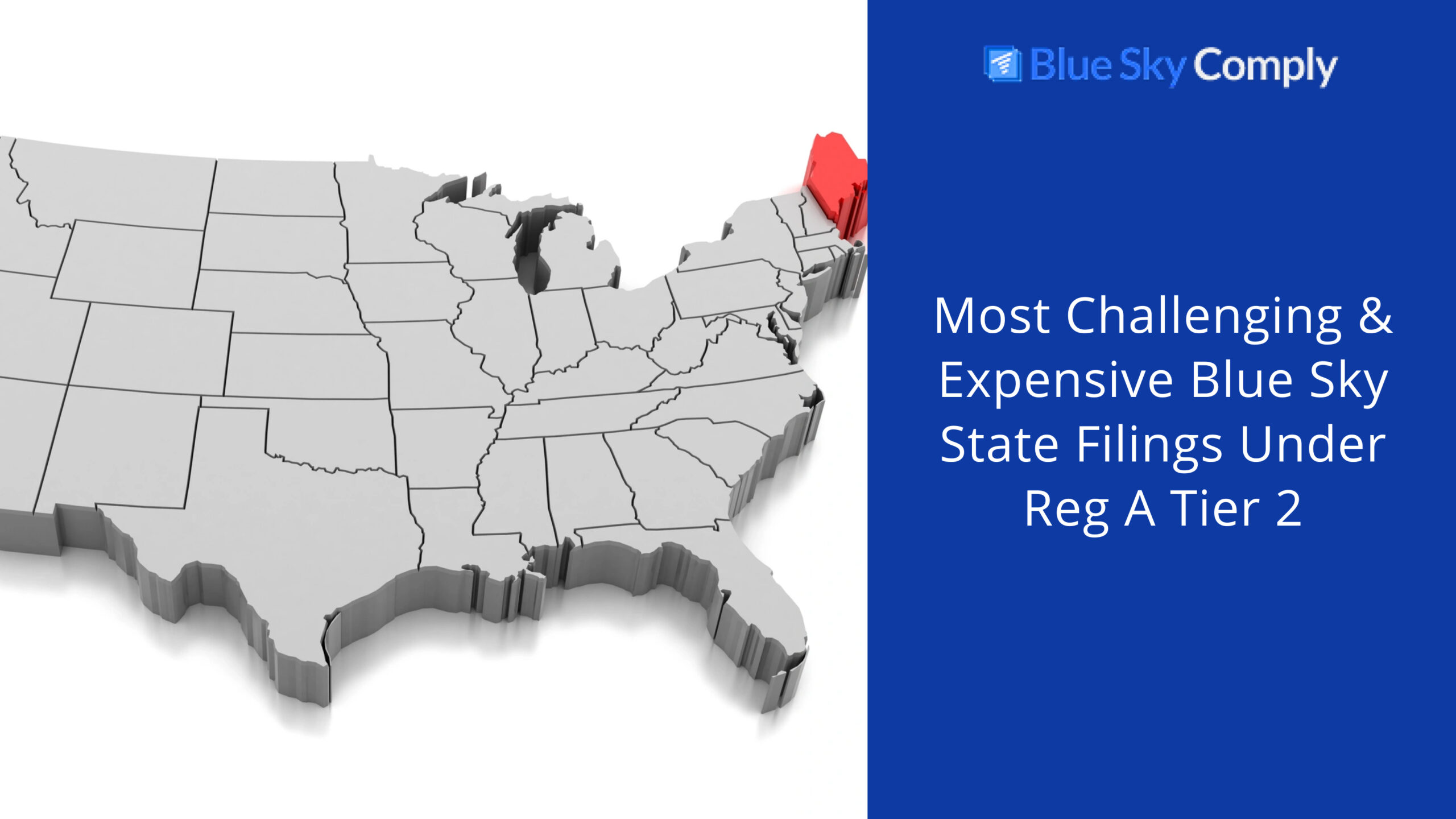


Let Us Simplify Compliance for You
Partner with Blue Sky Comply to unlock seamless compliance, efficient filings, and access to expertise that lets you focus on your growth.
Schedule A Free Demo