
Regulation A+
Regulation A+ Offerings
Category: Regulation A+
Regulation A has become a popular pathway for companies looking to raise capital from the public without going through a full IPO. It offers flexibility, access to both accredited and non-accredited investors, and a more streamlined process compared to traditional registration.
However, one of the most important decisions issuers must make early in the process is whether to pursue a Tier 1 or Tier 2 offering. While both fall under Regulation A, the differences between them are not just procedural. They fundamentally change how an offering is reviewed, approved, and managed across jurisdictions.
At the center of this distinction is a critical concept: state-level disclosure and merit review versus federal preemption.
This comparison highlights the central tradeoff between the two tiers: state-level complexity versus federal reporting obligations.
What Is Regulation A and Why the Two-Tier Structure Matters
Regulation A is an exemption under the Securities Act that allows companies to raise capital from the public with fewer requirements than a fully registered offering. To accommodate different types of issuers and capital needs, the SEC created two tiers within Regulation A. Tier 1 and Tier 2 share a common foundation. Both require filing and qualification of Form 1-A and allow companies to raise funds from a broad investor base. Where they diverge is in how regulatory oversight is applied. The choice between tiers determines whether your offering will be subject to state-by-state review under blue sky laws or primarily governed by federal law.The Core Difference: State Merit Review vs Federal Preemption
The most important distinction between Tier 1 and Tier 2 lies in how securities are regulated at the state level. Under Tier 1, offerings are not considered “covered securities.” This means issuers must comply with blue sky laws in every state where securities are offered. State regulators can require registration, impose filing fees, and, in some cases, conduct merit-based reviews of the offering itself. In contrast, Tier 2 offerings are classified as covered securities. This classification triggers federal preemption, meaning states cannot require registration or qualification of the offering. Instead, oversight is centralized at the federal level through the SEC. This distinction reshapes the entire compliance process. Tier 1 requires coordination across multiple state regulators, while Tier 2 removes that layer of review but introduces more robust federal reporting obligations. It is important to note that even under Tier 2, states may still require notice filings and fees. However, these are administrative in nature and do not involve substantive review of the offering.How Tier 1 Works: State-Level Disclosure and Approval
A Reg A Tier 1 offering is often viewed as the more traditional approach from a regulatory perspective. After filing Form 1-A with the SEC and receiving qualification, issuers must navigate each state in which they intend to sell securities. This process involves submitting filings to state regulators, paying applicable fees, and in some cases responding to comments or questions from those regulators. Because each state operates independently, the process can require careful coordination and sequencing. In certain jurisdictions, regulators may conduct a merit review. This means they evaluate whether the terms of the offering are fair to investors, not just whether disclosures are complete. While intended to protect investors, this layer of review can extend timelines and increase complexity. As a result, many Tier 1 offerings are limited to a smaller number of states. Expanding into additional jurisdictions can significantly increase the compliance burden. Read more on our Reg A Tier 1 Merit vs Disclosure review guide.How Tier 2 Works: Federal Preemption and Scaled Compliance
Reg A Tier 2 offerings take a different approach by centralizing regulatory oversight at the federal level. Once the SEC qualifies the Form 1-A offering statement, issuers can offer securities nationwide without undergoing state-by-state registration. This is possible because Tier 2 securities are treated as covered securities under federal law. As a result, state regulators are preempted from requiring qualification or merit review of the offering. This structure allows issuers to scale their capital raise across multiple states more efficiently. Instead of coordinating with individual state regulators, companies can focus on meeting federal requirements and managing a single qualification process. However, this streamlined state framework comes with additional federal obligations. Tier 2 issuers must comply with ongoing reporting requirements, including annual, semi-annual, and current reports. Financial statements must also be audited, adding another layer of preparation and cost.Key Differences Between Tier 1 and Tier 2
While the regulatory framework differs significantly, it is helpful to view the distinctions side by side. The table below summarizes the most important differences between the two tiers.| Category | Tier 1 | Tier 2 |
| Offering Limit | Up to $20 million | Up to $75 million |
| State Review | Required under blue sky laws | Preempted |
| Merit Review | Possible in certain states | Not applicable |
| SEC Reporting | Limited | Ongoing reporting required |
| Financial Statements | Not always audited | Audited required |
| Investor Limits | No limits | Limits for non-accredited investors |
| Geographic Reach | Often limited by state approvals | Nationwide offering |
Why Blue Sky Laws Matter in Tier 1 Offerings
Blue sky laws play a defining role in Tier 1 offerings. These state regulations are designed to protect investors by ensuring that securities offerings meet certain standards of fairness and transparency. In practice, this means issuers must engage directly with state regulators, who may request additional disclosures or impose specific requirements before allowing the offering to proceed. This process can introduce variability into the timeline, as each state may review the offering at a different pace. It can also increase costs through filing fees, legal coordination, and administrative overhead. For companies seeking to raise capital across multiple states, these factors can become significant constraints. Managing compliance across jurisdictions requires careful planning and often specialized expertise.When Tier 1 May Still Make Sense
Despite its complexity, Tier 1 can still be a viable option in certain scenarios. Companies that plan to raise smaller amounts of capital or focus on a limited geographic area may find Tier 1 to be sufficient. Because Tier 1 does not impose ongoing federal reporting requirements, it can also appeal to issuers looking to minimize post-offering compliance obligations. In situations where the investor base is concentrated in one or two states, the burden of state-level compliance may be manageable and aligned with the company’s goals.Why Most Issuers Choose Tier 2
In practice, many issuers gravitate toward Tier 2 because of its scalability. The ability to raise capital nationwide without navigating individual state approvals is a significant advantage. Tier 2 also supports broader marketing and investor outreach strategies, allowing companies to engage with a wider audience. This is particularly important for offerings that rely on public visibility and investor participation across multiple regions. While the ongoing reporting requirements add complexity, many issuers view this as a reasonable tradeoff for the efficiency and reach that Tier 2 provides.Compliance Tradeoffs: Simplicity vs Scale
Choosing between Tier 1 and Tier 2 ultimately comes down to a strategic decision about how to balance compliance and growth. Tier 1 offers simplicity at the federal level but introduces complexity at the state level. Tier 2 removes state barriers but requires a more structured and ongoing federal reporting framework. There is no one-size-fits-all answer. The right choice depends on factors such as the size of the raise, the target investor base, and the company’s capacity to manage ongoing compliance. Understanding these tradeoffs early in the process allows issuers to align their regulatory approach with their broader capital-raising strategy.Final Thoughts: Choosing Between Tier 1 and Tier 2
Regulation A provides a flexible pathway to raise capital, but the decision between Tier 1 and Tier 2 shapes how that process unfolds in practice. At its core, the distinction is straightforward:- Tier 1 operates within the framework of state disclosure and blue sky review, while
- Tier 2 relies on federal preemption and centralized oversight while only requiring notice filings and fees.

Regulation A has become an important capital-raising pathway for early-stage and growth companies that want to raise funds from the public without completing a full IPO. However, companies considering a Reg A Tier 1 offering quickly discover that the regulatory process can vary significantly depending on where investors are located.
Unlike Tier 2 offerings, Tier 1 offerings are not federally preempted from state securities regulation. This means issuers must comply not only with the U.S. Securities and Exchange Commission but also with individual state Blue Sky regulators. Each state retains the authority to review the offering before securities can be sold to investors in that jurisdiction.
One of the most important differences between states is the type of review they apply to securities offerings. Some states evaluate offerings through a merit-review framework, while others rely primarily on a disclosure-review approach. Understanding the difference between these two regulatory philosophies can help issuers anticipate review timelines, documentation requests, and potential revisions to their offering structure.
Both approaches ultimately seek to protect investors, but they do so through different mechanisms.
What Is a Regulation A Tier 1 Offering?
Regulation A was modernized under the JOBS Act to create a streamlined pathway for companies to raise capital from the public. The regulation is divided into two tiers, each with different limits and regulatory requirements. A Tier 1 offering allows companies to raise up to $20 million within a 12-month period. The issuer must file an offering statement with the SEC using Form 1-A, which contains information about the company’s business, management, financial condition, and the terms of the securities being offered. Once the SEC qualifies the Form 1-A offering statement, the company may begin selling securities to investors. However, unlike Tier 2 offerings, Tier 1 offerings must still comply with full registration requirements in every state where the securities will be offered or sold. This additional layer of oversight means issuers often interact with multiple state regulators during the review process.Why State Regulators Review Tier 1 Offerings
State securities laws, commonly referred to as Blue Sky laws, were originally designed to protect investors from fraudulent or overly speculative investments. While federal securities law establishes nationwide disclosure standards, states retain the authority to enforce their own rules for certain types of offerings. For Reg A Tier 1 offerings, state regulators may review the offering documents before allowing the sale of securities within their jurisdiction. Their role typically includes examining the offering statement, verifying that disclosures are adequate, and ensuring that the offering complies with state-specific requirements. However, the way regulators approach this review can differ depending on the regulatory model they follow. Broadly speaking, state oversight falls into two conceptual frameworks:- Merit review: Regulators evaluate the fairness and structure of the offering
- Disclosure review: Regulators focus primarily on whether investors receive sufficient information
What Is Merit Review in Securities Regulation?
Merit review is a regulatory approach in which the authority reviewing a securities offering evaluates not only the completeness of the disclosure but also the underlying fairness of the transaction itself. Under this framework, regulators may examine whether the terms of the offering are reasonable and equitable for investors. This can include reviewing factors such as the pricing of securities, the compensation paid to promoters or insiders, and the offering's overall financial structure. In other words, regulators applying merit review are not simply checking whether information is disclosed. They are also considering whether the investment opportunity itself appears fair from an investor protection perspective. In many merit review states, regulators may analyze elements such as:- whether the offering price appears reasonable
- whether insiders are receiving excessive compensation
- whether the capital structure creates unfair dilution for investors
- whether the company’s financial condition supports the proposed offering
How Merit Review Applies to Reg A Tier 1 Offerings
For companies pursuing a Reg A Tier 1 offering, merit review can influence both the timeline and the structure of the capital raise. When a state applies merit review standards, regulators may examine several aspects of the offering statement beyond simple disclosure. They may assess whether the terms of the securities offering are consistent with investor protection principles and whether the offering's structure could expose investors to unnecessary risk. For example, regulators may review:- the amount of compensation paid to promoters, founders, or brokers
- whether insiders are receiving preferred terms compared to public investors
- the dilution that new investors may experience
- whether the offering price appears justified relative to the company’s financial condition
What Is Disclosure Review in Securities Regulation?
Disclosure review represents a different regulatory philosophy. Instead of evaluating whether an investment is appropriate or fair, regulators focus on ensuring that investors receive complete, accurate, and transparent information about the offering. Under a disclosure-based approach, the responsibility for evaluating the investment rests primarily with the investor rather than the regulator. The regulator’s role is to verify that the offering documents provide sufficient information for investors to make an informed decision. This framework is based on the idea that well-informed investors can assess risks and decide whether an opportunity aligns with their investment goals. Regulators conducting disclosure review typically focus on questions such as:- Does the offering statement include all required information?
- Are risk factors clearly explained?
- Are financial statements accurate and properly presented?
- Are the terms of the securities clearly described?
How Disclosure Review Applies to Reg A Tier 1 Filings
In states that follow a disclosure-oriented approach, regulators reviewing a Reg A Tier 1 offering typically concentrate on the completeness and clarity of the Form 1-A filing. Their goal is not to determine whether the offering represents a good investment. Instead, they aim to ensure that the issuer provides sufficient information for investors to evaluate the opportunity independently. Regulators may review:- the business description and management discussion
- financial statements included in the offering statement
- the description of securities and investor rights
- the risk factor section
- the intended use of proceeds
Key Differences Between Merit Review and Disclosure Review
Although both regulatory models aim to protect investors, they operate in fundamentally different ways. Understanding these differences can help issuers anticipate how state regulators may approach their offering.| Differences | Merit Review | Disclosure Review |
| Regulatory focus | Fairness and structure of the offering | Adequacy of disclosure |
| Role of the regulator | Evaluates whether the offering terms are reasonable | Ensures investors receive complete information |
| Possible regulator actions | May require changes to pricing, compensation, or structure | Typically requests disclosure revisions |
| Investor responsibility | Shared between regulators and investors | Primarily for investors |
| Impact on offering terms | May lead to structural modifications | Rarely affects the offering structure |
Which States Use Merit Review vs Disclosure Review
The U.S. securities regulatory system includes a mixture of both approaches. Some states have historically adopted merit-review frameworks, while others rely more heavily on disclosure-based principles. For issuers planning a Reg A Tier 1 offering across multiple jurisdictions, this means the review process may vary by state. A company may encounter different types of feedback from regulators depending on how each state approaches securities regulation. Because Tier 1 offerings do not benefit from federal Blue Sky preemption, with only notice filings like in Tier 2 offerings, issuers must often coordinate filings and communications with several state regulators simultaneously.Practical Implications for Reg A Tier 1 Issuers
The presence of state review requirements can have practical consequences for companies planning a Tier 1 offering. First, review timelines may vary depending on the states involved and the complexity of the offering. Merit review states may require additional discussion about offering structure, which can extend the review process. Second, issuers may need to respond to regulator comments requesting clarification or revisions to their offering documents. These comments can involve disclosure updates or structural considerations, depending on the state's review model. Third, multi-state offerings require careful coordination to ensure that filings, responses, and approvals remain aligned across jurisdictions. For these reasons, companies preparing a Reg A Tier 1 offering often work with experienced securities counsel and filing professionals to manage the regulatory process efficiently.Why Many Issuers Choose Reg A Tier 2 Instead
While Tier 1 offerings can be attractive for smaller capital raises, many issuers ultimately choose Tier 2 because of its federal preemption benefits. Reg A Tier 2 offerings allow companies to raise up to $75 million within a 12-month period. More importantly, Tier 2 offerings are generally exempt from state merit review and registration requirements under federal law, but require only notice filings and state fees. This means issuers do not need to obtain approval from individual state regulators before selling securities nationwide. Instead, they focus primarily on the SEC qualification process. As a result, Tier 2 offerings often provide a more streamlined path for companies seeking to raise capital from investors across multiple states.Understanding State Review Helps Issuers Prepare for Tier 1 Offerings
Reg A Tier 1 remains an important capital-raising option, particularly for companies targeting smaller offerings or investors in a limited number of states. However, the continued role of state securities regulators means issuers must understand how different review frameworks affect the offering process. Merit review and disclosure review represent two distinct approaches to investor protection. One emphasizes evaluating the fairness of the investment itself, while the other focuses on ensuring transparency so investors can make their own decisions. For companies planning a Reg A Tier 1 offering, understanding these regulatory models can help anticipate state review expectations and reduce delays during the qualification process. Get started with Reg A blue sky filings today.
Filing Form 1-A with the U.S. Securities and Exchange Commission (SEC) is a critical step for companies seeking to raise capital through Regulation A or Regulation A+ offerings. This form serves as the official offering statement that qualifies your securities for sale under these exemptions. Understanding how to prepare and submit Form 1-A correctly can significantly streamline your fundraising process and help you avoid costly delays or compliance issues.
In this article, we will walk you through everything you need to know about filing Form 1-A, from its structure and content requirements to formatting, submission, and post-filing obligations.
What Is Form 1-A and When Must You File It?
Form 1-A is the offering statement required by the SEC for companies conducting securities offerings under Regulation A and the expanded Regulation A+, which allows smaller companies to raise capital with reduced regulatory burdens compared to traditional public offerings. Not every company or offering qualifies to use Form 1-A. The exemption applies only if your securities offering fits within the prescribed limits and eligibility criteria of Regulation A. There are two tiers:- Tier 1: Offerings up to $20 million in a 12-month period
- Tier 2: Offerings up to $75 million in a 12-month period
What Are the Three Parts of Form 1-A and How Should You Submit Them?
Form 1-A is uniquely divided into three distinct parts, each with specific content and formatting requirements mandated by the SEC’s EDGAR electronic filing system. Part I collects issuer information, certifications related to eligibility (including "bad actor" disclosures), details about the offering, jurisdictions in which securities will be sold, and information on unregistered sales. Importantly, Part I must be submitted in XML format to ensure structured data processing. Part II, known as the Offering Circular, resembles typical SEC filings in that it must be formatted in HTML or ASCII formats compliant with SEC EDGAR guidelines. This section contains detailed disclosures about the offering, risks, management, financial statements, and other material information investors need. Part III includes the exhibit index, exhibits (such as underwriting agreements or legal opinions), and signature blocks. These documents must be submitted in standard EDGAR format and be fully searchable. A key point to remember is that all electronic documents submitted must be searchable text files. While PDF files can be included as unofficial documents, they cannot substitute for the required searchable formats. If a PDF or scanned document is submitted without conversion, EDGAR will automatically discard it but will accept the rest of your filing. To avoid this, scanned documents must be converted into a compliant format before submission.What Financial Statements Are Required for Tier 1 vs Tier 2 Filings?
Financial disclosures are a critical component of Form 1-A and differ depending on whether you are filing under Tier 1 or Tier 2:- For Tier 1 issuers, financial statements for the two most recent fiscal years are required but need not be audited. This offers flexibility for smaller offerings while still providing investors with essential financial information.
- For Tier 2 issuers, audited financial statements for the last two fiscal years are mandatory. These audits must comply with generally accepted accounting principles (GAAP) and provide increased assurance on financial accuracy due to larger offering sizes.
| Requirement | Tier 1 Offering | Tier 2 Offering |
| Maximum Offering Size | Up to $20 million | Up to $75 million |
| Audited Financials | Not required | Required |
| Financial Periods | Last two fiscal years | Last two fiscal years |
| XBRL Tagging | Not required | Not required |
What Information Do You Need Before Filing Form 1-A?
Before starting your filing, it is essential to gather comprehensive information about your company and offering. This preparation helps ensure your Form 1-A is complete and reduces back-and-forth during SEC review. Key information includes:- Issuer details: Your legal company name, business address, and jurisdiction of incorporation
- Certifications: Confirmations regarding eligibility rules, including “bad actor” disclosures that may disqualify certain issuers
- Offering information: Description of securities offered (e.g., common stock or convertible notes), total amount sought in the offering, price per security
- Jurisdictions: States where you intend to offer your securities
- Unregistered sales: Disclosure of any prior unregistered securities sales within specified timeframes
- Financial statements: As outlined previously, depending on your tier status
- Supplemental information: Additional disclosures may be necessary based on your specific circumstances
How Do You Format Your Form 1-A Documents for SEC EDGAR Submission?
The SEC requires strict adherence to formatting rules when submitting Form 1-A electronically via EDGAR. Uniformity ensures machine-readability and facilitates regulatory review. For Part I’s XML submission, issuers often use worksheets or specialized software tools, or work with an EDGAR filing agent, to generate compliant XML files in accordance with SEC specifications. The Offering Circular in Part II needs to be converted to an HTML or ASCII document in accordance with EDGAR’s technical standards, including well-structured headings, embedded links to exhibits or footnotes where applicable, and fully searchable text free of formatting errors. Exhibits that comprise Part III should also be prepared as fully searchable HTML or ASCII files, using word processors, to help EDGAR filing providers avoid hidden special characters or scanning artifacts. If you have hard-copy-only documents such as signed legal opinions or third-party reports, these must be converted into searchable electronic formats before submission; otherwise, EDGAR may silently reject them or exclude them from your filing package.What Are the Steps to File Form 1-A on the SEC’s EDGAR System?
Filing Form 1-A via EDGAR involves several sequential steps that must be followed carefully:- Obtain Your EDGAR Access Codes through a Form ID application: If not already registered, obtain a Central Index Key (CIK) number by registering with the SEC’s EDGAR system.
- Prepare Part I XML File: Use an SEC filing agent to complete issuer info and certifications in XML format.
- Convert Your Offering Circular (Part II): Format your disclosure document into HTML or ASCII-compliant with SEC requirements.
- Compile Exhibits (Part III): Prepare all exhibits, including signature pages in EDGAR-compliant formats.
- Upload All Parts via EDGAR: Submit Parts I through III together, ensuring no missing files or formatting errors.
- Verify Acceptance: Review confirmation messages from EDGAR carefully and correct any errors by resubmitting affected files.
- Pay Filing Fees (if applicable): Depending on your offering size and tier level, fees may apply; confirm payment requirements during submission.
When Is Supplemental Information Required with Your Form 1-A Filing?
Sometimes, additional supporting documents beyond the basic three parts are necessary for a complete filing package:- A statement confirming whether compensation paid to underwriters has been cleared with FINRA (Financial Industry Regulatory Authority).
- Copies of any engineering reports, market analyses, management studies, or similar third-party reports referenced in your Offering Circular.
- Accompanying statements detailing distribution plans for these reports, including who received them and how many copies were distributed.
- Any other documentation requested by the SEC staff during their review process as evidence supporting assertions made in your filing.
What Happens After You Submit Form 1-A? Understanding Review and Ongoing Obligations
After submission, your Form 1-A undergoes review by SEC staff who may issue comment letters requesting clarifications or amendments before qualifying your offering statement. Responding thoroughly and promptly to these comments is crucial for timely approval. Once qualified:- You are subject to ongoing reporting obligations such as filing an annual report on Form 1-SA, which summarizes financial condition updates and business developments.
- Material changes occurring during or after your offering may require amended filings.
Key Takeaways on Filing Form 1-A Successfully with the SEC
Filing Form 1-A may appear complex at first due to its multipart structure, strict formatting demands, and tier-based financial disclosure requirements. However:- Understand when Regulation A applies and verify eligibility early
- Prepare each part of Form 1-A carefully according to SEC formatting guidelines
- Follow financial statement requirements based on whether you qualify as Tier 1 or Tier 2
- Gather accurate issuer details, including necessary certifications
- Convert all documents into searchable electronic formats compliant with EDGAR
- Submit all parts together following the step-by-step instructions on EDGAR
- Be prepared for supplemental info requests from SEC staff
- Respond promptly to comments during review
- Maintain post-filing reporting obligations diligently
When companies raise capital in the United States, they must navigate two overlapping but distinct regulatory systems: federal securities law and state securities law, commonly known as Blue Sky laws. While these systems are designed to work together, they operate at different levels of government and impose different types of obligations.
Understanding how Blue Sky laws differ from federal securities law is essential for issuers, fund managers, and compliance professionals. Federal exemptions do not automatically eliminate state responsibilities, and state authority does not override federal law. The relationship is layered, not either-or.
This comparison highlights an important principle. Federal law may determine whether a registration statement is required, but state law may still impose additional compliance obligations.
What Is the Difference Between Blue Sky Laws and Federal Securities Law?
At the highest level, the difference is structural. Federal securities laws are enacted by Congress and enforced by the Securities and Exchange Commission. They apply nationwide and govern how securities are offered, sold, and traded. Blue Sky laws are state-level securities laws enforced by individual state regulators. Each state has its own statutes and administrative rules that regulate securities offerings within its borders. Federal law can preempt certain state requirements, particularly registration requirements for covered securities. However, states retain authority to require notice filings and enforce anti-fraud provisions. As a result, issuers often must comply with both systems simultaneously.What Are Federal Securities Laws?
Federal securities laws form the foundation of U.S. capital markets regulation. The two most significant statutes are the Securities Act of 1933 and the Securities Exchange Act of 1934. The Securities Act of 1933 governs the offer and sale of securities. It generally requires that securities be registered with the SEC unless an exemption applies. Registration typically involves filing detailed disclosure documents such as Form S-1 or Form 1-A. The Securities Exchange Act of 1934 regulates secondary trading markets, ongoing reporting requirements, and broker-dealers. It established the SEC and provided the framework for enforcement and disclosure obligations. Federal law also provides exemptions from registration, including:- Regulation D for private placements
- Regulation A for limited public offerings
- Regulation CF for smaller online offerings
- Section 4(a)(2) for transactions not involving a public offering
- Rule 701 for employee compensation and equity incentive plans
- Rule 144A for resales of securities to qualified institutional buyers (QIBs)
- Intrastate offering exemptions (Rule 147 and Rule 147A) for offerings limited to a single state
- Regulation S for offerings conducted outside the United States
What Are Blue Sky Laws?
Blue Sky laws are the securities statutes enacted and enforced by individual states. Although many states base their laws on versions of the Uniform Securities Act, each state has its own regulatory agency and administrative rules. Blue Sky laws typically regulate:- Registration or qualification of securities offerings
- Licensing of brokers and investment advisers
- Anti-fraud provisions related to securities transactions
Registration Requirements: Federal vs State
The most significant distinction between federal and state securities law lies in registration requirements. At the federal level, securities must be registered with the SEC unless an exemption applies. Registration involves detailed disclosures about the issuer’s business, financial condition, risk factors, and management. The SEC reviews the filing for compliance with disclosure standards. At the state level, registration requirements historically required issuers to qualify their offerings in each state where securities were sold. However, federal legislation has significantly altered this landscape. To clarify the structural differences, the table below compares federal and state securities law in key areas:| Requirements | Federal Securities Laws |
Blue Sky State Laws |
| Primary Regulator | Securities and Exchange Commission | State securities regulators |
| Geographic Scope | Nationwide | Individual states |
| Registration Requirement | Required unless exempt | Required unless preempted or exempt |
| Review Standard | Disclosure-based | May include merit review in some contexts |
| Anti-Fraud Authority | Yes | Yes |
| Notice Filings | Not applicable | Often required for covered securities |
Federal Preemption and Covered Securities
The relationship between federal and state securities law changed significantly in 1996 with the passage of the National Securities Markets Improvement Act. This legislation created the concept of “covered securities.” Covered securities are exempt from state registration requirements. They include securities sold under Rule 506 of Regulation D and securities listed on national exchanges. This means that if an issuer conducts a Rule 506 offering, states cannot require full registration or merit review of that offering. However, preemption does not eliminate all state authority. States may still:- Require state notice filings with state-specific filing requirements that vary
- Collect filing fees based on the offering amount, and other factors found in the offering
- Enforce anti-fraud provisions
Notice Filings Versus State Registration
One of the most common sources of confusion is the difference between state registration and a Blue Sky notice filing. State registration is a substantive process. It may involve reviewing offering documents, financial disclosures, and, in some cases, evaluating whether the offering is fair to investors. A notice filing, by contrast, is less burdensome but typically requires submitting a copy of Form D and other state-specific forms and documents, paying a state-defined blue-sky fee, and providing consent to service of process. The state does not conduct a merit review but is formally notified of the offering. Notice filings are most commonly required for Rule 506 offerings under Regulation D. Issuers must file in each state where investors reside, usually within a specified time after the first sale.Enforcement Authority: SEC vs State Regulators
Federal and state regulators both have enforcement authority, and in some cases, their jurisdictions overlap. The SEC may bring civil enforcement actions for violations of federal securities laws, including misstatements, omissions, and fraudulent conduct. Remedies may include injunctions, penalties, and disgorgement. State regulators may also bring enforcement actions under their own Blue Sky laws. Even when an offering is federally exempt and preempted from state registration, states retain the power to investigate and prosecute fraud within their jurisdiction. In practice, federal and state enforcement actions can occur independently or in parallel. Compliance strategies must account for both levels of oversight.When Must Issuers Comply With Both Systems?
In most capital raises, issuers must comply with both federal and state securities laws simultaneously. For example, a company conducting a Rule 506 offering must:- Comply with Regulation D at the federal level
- File Form D with the SEC
- Submit Blue Sky notice filings in each state where investors reside
Common Misunderstandings About Federal and State Law
Several misconceptions arise not from filing mechanics, but from confusion about how regulatory authority is divided between federal and state governments. “Federal law is superior, so it replaces state law.” Federal securities law can preempt specific state requirements, particularly those related to the registration of covered securities. However, preemption is limited and defined by statute. States retain independent authority to enforce anti-fraud provisions and, in many cases, require notice filings and fees. Federal law does not eliminate state securities law. “State regulators simply enforce federal rules.” State securities divisions operate under their own statutes and administrative frameworks. While many state laws are modeled on versions of the Uniform Securities Act, they are not merely extensions of the SEC. States can initiate investigations, issue stop orders, and pursue enforcement actions independently of federal authorities. “If an offering is small, state law does not apply.” The size of the offering does not determine whether state securities law applies. State jurisdiction is generally triggered by the offer or sale of securities to residents within the state, regardless of offering size. “Blue Sky laws are outdated and rarely enforced.” Although federal regulation has expanded over time, state regulators remain active participants in securities oversight. States regularly bring enforcement actions, coordinate with the SEC, and monitor notice filings to ensure compliance. Understanding these structural distinctions helps issuers recognize that federal and state law operate concurrently rather than in a hierarchical manner. Compliance requires satisfying both systems where applicable.Why the Difference Matters
Understanding how Blue Sky laws differ from federal securities law is not merely academic. It directly impacts how offerings are structured, filed, and managed. Issuers who focus solely on federal exemptions risk overlooking state-level notice requirements. Conversely, misunderstanding federal preemption may lead to unnecessary state registration efforts. A coordinated compliance approach recognizes that:- Federal law establishes nationwide disclosure and exemption frameworks
- State law supplements federal oversight through notice filings and enforcement
- Both systems must be satisfied to lawfully offer securities
Are you a foreign company looking to raise capital in the U.S.? In 2026, understanding whether you can do a Reg A offering is crucial to unlocking new investment opportunities. This guide will walk you through the essentials of Reg A offerings for foreign entities and what steps to take.
Understanding Reg A Offerings in 2026
The Regulation A (Reg A) is a popular exemption from the registration requirements of the U.S. Securities and Exchange Commission (SEC), designed to help smaller companies raise capital from the public with less regulatory burden. Also known as a mini-IPO, Reg A allows companies to offer securities to investors nationwide without the extensive disclosure process required for a full public offering. In 2026, Reg A has gained even more traction, partly due to the rise of international companies seeking to enter the U.S. market and diversify their funding sources. The SEC has continuously updated the rules to streamline processes and make offerings more accessible, which is especially beneficial for foreign companies aiming to tap into the robust U.S. investor base.Can Foreign Companies Do a Reg A Offering?
Historically, there was uncertainty about whether foreign companies could leverage Reg A to raise capital in the United States. In 2026, this question has been largely settled in favor of allowing foreign companies to participate under certain conditions. The SEC's current rules specify that foreign companies are eligible to conduct Reg A offerings, provided they meet certain criteria. This includes complying with U.S. securities laws and ensuring that their securities are not restricted or barred from trading in the U.S. Regulation A falls under Rule 251(b)(1), which states: “an entity organized under the laws of the United States or Canada, or any State, Province, Territory or possession thereof, or the District of Columbia, with its principal place of business in the United States or Canada.” In essence, Regulation A is available only to companies formed under U.S. or Canadian law and with their main place of business in the United States or Canada. Alternatively, for Regulation Crowdfunding, Rule 100(b) sets a different but related constraint. Under this rule, a Reg CF issuer must be formed under, and subject to, the laws of a U.S. state or territory, or the District of Columbia. In other words, entities organized solely under foreign law cannot directly rely on Reg CF. Taken together, these provisions suggest at first glance that foreign companies are shut out of using U.S. crowdfunding exemptions, and more broadly may face significant hurdles in accessing U.S. investors. However, that conclusion is too narrow. With proper structuring—such as using a U.S. entity as the issuer—there are compliant pathways available for non-U.S. businesses to raise capital in the United States.Eligibility Requirements for Foreign Companies
While foreign companies are generally eligible to do a Reg A offering in 2026, they must satisfy specific eligibility criteria to qualify. These include:- Jurisdiction of Organization: The company must be organized or incorporated in the United States or Canada, with its principal business operations located in either country.
- No Disqualification: The company must not fall under any disqualifying conditions outlined in SEC Rule 262, such as certain criminal convictions or regulatory violations.
- Compliance with U.S. Laws: The company must comply with applicable U.S. securities laws during the offering process.
- SEC Filing: A Form 1-A must be filed with the SEC, including financial statements prepared in accordance with U.S. GAAP or IFRS, translated if necessary.
- Investor Limits: Under Tier 2 of Reg A, which most foreign companies opt for, there are limits on the amount of securities that can be sold annually (up to $75 million in 2026), and the company must meet certain ongoing reporting requirements.
Strategies for Foreign Companies to Comply with Reg A Requirements
Foreign companies aren’t entirely shut out of Regulation A, but they do need to structure their U.S. presence carefully to fit within the rules. Below are several common approaches that can allow a non-U.S. business to access Reg A while staying within the regulatory guardrails.- Redomiciling to the United States: One path is to shift the company’s place of incorporation to the U.S. This can open the door to using Regulation A, but it’s a major step with significant tax and corporate implications, especially when relocating substantial assets across borders. In addition, the company will generally need at least two years of audited financial statements prepared in accordance with U.S. GAAP to satisfy Reg A requirements.
- Forming a U.S. Holding Company: In some cases, a U.S. holding company can be created to serve as the crowdfunding vehicle. But for a Reg A offering, the issuer’s principal place of business must still be in the United States, which reintroduces many of the same structural and operational challenges described above.
- Use of Subsidiary Structure: International companies commonly establish a U.S. subsidiary to serve as the issuer for the offering, ensuring alignment with jurisdictional and regulatory requirements.
- Creating a New U.S. Operating Company That Licenses the Foreign Business or Product: A potentially flexible alternative is to form a new U.S. company that licenses the foreign company’s intellectual property, technology, or products. The new U.S. entity then conducts the offering and must use the proceeds in its own operations, not simply pass them through to the foreign licensor. Depending on the facts, this structure may be used with either Regulation A or Regulation Crowdfunding, but it requires careful planning to align the licensing, cash flows, and investor disclosures.
Steps to File a Reg A Offering as a Foreign Entity
Conducting a Reg A offering as a foreign company involves several critical steps. Blue Sky Comply can help consult through these steps at no cost.- Legal and Regulatory Consultation: Engage with U.S. securities attorneys who understand both U.S. and international law to ensure compliance from the outset.
- Prepare Financials: Compile financial statements according to U.S. GAAP or IFRS standards, translated into English if necessary, dating within the past 12 months.
- Draft the Offering Circular: Prepare a comprehensive offering circular outlining business details, financials, risk factors, and plans for use of proceeds.
- File Form 1-A with the SEC: Submit the offering circular along with required disclosures via Form 1-A, which undergoes review and potential comments from the SEC.
- File Blue Sky Notices to the States: This involves filing Reg A blue sky filings and state fees to each required jurisdiction in the U.S. This must be done before issuers can make sales, and depending on the state, up to 21 days before you make sales.
- Marketing and Investor Outreach: Market the offering within legal boundaries, targeting accredited and non-accredited investors, depending on the Tier.
- Close the Offering: Complete the securities sale, receive funds, and fulfill ongoing reporting obligations as required by SEC rules.
Benefits of Reg A for Foreign Companies
Utilizing Regulation A offers several strategic advantages for foreign companies looking to enter or expand within the U.S. market. It provides access to a large and diverse base of U.S. retail and institutional investors, creating opportunities to build brand awareness and market presence while raising capital. Reg A can also serve as a cost-effective alternative to a traditional IPO, often resulting in lower legal and regulatory expenses and a faster time-to-market. With the ability to raise up to $75 million under Tier 2 in 2026, companies can secure meaningful growth capital without the full burdens of a public offering. In addition, registering securities under Reg A can enhance a company’s credibility with U.S. customers, partners, and other stakeholders, while the exemption's structure facilitates potential follow-on offerings and repeat investments as the business scales.Reg A Offerings: Trends and Predictions for 2026
Looking ahead to 2026, several key trends are shaping the landscape for Regulation A offerings by foreign companies. International participation continues to grow, with more non-U.S. issuers—particularly those in emerging markets and technology sectors—turning to Reg A as a pathway to U.S. capital. At the same time, the SEC has provided clearer guidance and support for international issuers, helping to streamline the offering process and reduce regulatory uncertainty. The rise of digital and tokenized securities is also beginning to influence traditional capital-raising, with some foreign companies exploring tokenized offerings under the Reg A framework. Investor and regulatory expectations around disclosure are increasing, driving higher standards of due diligence, transparency, and governance. Finally, many companies are placing greater emphasis on environmental, social, and governance (ESG) considerations in their Reg A offerings, aligning their messaging and business models with the growing interest among U.S. investors in sustainability and social impact. Overall, the outlook for foreign companies conducting Reg A offerings in 2026 is optimistic, with continued growth driven by regulatory support, technological advancements, and globalization of capital markets.Looking Forward
In the evolving landscape of securities offerings, Reg A remains an attractive and accessible option for foreign companies aiming to raise capital in the U.S. in 2026. With the right strategic planning, legal guidance, and compliance, foreign entities can successfully leverage Reg A to access the lucrative U.S. investment market. Stay informed about current trends, and consider engaging experienced professionals to streamline the process and maximize your fundraising potential in this dynamic environment. Whether you're entering the U.S. market for the first time or expanding your investor base, understanding the opportunities and challenges of Reg A offerings today is crucial for success in 2026 and beyond, and Blue Sky Comply can help you with that journey.
Choosing a path for your early capital raise is less about buzzwords and more about fit. Rule 504 sits inside Regulation D and can be a practical option when you want a lighter lift for a smaller offering, especially if your investor base is close to home. The decision often hinges on a few grounded realities:
- Size of the round
- Who your investors are
- How widely you plan to market
- Whether you can embrace state-level steps.
What Rule 504 Is and How It Works
Rule 504 supports smaller offerings with a comparatively simple structure. Broadly speaking, it can allow certain flexibility when the offering is registered at the state level, and it permits sales to both accredited and non-accredited investors, subject to state rules. Documentation and disclosure/filing requirements for Reg D 504 are simple on the federal-filing side to the SEC, but more complicated on the state level. Further, you will spend most of your energy coordinating state requirements, since federal preemption is not the default advantage. Contact us to learn more. State review and registration are what make 504 feel different in practice. Your marketing leeway often flows from what a specific state has reviewed and allowed. If you plan to sell only in a handful of states, you can right-size the process and move faster. If you plan to market broadly across many states, the complexity can add up. Rule 504 could be fast and flexible for small rounds, but varying state requirements will likely determine your true cost and timeline.When Rule 504 Is a Good Fit
Rule 504 tends to click for companies that already have a defined local or regional audience and want to raise a modest amount without building a national marketing campaign. Imagine a consumer brand with loyal customers in two or three states, or a real estate vehicle focused on one metro area. The practical benefits are speed, familiarity with the investor base, and fewer moving parts than a larger retail pathway. If your investors are not all accredited or you have more than 35 non-accredited investors, a state-registered 504 can offer a compliant on-ramp where 506(c) and (b) would not fit your plan. A founder with a strong email list and in-market events might find 504 especially appealing. The existing relationships compress the marketing cycle, and the alignment between your intended investors and the states you choose to register in keeps the filing work proportional to the raise.When Rule 504 Might Not Be the Best Choice
Rule 504 will struggle to keep pace if your strategy looks national, your investor mix is primarily accredited, and you want to openly advertise online. In that scenario, 506(c) can deliver general solicitation with federal preemption on state law, which simplifies the filing posture and helps you move faster across state lines. If your vision is a truly retail-friendly offering at a larger scale with broad reach, Regulation A Tier 2 is often the correct framework, even though it brings ongoing reporting and audited financials. If you expect to run a platform-based, community-centric campaign, Regulation CF may be a better match than 504. The portal infrastructure can be worth the tradeoffs when your goal is to grow your audience from the crowd. If your plan is to market broadly to accredited investors nationwide, 506(c) is usually more efficient than Rule 504.Rule 504 Compared to 506(b) and 506(c)
The differences between these Reg D routes come down to solicitation, investor eligibility, and how much state-level coordination you want. With 506(b), you can avoid general solicitation and raise funds from accredited investors and up to 35 sophisticated non-accredited investors, leveraging preexisting relationships. It is quiet and controlled. With 506(c), you gain the right to generally solicit, but you must verify accreditation status. In both cases, federal preemption lightens the state burden. With Rule 504, you can gain more flexibility via state registration, but the tradeoff is the filing and review workload that sits with those states. If your raise is concentrated where you already do business, that tradeoff can be worth it.Rule 504 vs Regulation CF
Crowdfunding under Reg CF formalizes the public campaign format. You will work through a registered portal, follow disclosure templates, and accept investment caps and limits that come with the territory. The upside is access to a broad retail audience and platform tools designed for conversion. You can raise from unlimited non-accredited investors up to $5mm. By contrast, Rule 504 is most compelling if you can focus on a few states, tailor your messaging to what those states have reviewed, and lean on existing customer affinity. If your plan already involves a portal and national outreach, you will likely be better served by Regulation CF.Rule 504 vs Regulation A Tier 2
Reg A Tier 2 is the heavyweight retail exemption suitable for larger raises with a wide audience, which allows non-accredited investors and free-trading shares suitable for trading. It introduces audited financials, offering circular review and ongoing reporting, all of which support a durable investor relations posture. That structure brings credibility and reach, but it also brings time and budget commitments. Rule 504 is the smaller, faster option for local raises where the goal is to get to a close efficiently without building the infrastructure of a national retail offering. If your strategy anticipates scaling marketing and investor count significantly, a Reg A Offering deserves a serious look.Can You Advertise a Rule 504 Offering?
The short answer is yes, but only under specific conditions tied to state law. Rule 504 by itself does not grant a blanket right to advertise. Public solicitation is permitted when your offering is registered in the states where you intend to solicit or when you use a state exemption that expressly allows general solicitation and requires a public filing and delivery of a disclosure document. In these situations, your ads and public statements should be consistent with what the state reviewed and permitted. If you are not pursuing a path that allows general solicitation under state law, treat communications like a traditional private placement and avoid public promotion. Many issuers that want broad public outreach choose 506(c) instead, because it permits general solicitation with federal preemption. When in doubt, align your plan with state-reviewed materials and keep copies of everything you publish.State Compliance Realities Under Rule 504
The mechanics of 504 are won or lost in the details of state coordination. Each state may have its own form of review (merit-based or disclosure-based reviews), comment cycles, and timelines. Fees also vary. Because your marketing claims should match the filed terms that a state has approved, you will want your marketing and legal teams to communicate closely. For issuers working across a handful of states, it can help to sequence filings based on expected investor demand and processing speed. Select the states where your investor list is strongest, start there, and avoid overextending your filing footprint until you see conversion. When you need a reference point for what these filings entail, it is useful to look at the broader category of State Reg D filings so you can budget time and resources. The core idea is the same:- Plan for state and legal fees
- Filing documents and paperwork
- Examiner comments
- Align your calendar accordingly
Costs, Timelines, and Documentation
Issuers sometimes underestimate the time and attention required to align marketing with state-reviewed materials. A realistic plan includes a calendar for filing and comment resolution in each state, time for drafting and revising offering documents, and a playbook for what your team can and cannot say during the campaign. It also includes recordkeeping and post-close filings, particularly if you accept investments in tranches. To avoid surprises, map your budget to state fees and core drafting tasks. Documentation usually includes subscription agreements, investor questionnaires, disclosure materials that mirror state filings, and carefully reviewed communication materials. Here is a simple view that helps set expectations without drowning in details:| Topic | What to expect under Rule 504 | Practical tip |
| State reviews | Vary by state, with possible comment cycles | Sequence filings by expected demand and speed |
| Fees | Vary by state and can compound across jurisdictions | Build a per-state fee model and track actuals |
| Marketing | Tied to what has been filed or approved | Keep marketing aligned with filed terms and disclosures |
| Investor mix | Can include non-accredited investors with state registration | Pre-plan investor communications and FAQs |
| Timeline | Often faster for a few states, longer for many | Pilot in core states before expanding |
Marketing and Communications Under Rule 504
Good messaging respects what you have filed. If a state has reviewed and cleared specific claims, lean on that approved language. Do not improvise on terms, and do not make performance promises. Your investor communications should be templated, and your team should know which materials are greenlit and which need legal review before use. A well-run 504 campaign often looks and feels like a focused product launch. You address a known audience with clear, consistent materials, and you measure response state by state. That discipline keeps the raise clean and shortens your path to closing.Case Snapshots: Where Rule 504 Works
Consider a consumer food brand with a devoted regional following. The company has strong sales in two neighboring states and wants to invest in customers who ask about participating. Registering under Rule 504 in those states allows the brand to market within a known footprint. Because the audience already trusts the product, the message lands, and the brand can focus its budget on filings instead of national advertising. Another example is a small business services firm whose clients are concentrated within one metropolitan area. Their investors are primarily customers and partners. A targeted 504 effort allows the firm to share the opportunity ethically and coherently without scaling up a national compliance structure. A third scenario is a community real estate vehicle that aggregates investment into local projects. The value proposition is local knowledge and visibility. That is a natural use case for a state-registered offering that stays close to its base.Common Pitfalls and How to Avoid Them
Even well-prepared teams can stumble if they treat 504 like a generic Reg D raise. The most common missteps include drifting off script in marketing materials, underbudgeting state and filing fees, and assuming every state processes at the same pace. You can avoid those risks by setting internal controls for content, tracking a state-specific calendar, and making sure subscription, disclosure, and investor updates reflect the same set of terms. A short checklist can help you stay on track after you choose Rule 504:- Confirm which states you will file in and why those states align with your investor list.
- Lock approved language for marketing and investor communications and train the team.
- Map state timelines to your campaign calendar and hold to a weekly review cadence.
- Track commitments and funds by state, so post-close filings are complete and timely.
Choosing Rule 504 With Clarity
Rule 504 shines when your raise is modest, your investors are concentrated in a few states, and you can align marketing with state-reviewed materials. If you value speed, simplicity, and access to non-accredited investors in a focused footprint, 506(b) or Reg CF may be a better option. If your plan involves nationwide outreach, general solicitation, or a larger retail audience, you will usually find a better fit in 506(c), Reg CF, or Reg A. Match the exemption to your audience, geography, and timeline to avoid friction and rework. For tailored support with state securities filings and Reg D strategies, Blue Sky Comply can be contacted for related support.
Navigating federal securities law is complex—but it becomes even more challenging when layered with individual state securities regulations, known as Blue Sky laws. While certain SEC filings benefit from federal preemption, many still trigger state-level notice, exemption, or registration requirements. Skipping these steps can result in costly fines, cease and desist orders, or enforcement actions.
What Are Blue Sky Filings?
Blue Sky laws are state-level securities laws designed to protect investors from fraud. Even if an offering is exempt from federal registration, the issuer often must submit a notice filing with each state where the securities are offered or sold. These filings frequently include a copy of the SEC form (such as Form D), a consent to service of process (typically Form U-2), and a filing fee.SEC Filings That Trigger Blue Sky Filings
Below is a detailed breakdown of the most common SEC filings and how they interact with Blue Sky law obligations at the state level.Form D (Regulation D: Rules 504, 506(b), 506(c))
- Triggers Blue Sky filings in all states where securities are sold.
- Rule 504: No federal preemption. Issuers must register or file for exemption in each state.
- Rules 506(b) and 506(c): Federal preemption applies under the National Securities Markets Improvement Act (NSMIA), but issuers must still file notice filings and fees with each applicable state.
Form 1-A (Regulation A: Tier 1 and Tier 2 Offerings)
- Tier 1 (up to $20M): No federal preemption. Full Blue Sky registration is required in every state where securities are offered.
- Tier 2 (up to $75M): Federal preemption of registration, but most states still require notice filings and fees, including Form 1-A, U-2, and filing fees.
- Some states require issuer-dealer registration for direct sales to investors.
Form C (Regulation Crowdfunding - Reg CF)
Although Reg CF enjoys federal preemption, some states still require a Blue Sky notice filing for crowdfunding offerings. Required filings often include:- A notice filing of the Reg CF offering
- A filing fee
- Any applicable state-specific forms
- Investor Residency Concentration: Individuals who purchase 50% or more of the total securities sold (via dollar amount) in the Reg CF offering are residents of the corresponding state.
- State of Principal Place of Business: If your principal place of business is located in a U.S. State that mandates state filings, you may need to comply with these requirements.
Form S-1 (Initial Public Offerings and Direct Listings)
- Used for public offerings of securities.
- If securities are not listed on a national securities exchange (like NASDAQ or NYSE), Blue Sky registration may be required in states where the securities are sold.
- Some states require issuer-dealer or agent registration for direct-to-investor IPOs.
Forms S-3, S-4, S-8, F-1, F-3, F-4
- Used for follow-on offerings, mergers, employee stock compensation, and foreign issuer registrations.
- If securities are NMS-listed (traded on a national securities exchange), Blue Sky laws are typically preempted.
- However, resale of securities or direct offerings to employees (e.g., via S-8) may still trigger notice filings in specific states.
Form 10 / Form 8-A
These forms are used for registering securities under the Securities Exchange Act of 1934.- If the issuer’s securities are not listed on a national exchange, Blue Sky registration or exemption may still be required for secondary sales in some states.
Rule 147 / Rule 147A (Intrastate Offerings)
- These rules allow for intrastate offerings exempt from federal registration.
- Issuers must comply fully with the Blue Sky registration or exemption process in the offering state.
Regulation S (Offshore Offerings)
- Reg S allows offerings made outside the U.S. to foreign investors.
- Generally does not require Blue Sky filings, unless securities are later resold in U.S. states. In such cases, state-level compliance may be required for secondary market activity.
Rule 701 (Employee Compensation Plans for Private Companies)
- Allows companies to issue equity as compensation to employees without federal registration.
- Several states require a Blue Sky notice filing if employees reside in their jurisdiction and receive equity under Rule 701.
Regulation E (Closed-End Investment Companies)
- Applies to small business investment companies or BDCs (business development companies).
- Triggers Blue Sky filings in each state where securities are sold.
Regulation CE (Rule 1001 – California-Only Exemption)
- Applies only to California-based offerings under federal exemption.
- Still requires compliance with California Blue Sky laws.
What Happens If You Don’t File?
Failure to comply with Blue Sky laws may result in:- Fines from $100 to $5,000+ per violation
- Cease and desist orders
- Rescission rights for investors
- Barred ability to raise capital in noncompliant states
- Reputational harm
Best Practices for Issuers
- Determine investor locations early in the offering process
- Track and meet all filing deadlines (e.g., 15-day window post-sale for Form D)
- Budget for state fees (ranging from $100 to over $2,500 per state)
- Use an experienced Blue Sky compliance partner to ensure filings are timely, complete, and cost-effective
Need Help?
At Blue Sky Comply, we monitor all 50 states and D.C. for compliance rules, filing requirements, and deadlines. Whether you're raising under Reg D, Reg A, Reg CF, or another exemption or offering, we provide expert filing services and cost-saving compliance management.
Issuers must comply with federal and state securities laws when raising capital through private or public securities offerings. While SEC regulations play a central role in governing these transactions, state-level Blue Sky Laws also impose additional requirements to protect investors from fraudulent practices.
Blue Sky Compliance refers to the process of adhering to these state securities regulations, ensuring that issuers meet filing, disclosure, and registration requirements. Failure to comply with Blue Sky laws can result in penalties, restrictions on securities sales, and regulatory enforcement actions. In this guide, we explore the importance of Blue Sky Compliance, state-specific filing requirements, and best practices to ensure issuers remain fully compliant when conducting securities offerings.
Understanding Blue Sky Laws Blue Sky Laws are state-level securities regulations designed to protect investors from fraudulent or misleading investment schemes. These laws require companies selling securities within a particular state to register or file exemptions before offering securities to investors. Each state has its own set of Blue Sky Laws, which typically require:
- Registration of securities or exemption filings before securities can be sold in that state.
- Disclosure of offering details, including financial statements and investor protections.
- Filing fees and periodic renewals to maintain compliance.
- Issuer-dealer and broker-dealer registration if the company is selling securities directly.
Who Needs Blue Sky Compliance?
Any company conducting a securities offering—whether private placements under Regulation D public offerings under Regulation A or traditional IPOs—must ensure they comply with Blue Sky Laws in every state where their securities are sold.Blue Sky Offering Types
Here are some common types of offerings requiring Blue Sky Compliance:- Regulation D Offerings (Rule 506(b) and 506(c)) – Most states require notice filings for Form D submissions.
- Regulation A Offerings (Tier 1 and Tier 2) – Tier 1 issuers must comply with full state registration, while Tier 2 issuers must file notice filings in certain states.
- Initial Public Offerings (IPOs) – Full registration is required in every state where securities are offered.
- Secondary Trading – Some states require ongoing compliance for publicly traded securities.
Key Elements of Blue Sky Compliance
Ensuring Blue Sky Compliance involves several critical steps that vary by state. The primary areas of focus include state notice filings, registration for non-exempt offerings, and issuer-dealer and broker-dealer registration. For exempt offerings like Regulation D Rule 506(b) and 506(c), issuers must file a Form D notice filing with each state where securities are sold. This typically includes:- A copy of Form D as filed with the SEC.
- State-specific filing forms.
- A filing fee varies by state (ranging from $100 to $2,500 per filing).
- Filing deadlines, usually within 15 days of the first sale.
- A detailed disclosure of financials.
- Business plans and risk disclosures.
- Underwriter agreements.
- State regulator approval before sales begin.
- Tier 1 Offerings (Up to $20M) – State registration is required in every state where securities are sold.
- Tier 2 Offerings (Up to $75M) – State registration is preempted, but some states require notice filings and fees.
- State-level registration forms.
- Licensing of officers or agents engaging in sales.
- Compliance with record-keeping and reporting obligations.
Common Blue Sky Compliance Mistakes
- Failing to File State Notice Filings – Even if an offering is federally exempt, missing state-level filings can result in fines and sales restrictions.
- Missing Filing Deadlines – Most states require notice filings within 15 days of the first sale; missing these can lead to late fees.
- Ignoring Renewal Requirements – Some states require annual renewals for ongoing offerings.
- Not Registering as an Issuer-Dealer – Selling securities directly without proper registration in certain states can lead to enforcement actions.
- Review State-Specific Requirements – Each state has unique Blue Sky Laws. Research filing deadlines, fees, and exemptions.
- Track Filing Deadlines and Renewals – Use a compliance calendar to ensure timely filings.
- Work with Compliance Professionals – Blue Sky Compliance firms help issuers manage filings across multiple states.
- Maintain Proper Documentation – Keep records of all filings, investor communications, and regulatory correspondence.
- State-imposed fines range from $100 to $10,000 per violation.
- Restrictions on securities sales in non-compliant states.
- Legal actions from state regulators.
- Investor lawsuits for non-disclosure of required filings.
The Controversy Around Reg A Tier 2 Blue Sky Notices
There is ongoing debate about whether Blue Sky notices are required for Regulation A (Reg A) Tier 2 offerings. While Reg A Tier 2 benefits from state law preemption under the Securities Act of 1933, which exempts issuers from complete Blue Sky registration, this preemption does not eliminate all state-level requirements. The SEC’s rule states that Tier 2 offerings are exempt from state securities law registration, but it does not explicitly exempt issuers from notice filings.
As a result, while some issuers assume they are free from Blue Sky compliance, most states still require notice filings. Failing to file these notices can lead to penalties, fines, and restrictions on securities sales. Therefore, understanding the nuances of Blue Sky compliance is essential for issuers conducting Reg A Tier 2 offerings.
Are Blue Sky Notices Required for Reg A Tier 2?
While Reg A Tier 2 offerings are exempt from full Blue Sky registration, at least 42 states still require notice filings. For example, see WA guidance on its state filing requirements. These filings inform state regulators about the offering and typically include a copy of Form 1-A, the SEC qualification, and payment of filing fees. Notice filings help maintain transparency and allow state regulators to monitor securities sales activity within their jurisdictions. Notice filings typically include:- A copy of the Form 1-A (offering circular) was submitted to the SEC.
- The SEC qualification
- Filing fees, which vary by state.
- A consent to service of process (Form U-2), granting the state jurisdiction over legal proceedings.
21-Day Waiting Period Before Sales
In addition to notice filings, most states impose a 21-day waiting period before initial sales can begin. This means that issuers must wait at least 21 calendar days after filing Blue Sky notices before offering securities to investors. You can see a full list of blue sky waiting periods on our Reg A blue sky state fees list. For example, states like Minnesota and Washington require that notice filings be submitted at least 21 days before the first sale of securities. This waiting period allows state regulators to review the offering and ensure compliance with local securities laws. Failing to observe the 21-day notice rule can lead to enforcement actions and legal consequences, even if the offering is qualified at the federal level. All in all, these waiting periods need to be complied with before companies can make sales. View a full list of blue sky filing fees and waiting periods.Reg A Tier 2 Blue Sky Notice Requirements
To help issuers comply with Reg A Tier 2 Blue Sky regulations, we’ve created a comprehensive compliance guide covering the necessary filings, deadlines, and best practices. Access our full Reg A Tier 2 compliance guide hereConsequences of Non-Compliance
Failing to comply with Blue Sky notice requirements can result in:- State-imposed fines and penalties range from hundreds to thousands of dollars.
- Restrictions on securities sales in non-compliant states.
- Reputational damage, diminishing investor confidence, and deterring future fundraising efforts.
Best Practices for Reg A Tier 2 Blue Sky Compliance
To avoid penalties and ensure compliance, issuers should follow these best practices:- Track filing deadlines: Submit Blue Sky notices promptly to avoid late fees or sales restrictions.
- Verify state-specific requirements: Some states may request additional forms or documents.
- Maintain accurate records: Keep copies of filings, confirmations, and correspondence with regulators.
- Consult with compliance experts: Work with specialists familiar with Blue Sky regulations to avoid costly mistakes.
Conclusion
While Reg A Tier 2 offerings benefit from state law preemption, Blue Sky notice filings are still required in most states. Additionally, issuers must adhere to the 21-day waiting period before initiating sales, which can catch issuers off guard if they are unaware of state-specific rules. At Blue Sky Comply, we offer free consultations to help issuers assess their Blue Sky filing requirements and avoid costly compliance mistakes.
Filing a Regulation A Tier 2 (Reg A+) offering comes with the perk of federal preemption, but it doesn’t exempt issuers from state-level notice filings, which often vary in complexity, cost, and review procedures. Some states make the process especially time-consuming or costly.
Most Challenging States for Reg A Tier 2 Blue Sky Filings
Below is a guide to the most difficult states to file in for Reg A Tier 2 Blue Sky filings based on filing fees, timing requirements, and known bureaucratic burdens.1. New York (NY)
- Filing Deadline: Prior to first sale and acceptance by the state
- Filing Fee: $300 for offerings under $500,000; $1,200 for offerings over $500,000. Real estate offerings can be as high as $2,135.
- Late Fee: $30 and potential additional fines
- Notes: Requires paper submission and formal acceptance; high scrutiny
2. Texas (TX)
- Filing Deadline: Prior to first sale and acceptance
- Filing Fee: $70 + 0.1% of the offering amount (no max)
- Notes: No maximum cap makes large offerings extremely expensive
3. Alabama (AL)
- Filing Deadline: Prior to first sale
- Filing Fee: $40 + 0.1% of offering (min $100, max $1,500)
- Notes: Paper-based processes and limited automation slow down processing
4. New Jersey (NJ)
- Filing Deadline: N/A
- Filing Fee: N/A
- Notes: Known for requesting frequent supplemental documentation despite not publishing standard fees
5. Washington (WA)
- Filing Deadline: 21 days prior to first sale
- Filing Fee: $100 for the first $100,000, then 0.025% of excess
- Notes: Detailed reviews and slow response times
6. Indiana (IN)
- Filing Deadline: 21 days prior to first sale
- Filing Fee: None
- Notes: Free to file but requires strict advance notice and physical filings
7. California (CA)
- Filing Deadline: Prior to first sale
- Filing Fee: $600
- Notes: Aggressively monitors issuer compensation and finder activity
8. Massachusetts (MA)
- Filing Deadline: 2 business days prior to first sale
- Filing Fee: 1/20th of 1% of offering (min $300, max $1,500)
- Notes: Tight timeline; high regulatory scrutiny
9. New Hampshire (NH)
- Filing Deadline: Upon approval by the state
- Filing Fee: $200 exam fee + 0.2% of offering (max $1,050)
- Late Fee: 0.1% (max $525)
- Notes: Must receive explicit state approval before sales begin
10. Puerto Rico (PR)
- Filing Deadline: 21 days prior to first sale
- Filing Fee: $350 – $1,500 based on offering size
- Notes: Expensive and known for vague communication and process delays
11. Rhode Island (RI)
- Filing Deadline: Prior to first sale
- Filing Fee: 0.1% of offering (min $300, max $1,000)
- Notes: Costs disproportionate to investor volume and jurisdiction size
12. South Carolina (SC)
- Filing Deadline: 21 days prior to first sale
- Filing Fee: $500
- Notes: Among the highest flat fees for Reg A Tier 2
13. Virginia (VA)
- Filing Deadline: 21 days prior to first sale
- Filing Fee: $500
- Notes: Flat fee with annual renewal costs; extensive documentation
14. Illinois (IL)
- Filing Deadline: Not specified
- Filing Fee: 1/20th of 1% of the offering (min $500, max $2,500)
- Notes: Among the most expensive variable-rate states
15. Mississippi (MS)
- Filing Deadline: Within 15 days of the first sale
- Filing Fee: $300 + 1% of sold amount (max $5,000)
- Notes: Post-sale percentage adds hidden costs; highest potential total
Most Expensive States for Reg A+ Tier 2 Compliance
Below is a list of the highest state fees if the offering amount were $75,000,000 per the Regulation A Tier 2 max offering limit:| State | Max Fee or High Estimate | Known for… |
| Texas (TX) | $75,070 | No maximum cap; calculated as $70 + 0.1% of full raise |
| Washington (WA) | $18,825 | 0.025% on excess of $100,000; very high for large raises |
| Mississippi (MS) | $5,000 | 1% of the amount sold; the highest post-sale percentage fee cap |
| Illinois (IL) | $2,500 | Highest cap on variable-rate fees |
| New York (NY) | $2,135 | Real estate fees + state acceptance delays |
| Puerto Rico (PR) | $1,500 | Top tier filing range; known for process delays |
| Massachusetts (MA) | $1,500 | Flat % fee with a $1.5M cap; fast turnaround needed |
| Alabama (AL) | $1,500 | Manual process; 0.1% with $1,500 cap |
| New Hampshire (NH) | $1,250 | 0.2% exam fee (capped) + $200 base |
| Louisiana (LA) | $1,250 | Percentage-based with cap; also requires manual steps |
Conclusion
Issuers under Reg A Tier 2 should not assume Blue Sky compliance is “easy” just because of federal preemption. Some states still make the process costly or cumbersome through review times, expensive filing fees, or complex approval rules. Understanding where the hurdles lie can help you avoid delays—and potentially save thousands in fees and administrative effort.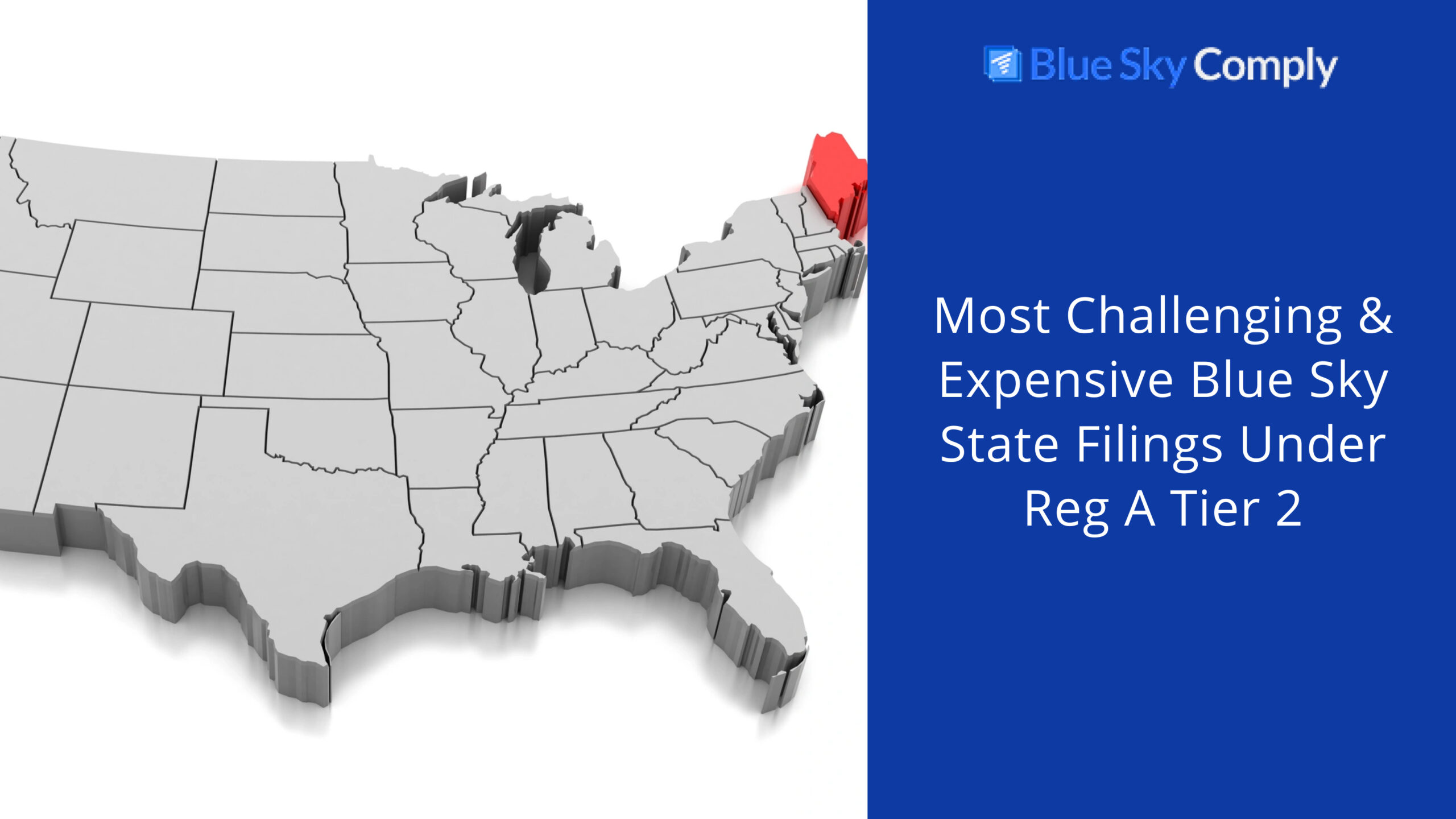


Let Us Simplify Compliance for You
Partner with Blue Sky Comply to unlock seamless compliance, efficient filings, and access to expertise that lets you focus on your growth.
Schedule A Free Demo