
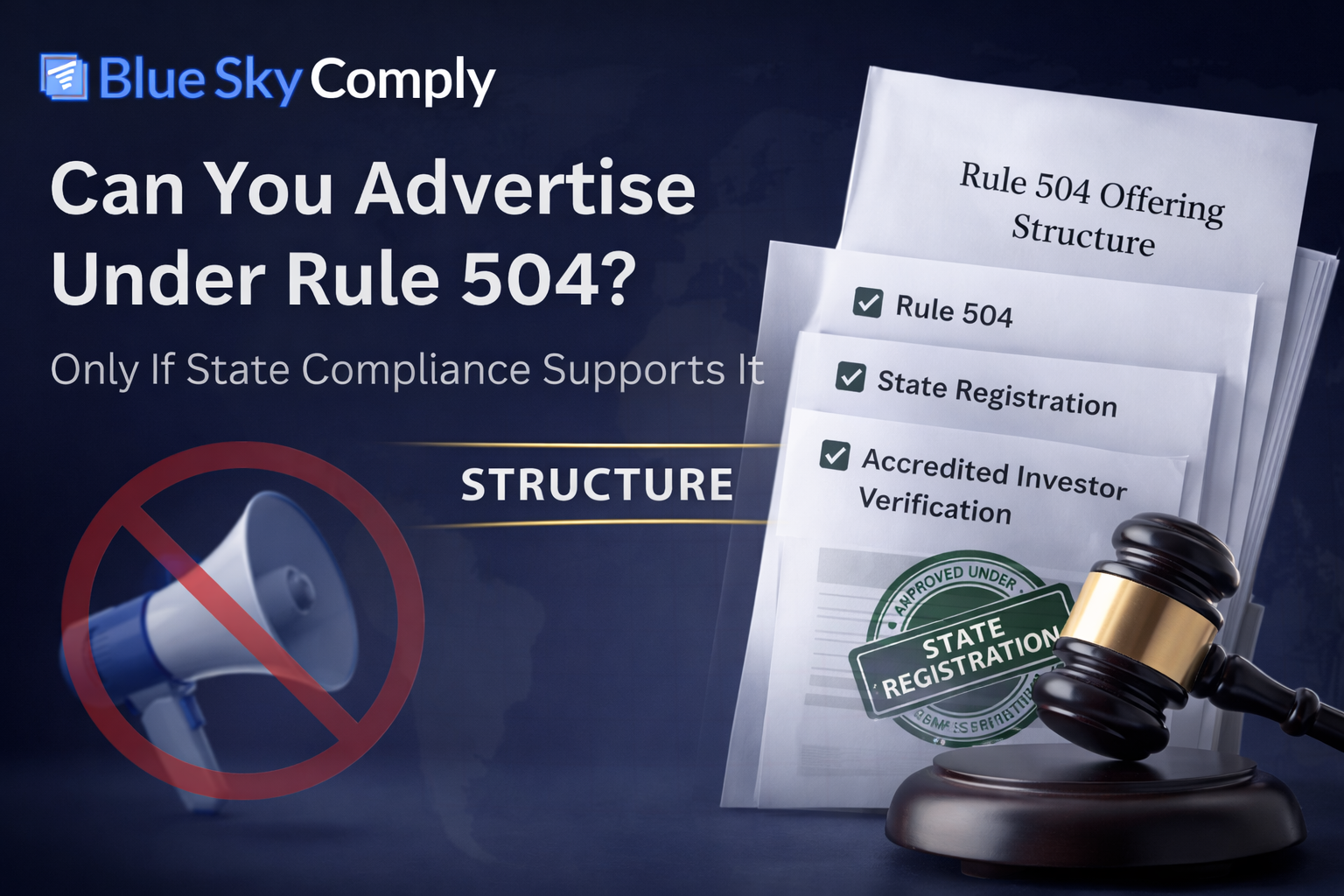
Yes, Rule 504 permits advertising, but only if the offering is structured to meet specific conditions tied directly to state securities regulations. In other words, Rule 504 is not a blanket permission to market a private raise publicly. Rule 504 is a limited federal exemption with a practical reality: your ability to advertise often depends on how you comply with state Blue Sky laws.
Many founders and issuers ask this question because marketing is how most modern fundraising happens. A LinkedIn post, a pitch page, a targeted ad, or a simple “we are raising” email can quickly become public-facing. Under many private offering exemptions, such outreach can create immediate compliance issues. Rule 504 is unusual because, in certain cases, it can accommodate broader marketing, but only if the rest of the compliance structure supports it.
Rule 504 is within Regulation D, which generally imposes restrictions on “general solicitation” and “general advertising.” Those restrictions are famously strict under Rule 506(b), less strict under Rule 506(c), and conditional under Rule 504. Understanding those differences is the key to answering the advertising question correctly.
What is Rule 504, and when do issuers use it?
Rule 504 is a Regulation D exemption that allows eligible issuers to offer and sell up to $10 million in a 12-month period without registering the offering with the SEC. This offering limit was increased from $5 million to $10 million through SEC amendments effective March 15, 2021.
Rule 504 is generally available only to certain non-reporting issuers and excludes certain categories of issuers, such as investment companies. A key point for issuers is that Rule 504 also requires intensive compliance with state securities laws in the states where offers and sales occur.
That last point is what makes Rule 504 highly relevant to advertising questions. Unlike Rule 506 offerings, Rule 504 generally does not come with the same broad federal preemption of state registration requirements. As a result, state-level compliance often becomes the gating factor for how the offering can be conducted, including whether and how it can be marketed.
What counts as “advertising” or “general solicitation” in Reg D?
In Regulation D, “general solicitation” and “general advertising” are not defined by a single modern checklist, but the rules do provide examples. Rule 502(c) covers communications such as newspaper and magazine advertisements, broadcast media, and public seminars at which attendees were invited through general advertising.
In today’s context, issuers usually think about general solicitation more practically: if you are communicating offering information to people you do not have a pre-existing, substantive relationship with, and you do it publicly or broadly, you are likely in solicitation territory.
Here are common activities that are typically treated as general solicitation in practice:
- Public social media posts announcing the raise or offering terms
- Online ads targeting broad audiences
- Mass email blasts to lists where recipients do not have a prior relationship with the issuer
- Public-facing offering pages that invite anyone to invest
The risk is not just that you “talked about fundraising.” The risk is that your communications change the nature of the offering from private to public, thereby undermining the exemption you intended to rely on.
When is advertising permitted in Rule 504 offerings?
Rule 504 does not automatically allow advertising. Instead, the rule limits the circumstances in which general solicitation is permitted. The SEC’s framework is designed to prevent Rule 504 from becoming a backdoor public offering while still allowing certain smaller raises to market more broadly when appropriate investor protections are in place at the state level.
In plain terms, advertising under Rule 504 is typically possible when the offering is either:
- Registered in at least one state with a substantive review process that includes public filing and delivery of a disclosure document to investors before sale (with delivery to all purchasers), or
- Conducted exclusively under state law exemptions that permit general solicitation and general advertising, but only if sales are made to accredited investors.
Those conditions are reflected in the text of Rule 504’s specific conditions.
To make this easier to apply, here is a practical summary of when issuers can advertise and what they typically need in place.
| Rule 504 approach | Can you advertise? | What you generally must do to support it |
| State registration pathway | Often yes | Register in at least one state with substantive disclosure requirements; make offers and sales in that state in compliance with the state process; deliver the required disclosure document to all purchasers before sale |
| State exemption pathway that permits solicitation | Sometimes yes | Rely exclusively on state exemptions that allow solicitation; limit sales to accredited investors (where required by the exemption structure) |
| No state structure that supports solicitation | Usually no | Avoid public advertising; shift to a more controlled outreach strategy or consider a different exemption that fits your marketing plan |
The big takeaway: with Rule 504, advertising is not a standalone choice. It is a consequence of the regulatory pathway you select.
Under Rule 504, marketing and state compliance strategies must be designed together.
How does Rule 504 advertising compare to Rule 506(b) and Rule 506(c)?
Founders often hear that “Reg D means no advertising,” which is only partly true. The rules depend on which exemption you rely on and how you handle investor eligibility.
At a high level:
- Rule 506(b): general solicitation is not permitted, and issuers generally rely on pre-existing relationships.
- Rule 506(c): general solicitation is permitted, but sales must be to accredited investors, and issuers must take reasonable steps to verify accredited status.
- Rule 504: general solicitation may be permitted only in the limited circumstances described above, often tied to state registration or state exemptions, and it generally does not provide the same state preemption dynamics as Rule 506.
If your fundraising plan depends on broad online promotion, Rule 506(c) is often the “cleaner” federal pathway from a marketing standpoint, while Rule 504 can work but requires careful alignment with state conditions. The right choice depends on the investor base you are targeting, the amount you intend to raise, and your willingness to accept state-by-state complexity.
What should issuers do before promoting a Rule 504 raise?
Before you publish a post, run ads, or direct traffic to an offering page, treat the offering as a structured compliance project rather than a marketing campaign. In Rule 504, the most common problems arise when communication moves faster than planning.
Here is a short, practical set of steps issuers typically consider before they promote:
- Confirm you are eligible for Rule 504 and remain within the $10 million 12-month cap
- Decide whether your plan involves true public marketing or controlled outreach
- Identify where your prospective investors are located, since state obligations follow investor residency
- Choose the pathway that supports advertising (state registration route or state exemption route that permits solicitation)
- Keep offering communications consistent, documented, and aligned with the exemption you are relying on
A simple rule of thumb: if you cannot explain your Rule 504 advertising basis in one sentence, you should not be marketing yet.
Final Words
Rule 504 can be a useful exemption for smaller capital raises and may permit advertising in limited circumstances. But the permission to advertise is not the default. It is conditional, and those conditions often connect directly to how the offering is being handled under state Blue Sky laws.
If you approach Rule 504 with the mindset that “advertising is allowed,” you risk building the wrong process. If you approach it with the mindset that “advertising must be earned by structure,” you are far more likely to stay within the exemption and avoid surprises later.
Blue Sky Comply helps companies coordinate the state Blue Sky requirements that often determine whether and how a Rule 504 offering can be advertised.