
Form D
Category: Form D
Filing Form D is a critical step for many companies raising capital under Regulation D of the Securities Act of 1933. While Regulation D private offerings allow businesses to raise money without registering their securities with the SEC, Form D acts as a required notice of the exempt offering and must be filed electronically through the SEC’s EDGAR system.
This article explains who is required to file Form D, when it must be filed, and what it includes.
What Is Form D?
Form D is a brief notice filed with the SEC to claim an exemption from full registration under Regulation D. It includes basic information about the issuer, the type and amount of securities offered, and the identity of certain individuals involved in the offering. Importantly, Form D is not an application for exemption approval—it is a notification that the issuer is relying on one of the exemptions under Regulation D.What Entities Are Required to File Form D?
The following parties are required to file Form D with the SEC:Companies Offering Securities Under Rule 504
- Can raise up to $10 million in a 12-month period.
- No federal preemption: issuers must also comply with state-level Blue Sky registration or exemption requirements.
- Form D is required to notify the SEC of the exempt offering.
Companies Offering Securities Under Rule 506(b)
- Can raise an unlimited amount of capital.
- Can sell to an unlimited number of accredited investors and up to 35 non-accredited (but sophisticated) investors.
- Offers are not publicly advertised.
- Federal preemption applies, but Form D is still required as a notification filing.
Companies Offering Securities Under Rule 506(c)
- Allows general solicitation and advertising of the offering.
- All investors must be accredited and verified.
- No limit on the amount of capital raised.
- Like 506(b), Form D is required and federal preemption applies, though state notice filings are still mandatory in most jurisdictions.
Any Domestic or Foreign Private Issuer Using a Reg D Exemption
- Whether a U.S. company or a foreign issuer, if they are offering securities under Reg D to U.S. investors, Form D must be filed with the SEC.
Investment Funds and Private Equity Firms
- Hedge funds, venture capital funds, and private equity firms frequently rely on Rule 506 exemptions and are required to file Form D when raising capital from investors.
Startups and Early-Stage Companies
- Most early-stage companies raising capital through friends, family, angel investors, or venture capital under Reg D are legally obligated to file Form D with the SEC to remain in compliance.
When Must Form D Be Filed?
Form D must be filed within 15 calendar days after the first sale of securities in the offering.- A “sale” occurs when an investor is legally obligated to invest, not necessarily when funds are received.
- If the 15th day falls on a weekend or federal holiday, the deadline is extended to the next business day.
What Happens If You Don’t File Form D?
- Loss of exemption: Issuers that fail to file Form D may lose their Reg D exemption and be forced to register the offering or return investor funds.
- State enforcement: Many states also require notice filings that depend on timely SEC Form D submission.
- Reputational risk: Noncompliance can harm investor confidence and damage relationships with future backers or partners.
- Future fundraising limitations: Issuers may be barred from relying on Regulation D for future offerings.
What’s Included in Form D?
- Basic company information (name, address, jurisdiction)
- Offering size and amount already sold
- Type of security being offered
- Minimum investment accepted
- Use of proceeds
- Details about executive officers, promoters, and related parties
- Exemption rule being relied upon (504, 506(b), or 506(c))
Best Practices
- Track offering dates and file Form D before the 15-day deadline
- Coordinate state Blue Sky notice filings alongside your federal Form D
- Work with a compliance professional to ensure accuracy and timely filing
- Amend Form D if material information changes (e.g., increase in offering size)
Conclusion
Any company raising capital under Regulation D Rules 504, 506(b), or 506(c) must file Form D with the SEC. Filing is mandatory, not optional—even if you're a private company, foreign issuer, or raising from accredited investors only. Need Help? Blue Sky Comply offers turnkey support for Form D preparation, SEC submission, and state-level Blue Sky filings to help you stay compliant and focused on raising capital.
Raising capital through Regulation D (Reg D) offerings can be a strategic and efficient way for private companies to secure funding without undergoing a full SEC registration. However, many issuers often wonder: Are Blue Sky filings required under Reg D? The answer is nuanced and depends on the type of exemption used under Reg D and the state in which the securities are offered. Below, we break down what Blue Sky laws are, how they apply to Reg D offerings, and why compliance is critical for issuers.
In short:
What Is a Blue Sky Filing?
Blue Sky laws refer to individual state securities laws designed to protect investors against fraud. These laws require that companies making securities offerings either register those securities or file for an exemption in each state where they are selling them. A Blue Sky filing is the documentation submitted to a state securities regulator to comply with that state’s laws. While Reg D offerings are exempt from federal registration under the Securities Act of 1933, they are not automatically exempt from state-level notice requirements. This is where Blue Sky filings come into play.Regulation D Overview: Rule 504, 506(b), and 506(c)
Reg D includes several exemptions, each with its own compliance obligations:- Rule 504: Allows companies to raise up to $10 million within a 12-month period. State registration or notice filings are required, and federal preemption does not apply.
- Rule 506(b): Allows raising an unlimited amount from accredited investors (and up to 35 non-accredited investors who meet sophistication requirements). Offers a federal preemption, but notice filings (Form D) are still required in each state where securities are sold.
- Rule 506(c): Also permits raising an unlimited amount but allows general solicitation, provided all investors are verified accredited investors. Like 506(b), federal preemption applies, but state notice filings are still mandatory.
Are Blue Sky Filings Required Under Reg D?
| Rule | Federal Preemption | State Registration Required? | State Notice Filing Required? | State Fees Required? |
| 504 | ❌ No | ✅ Yes (in most states) | ❌ No | ✅ Yes |
| 506(b) | ✅ Yes | ❌ No | ✅ Yes | ✅ Yes |
| 506(c) | ✅ Yes | ❌ No | ✅ Yes | ✅ Yes |
- Rule 504 does not enjoy federal preemption. You must register or file for exemption in each state.
- Rules 506(b) and 506(c) allow for federal preemption, but Form D must be filed federally and with each state where securities are sold, usually within 15 days of the first sale in that state.
When Are Blue Sky Filings Required Under Reg D?
Blue Sky filings are required to be filed within 15 days of the first sale within each state, typically. See our full list of state filing deadlines and fees.What is a Form D?
Form D is a brief notice that includes information about the offering, such as:- The names and addresses of the company’s executive officers and directors
- The type and amount of securities offered
- The identities of promoters and offering agents
- Exemption being relied on (506(b), 506(c), etc.)
- A notice filing and copy of the Form D
- Consent to service of process (U-2 form)
- Other filing requirements based on state (Form 99, etc.)
- Filing fee (varies by state)
What Happens If You Don’t File?
Failing to comply with Blue Sky laws can lead to:- State-level enforcement actions
- Civil penalties or fines
- Loss of exemption status, exposing the issuer to full SEC registration requirements
- Restrictions on future fundraising
- Reputational damage
Why Blue Sky Compliance Still Matters Under Reg D
Even with federal preemption under Rules 506(b) and 506(c), state-level notice filings remain a legal requirement. Issuers who assume that a federal exemption means they can skip state filings often end up in violation. Furthermore, many states require annual renewal filings, fee payments, or amendments if offering details change (e.g., the amount raised, change in company officers).How Blue Sky Comply Helps
Blue Sky Comply offers a full-service platform and support team to ensure that Reg D issuers:- File Form D with both the SEC and each required state on time
- Submit Blue sky notice filings, where necessary
- Calculate and pay state filing fees (some states charge up to $2,500)
- Track annual renewals and amendments to maintain good standing
- Manage state regulator inquiries and responses
Conclusion
While federal law may preempt full state registration under Rules 506(b) and 506(c), notice filings and state-specific forms are still mandatory. Noncompliance can result in serious financial and legal repercussions. Companies using Rule 504 have even more obligations, as they lack federal preemption entirely. For a smooth, compliant capital raise, consider working with experts like Blue Sky Comply, who offer tailored solutions for all Reg D filings across the country.
Issuers must comply with federal and state securities laws when raising capital through private or public securities offerings. While SEC regulations play a central role in governing these transactions, state-level Blue Sky Laws also impose additional requirements to protect investors from fraudulent practices.
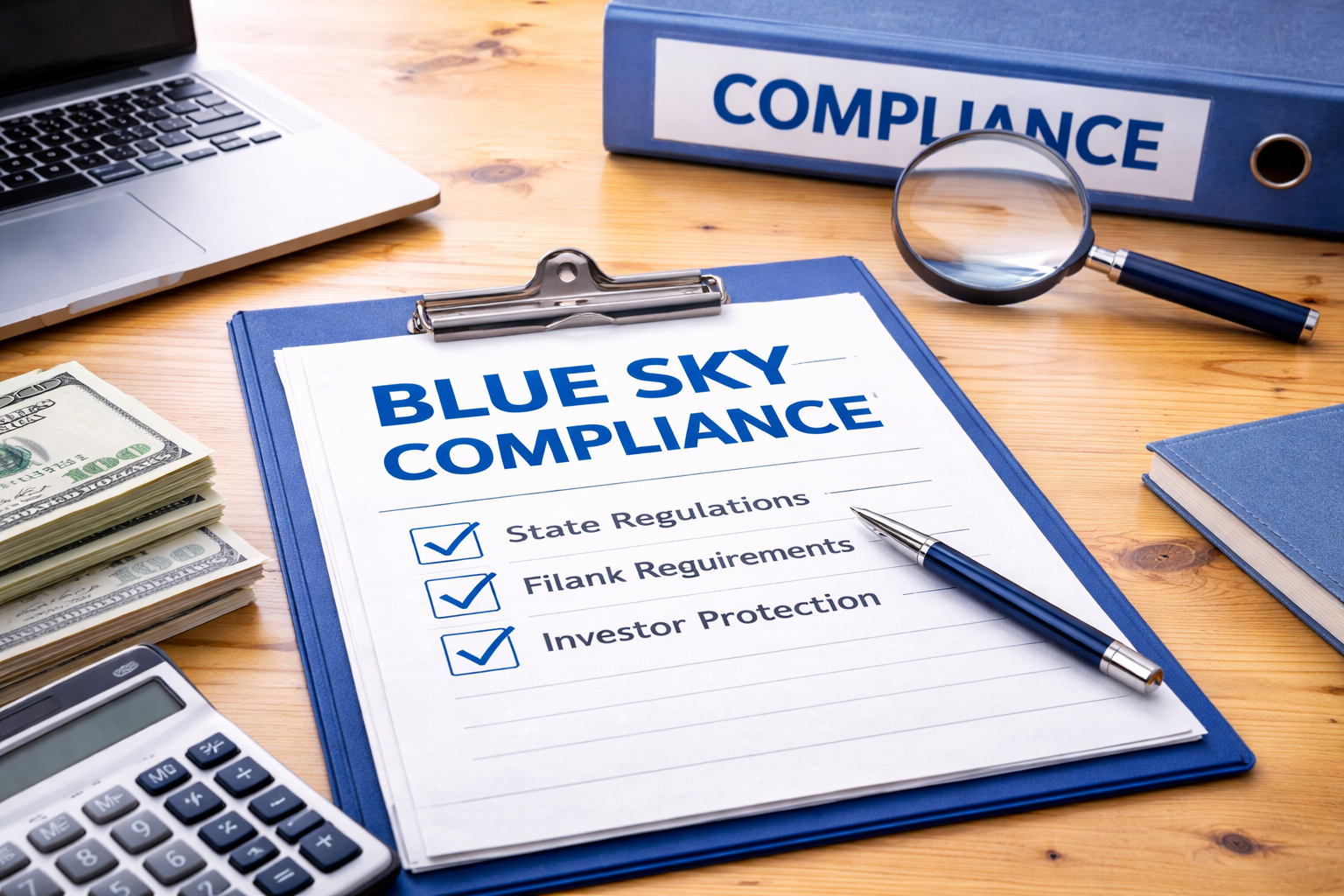
Blue Sky Compliance refers to the process of adhering to these state securities regulations, ensuring that issuers meet filing, disclosure, and registration requirements. Failure to comply with Blue Sky laws can result in penalties, restrictions on securities sales, and regulatory enforcement actions. In this guide, we explore the importance of Blue Sky Compliance, state-specific filing requirements, and best practices to ensure issuers remain fully compliant when conducting securities offerings.
Understanding Blue Sky Laws Blue Sky Laws are state-level securities regulations designed to protect investors from fraudulent or misleading investment schemes. These laws require companies selling securities within a particular state to register or file exemptions before offering securities to investors. Each state has its own set of Blue Sky Laws, which typically require:
- Registration of securities or exemption filings before securities can be sold in that state.
- Disclosure of offering details, including financial statements and investor protections.
- Filing fees and periodic renewals to maintain compliance.
- Issuer-dealer and broker-dealer registration if the company is selling securities directly.
Who Needs Blue Sky Compliance?
Any company conducting a securities offering—whether private placements under Regulation D public offerings under Regulation A or traditional IPOs—must ensure they comply with Blue Sky Laws in every state where their securities are sold.Blue Sky Offering Types
Here are some common types of offerings requiring Blue Sky Compliance:- Regulation D Offerings (Rule 506(b) and 506(c)) – Most states require notice filings for Form D submissions.
- Regulation A Offerings (Tier 1 and Tier 2) – Tier 1 issuers must comply with full state registration, while Tier 2 issuers must file notice filings in certain states.
- Initial Public Offerings (IPOs) – Full registration is required in every state where securities are offered.
- Secondary Trading – Some states require ongoing compliance for publicly traded securities.
Key Elements of Blue Sky Compliance
Ensuring Blue Sky Compliance involves several critical steps that vary by state. The primary areas of focus include state notice filings, registration for non-exempt offerings, and issuer-dealer and broker-dealer registration. For exempt offerings like Regulation D Rule 506(b) and 506(c), issuers must file a Form D notice filing with each state where securities are sold. This typically includes:- A copy of Form D as filed with the SEC.
- State-specific filing forms.
- A filing fee varies by state (ranging from $100 to $2,500 per filing).
- Filing deadlines, usually within 15 days of the first sale.
- A detailed disclosure of financials.
- Business plans and risk disclosures.
- Underwriter agreements.
- State regulator approval before sales begin.
- Tier 1 Offerings (Up to $20M) – State registration is required in every state where securities are sold.
- Tier 2 Offerings (Up to $75M) – State registration is preempted, but some states require notice filings and fees.
- State-level registration forms.
- Licensing of officers or agents engaging in sales.
- Compliance with record-keeping and reporting obligations.
Common Blue Sky Compliance Mistakes
- Failing to File State Notice Filings – Even if an offering is federally exempt, missing state-level filings can result in fines and sales restrictions.
- Missing Filing Deadlines – Most states require notice filings within 15 days of the first sale; missing these can lead to late fees.
- Ignoring Renewal Requirements – Some states require annual renewals for ongoing offerings.
- Not Registering as an Issuer-Dealer – Selling securities directly without proper registration in certain states can lead to enforcement actions.
- Review State-Specific Requirements – Each state has unique Blue Sky Laws. Research filing deadlines, fees, and exemptions.
- Track Filing Deadlines and Renewals – Use a compliance calendar to ensure timely filings.
- Work with Compliance Professionals – Blue Sky Compliance firms help issuers manage filings across multiple states.
- Maintain Proper Documentation – Keep records of all filings, investor communications, and regulatory correspondence.
- State-imposed fines range from $100 to $10,000 per violation.
- Restrictions on securities sales in non-compliant states.
- Legal actions from state regulators.
- Investor lawsuits for non-disclosure of required filings.
Regulation D (Reg D) is one of the most commonly used exemptions under the Securities Act of 1933, allowing companies to raise capital through private offerings without undergoing the burdensome registration process required for public offerings. However, while Reg D provides significant advantages, it also comes with specific compliance requirements that issuers must follow to avoid regulatory penalties and maintain investor confidence.
This guide explores the key compliance obligations associated with Reg D, including Form D filings, Blue Sky laws, investor verification, and ongoing reporting requirements. By understanding and adhering to these rules, issuers can successfully navigate the complexities of private placements and ensure legal compliance.
What is Regulation D?
Regulation D is an exemption from SEC registration requirements, designed to facilitate capital raising for startups, small businesses, and private companies. It enables companies to sell securities to accredited and, in some cases, non-accredited investors without the need for a full public offering. The two primary rules under Reg D include:- Rule 506(b) – Allows issuers to raise an unlimited amount of capital but restricts general solicitation. Offers can include up to 35 non-accredited investors, but they must receive disclosure documents similar to a registered offering.
- Rule 506(c) – Allows general solicitation and advertising but limits investors to accredited individuals only. Issuers must take reasonable steps to verify accredited status, such as reviewing tax returns or bank statements.
Form D Filing Requirements
One of the most critical compliance obligations for Reg D offerings is the Form D filing. Form D is a notice filed with the SEC that provides key information about the offering and must be submitted within 15 days after the first sale of securities. Key Information Required in Form D:- Issuer details (company name, location, industry classification)
- Offering type and exemption relied upon (Rule 504, 506(b), or 506(c))
- Total amount of securities offered and sold
- Number of investors participating in the offering
- Issuer executive details
- Late Filings – Missing the 15-day deadline can result in penalties and loss of the Reg D exemption.
- Inaccurate Information – Any misrepresentation in the filing can trigger SEC investigations.
- Failure to Amend—If the offering significantly changes (e.g., increased capital raised, changes in executive officers), issuers must file an amended Form D promptly.
Blue Sky Laws and State Filing Requirements
While Reg D is a federal exemption, issuers must also comply with state-level securities laws, commonly referred to as Blue Sky Laws. Each state has its regulations regarding notice filings, fees, and disclosure requirements. Key Blue Sky Compliance Obligations:- Notice Filings – Many states require a separate filing in addition to Form D.
- Filing Fees – States impose fees that vary based on the amount raised and the number of investors.
- Renewals – Some states require annual renewals for ongoing offerings.
- Issuer-Dealer Registration – Certain states require issuers to register as a dealer if selling directly to investors.
Investor Verification and Compliance
Under Rule 506(c) of Reg D, issuers must take reasonable steps to verify that all investors meet the accredited investor criteria. This requirement is intended to protect non-accredited investors from high-risk private placements. Accepted Methods of Investor Verification:- Tax Returns & W-2 Forms – Confirming annual income of at least $200,000 ($300,000 for joint income).
- Bank Statements & Brokerage Reports – Showing assets exceeding $1 million (excluding primary residence).
- Third-Party Verification – Letters from CPAs, attorneys, or investment advisors confirming accreditation status.
Ongoing Compliance and Recordkeeping
Even after an offering is completed, issuers must adhere to ongoing compliance requirements to maintain Reg D eligibility and investor trust. Best Practices for Ongoing Compliance:- Maintain Records of Investor Accreditation – Store verification documents for at least five years.
- Monitor Blue Sky Renewals – Track state-level filing deadlines and renewal requirements.
- Keep Investors Informed – Provide updates on the offering and financial performance to ensure transparency.
- Prepare for Audits – Maintain accurate records in case of SEC or state regulatory audits.
Conclusion: Ensuring Full Compliance with Blue Sky Compliance
Successfully conducting a Regulation D offering requires meticulous adherence to federal and state-level regulations. From filing Form D on time to ensuring Blue Sky compliance and investor verification, issuers must take proactive steps to remain compliant. At Blue Sky Compliance, we specialize in helping issuers navigate the complexities of Reg D filings, Blue Sky laws, and ongoing reporting obligations. By working with compliance experts, issuers can avoid costly mistakes, reduce regulatory risks, and ensure a smooth capital-raising process. If you're preparing for a Reg D offering, contact Blue Sky Compliance today to ensure full regulatory compliance and seamless execution.
The Securities and Exchange Commission (SEC) continues to escalate enforcement actions against companies that fail to comply with federal securities laws, particularly regarding required filings. In recent months, the SEC has taken action against multiple firms for failing to meet deadlines for essential filings, including Form D for Regulation D offerings and Blue Sky notice filings required by various states. These enforcement actions highlight the growing emphasis on regulatory compliance and the consequences for issuers who fail to follow the rules.
For companies raising capital through exempt offerings under Regulation A or Regulation D, compliance filings are not optional—they are a legal requirement. The SEC's recent enforcement initiatives serve as a stark reminder that even seemingly minor compliance oversights can lead to significant penalties. According to SEC records, non-compliance with required filings has resulted in millions of dollars in cumulative fines, impacting both small and large issuers alike.
SEC Enforcement Actions: A Renewed Focus on Compliance
Recently, the SEC has charged multiple firms for failing to submit timely Form D filings, an essential requirement for issuers conducting private offerings under Regulation D. Form D is a short disclosure form that provides the SEC with basic information about an offering, including the amount raised and the types of investors participating. While Regulation D offerings provide an exemption from full SEC registration, issuers must still submit Form D within 15 days of the first sale of securities. Additionally, many states require Blue Sky filings, which notify state securities regulators of the offering and ensure compliance with local laws. Failure to meet these deadlines can result in the following penalties:- SEC enforcement actions and financial penalties
- State-level fines and the inability to offer securities in certain jurisdictions
- Reputational damage, which can impact investor confidence
- Re-Envision Wealth: In December 2024, the Securities and Exchange Commission (SEC) charged Re-Envision Wealth for failing to file a Form D in connection with an exempt offering under Regulation D. The company agreed to a settlement that included a civil penalty of $60,000.
- Pipe Technologies: In the same enforcement action, Pipe Technologies was charged for not complying with the Form D filing requirements. They settled with the SEC, agreeing to pay a civil penalty of $195,000.
- Underdog Sports Holdings: In December 2024, Underdog Sports Holdings was also charged with failing to file Form D as required under Regulation D. The company reached a settlement with the SEC, which included a financial penalty of $175,000.
The Impact of Non-Compliance on Issuers
Companies that fail to file Form D or required state notices put their fundraising efforts at risk. A missed filing deadline can trigger regulatory scrutiny, leading to legal action, fines, and even restrictions on future offerings. For companies relying on private placements to secure capital, these consequences can be devastating. Here’s what can happen when issuers fail to comply:1. Hefty Fines & Regulatory Actions
- The SEC has the authority to impose significant fines on companies that fail to meet filing requirements.
- State securities regulators may deny exemptions for issuers who do not submit required Blue Sky filings.
- Failure to comply with Form D requirements can lead to cease-and-desist orders, preventing companies from conducting further offerings.
2. Loss of Investor Confidence
- Investors expect issuers to follow legal and regulatory guidelines.
- A lack of compliance may signal financial instability, poor management, and potentially deceitful business practices, which can discourage future investment and trust.
- Institutional investors and venture capital firms often conduct due diligence, and compliance failures can be a red flag.
- Companies with consistent regulatory infractions may face long-term reputational damage, leading to decreased funding opportunities.
3. Operational Delays & Legal Costs
- Non-compliance can lead to prolonged investigations by regulators.
- The costs of defending against SEC or state enforcement actions can be substantial, often exceeding $50,000 per case.
- Companies may be required to resubmit filings, pay additional fees, or rectify compliance failures, causing unnecessary delays in capital-raising efforts.
- In extreme cases, issuers may be prohibited from raising capital under exemptions until all compliance issues are resolved.
The SEC’s Message: Compliance is Not Optional
The SEC’s latest enforcement actions reinforce the importance of timely and accurate compliance filings. Regulatory agencies are sending a clear message: issuers who fail to meet legal obligations will face consequences. Compliance should be a top priority for businesses seeking to raise capital through private placements or exempt offerings. Companies can protect their fundraising efforts by proactively managing Form D filings, Blue Sky notices, and issuer-dealer registrations and maintaining investor confidence. At Blue Sky Comply, we take the burden of compliance off your shoulders so you can focus on growing your business. Our comprehensive filing services, regulatory monitoring, and expert compliance support ensure your company meets all SEC and state-level requirements.Stay Ahead of SEC Enforcement with Blue Sky Comply
As the SEC intensifies its enforcement actions, issuers cannot afford to overlook compliance obligations. Partner with Blue Sky Comply to avoid fines, protect your reputation, and ensure seamless capital raising. Don’t wait until it’s too late. Contact Blue Sky Comply today to ensure full compliance with Form D, Blue Sky Laws, and all regulatory requirements.


Let Us Simplify Compliance for You
Partner with Blue Sky Comply to unlock seamless compliance, efficient filings, and access to expertise that lets you focus on your growth.
Schedule A Free Demo