
Raising capital under Regulation D or another federal exemption often feels straightforward once the SEC filing is complete. But many issuers learn the hard way that state compliance is where small procedural errors turn into formal notices from regulators. A Blue Sky deficiency letter can interrupt your offering, create unnecessary legal expense, and raise avoidable questions about your compliance controls.
Most deficiency letters are not issued due to fraud. They are triggered by preventable mistakes. Understanding the patterns behind these errors is the first step toward avoiding them.
The difference between smooth compliance and regulatory correspondence is often just a few days.
What Is a Blue Sky Deficiency Letter?
A Blue Sky deficiency letter is a formal communication from a state securities regulator identifying a problem with your notice filing, timing, documentation, or compliance posture. It is typically issued when a regulator believes your filing is incomplete, late, inaccurate, or inconsistent with state requirements. In many cases, the regulator will request corrective action within a defined timeframe. In more serious cases, the deficiency may escalate into late fees, administrative penalties, or even a temporary suspension of offering activity in that state. A deficiency letter is a warning sign. It is not yet enforcement, but it signals regulatory attention. Responding quickly and accurately matters, which Blue Sky Comply can help with. But preventing the letter altogether is far better.Mistake #1: Assuming Federal Exemption Eliminates State Obligations
One of the most common triggers of deficiency letters is the assumption that a federal exemption solves everything. Issuers often rely on Rule 506 under Regulation D and believe that because the offering is federally exempt from registration, no additional state action is required. While Rule 506 offerings are considered covered securities and are preempted from state registration, they are not exempt from state notice filing requirements. States still require:- A copy of Form D
- Payment of the required state filing fee
- Consent to service of process
Mistake #2: Missing the 15 Day Filing Deadline
Timing is one of the most frequent causes of deficiencies. Most states require that a Blue Sky notice filing be made either before the first sale in the state or within 15 calendar days after the first sale. The problem arises when companies accept investor funds and only later confirm which states require filing. Once the 15-day window has passed, the filing is considered late even if it is eventually submitted. Late filings can trigger:- Monetary late fees
- Administrative penalties
- Unregistered sale designation and penalty
- Formal deficiency notices
| Scenario | Filing Timing | Regulatory Outcome |
| Notice filed before first sale | Pre-filing compliance | No deficiency |
| Notice filed within 15 days | Timely compliance | No deficiency |
| Notice filed after 15 days | Late filing | Deficiency letter likely and possibly late fees |
| No filing submitted | Ongoing violation | Enforcement risk |
Mistake #3: Accepting Investors From States Where No Filing Exists
Blue Sky obligations are triggered by the investor's residency, not the issuer's location. An issuer may be headquartered in Texas, but if an investor resides in California, New York, or Illinois, a filing is required in that investor’s state. Online capital raises make this even more complex because investors can participate from anywhere. A common error occurs when:- An investor commits funds from a state where no notice has been filed
- The company processes the investment before completing the state filing
- The filing is rushed after the fact
Mistake #4: Incomplete or Incorrect State Filings
Not all deficiencies are about timing. Many involve documentation errors. State filings often require more than simply uploading Form D. Common administrative mistakes include:- Incorrect fee amount
- Missing correct state-specific forms
- Incorrectly completed filings and forms
- Filing in the wrong system
- Omitting other requirements
Mistake #5: Improper General Solicitation in Rule 506(b) Offerings
Marketing conduct can also trigger Blue Sky scrutiny. Rule 506(b) prohibits general solicitation and advertising. While this is a federal rule, states also enforce anti-fraud and solicitation restrictions under their Blue Sky statutes. Examples that create problems include:- Public social media posts promoting the offering
- Open demo day presentations
- Broad email campaigns without pre-existing relationships
Mistake #6: Failing to File Amendments or Annual Renewals
Compliance does not end after the initial filing. Certain states require annual renewal filings if the offering remains open for more than 12 months. Others require amendments if there are material changes to the offering. Detailed guidance on what constitutes a material change and when updates are required can be found in our Form D Amendment Triggers Explained guide. Issuers sometimes forget that these events automatically trigger updated filings at both the SEC and state level. A regulator who notices outdated information may issue a deficiency letter requesting correction. Ongoing compliance requires structured calendar management, not just initial submission.The True Cost of a Deficiency Letter
While a deficiency letter may seem procedural, the consequences can extend beyond administrative correction. Potential impacts include:- Late fees that range from hundreds to thousands of dollars
- Legal fees for response and remediation
- Enforcement action, including prior offering rescission in the state, a temporary ban from doing offerings in the state, and civil legal judgments
- Reputational concerns with future regulators
How to Prevent Blue Sky Filing Deficiencies
Preventing deficiency letters requires a structured approach. While each offering differs, effective compliance programs typically include the following elements:- Conducting a state-by-state analysis before launch
- Identifying potential investor states during marketing planning
- Filing proactively where marketing is expected
- Implementing investor residency screening during onboarding
- Maintaining a centralized compliance calendar
- Monitoring amendment triggers
Building a Sustainable Blue Sky Compliance Framework
Blue Sky compliance becomes more complex as offerings expand across multiple states. What begins as a single Form D filing quickly turns into multiple state filings. A sustainable compliance framework includes:- Clear assignment of responsibility within the organization
- Standardized documentation processes
- Regular internal compliance reviews
- Coordination between legal, finance, and investor relations teams
Precision Prevents Problems
State regulators are not looking for perfection, but they do expect precision. Most Blue Sky deficiency letters stem from inadequate legal support. Blue Sky Comply’s team of experts works with state regulators on a regular-basis and knows each of them well, which helps prevent such compliance issues discussed in this article. By tracking investor sales carefully and maintaining proper compliance, issuers can avoid unnecessary regulatory scrutiny.
When companies raise capital in the United States, they must navigate two overlapping but distinct regulatory systems: federal securities law and state securities law, commonly known as Blue Sky laws. While these systems are designed to work together, they operate at different levels of government and impose different types of obligations.
Understanding how Blue Sky laws differ from federal securities law is essential for issuers, fund managers, and compliance professionals. Federal exemptions do not automatically eliminate state responsibilities, and state authority does not override federal law. The relationship is layered, not either-or.
This comparison highlights an important principle. Federal law may determine whether a registration statement is required, but state law may still impose additional compliance obligations.
What Is the Difference Between Blue Sky Laws and Federal Securities Law?
At the highest level, the difference is structural. Federal securities laws are enacted by Congress and enforced by the Securities and Exchange Commission. They apply nationwide and govern how securities are offered, sold, and traded. Blue Sky laws are state-level securities laws enforced by individual state regulators. Each state has its own statutes and administrative rules that regulate securities offerings within its borders. Federal law can preempt certain state requirements, particularly registration requirements for covered securities. However, states retain authority to require notice filings and enforce anti-fraud provisions. As a result, issuers often must comply with both systems simultaneously.What Are Federal Securities Laws?
Federal securities laws form the foundation of U.S. capital markets regulation. The two most significant statutes are the Securities Act of 1933 and the Securities Exchange Act of 1934. The Securities Act of 1933 governs the offer and sale of securities. It generally requires that securities be registered with the SEC unless an exemption applies. Registration typically involves filing detailed disclosure documents such as Form S-1 or Form 1-A. The Securities Exchange Act of 1934 regulates secondary trading markets, ongoing reporting requirements, and broker-dealers. It established the SEC and provided the framework for enforcement and disclosure obligations. Federal law also provides exemptions from registration, including:- Regulation D for private placements
- Regulation A for limited public offerings
- Regulation CF for smaller online offerings
- Section 4(a)(2) for transactions not involving a public offering
- Rule 701 for employee compensation and equity incentive plans
- Rule 144A for resales of securities to qualified institutional buyers (QIBs)
- Intrastate offering exemptions (Rule 147 and Rule 147A) for offerings limited to a single state
- Regulation S for offerings conducted outside the United States
What Are Blue Sky Laws?
Blue Sky laws are the securities statutes enacted and enforced by individual states. Although many states base their laws on versions of the Uniform Securities Act, each state has its own regulatory agency and administrative rules. Blue Sky laws typically regulate:- Registration or qualification of securities offerings
- Licensing of brokers and investment advisers
- Anti-fraud provisions related to securities transactions
Registration Requirements: Federal vs State
The most significant distinction between federal and state securities law lies in registration requirements. At the federal level, securities must be registered with the SEC unless an exemption applies. Registration involves detailed disclosures about the issuer’s business, financial condition, risk factors, and management. The SEC reviews the filing for compliance with disclosure standards. At the state level, registration requirements historically required issuers to qualify their offerings in each state where securities were sold. However, federal legislation has significantly altered this landscape. To clarify the structural differences, the table below compares federal and state securities law in key areas:| Requirements | Federal Securities Laws |
Blue Sky State Laws |
| Primary Regulator | Securities and Exchange Commission | State securities regulators |
| Geographic Scope | Nationwide | Individual states |
| Registration Requirement | Required unless exempt | Required unless preempted or exempt |
| Review Standard | Disclosure-based | May include merit review in some contexts |
| Anti-Fraud Authority | Yes | Yes |
| Notice Filings | Not applicable | Often required for covered securities |
Federal Preemption and Covered Securities
The relationship between federal and state securities law changed significantly in 1996 with the passage of the National Securities Markets Improvement Act. This legislation created the concept of “covered securities.” Covered securities are exempt from state registration requirements. They include securities sold under Rule 506 of Regulation D and securities listed on national exchanges. This means that if an issuer conducts a Rule 506 offering, states cannot require full registration or merit review of that offering. However, preemption does not eliminate all state authority. States may still:- Require state notice filings with state-specific filing requirements that vary
- Collect filing fees based on the offering amount, and other factors found in the offering
- Enforce anti-fraud provisions
Notice Filings Versus State Registration
One of the most common sources of confusion is the difference between state registration and a Blue Sky notice filing. State registration is a substantive process. It may involve reviewing offering documents, financial disclosures, and, in some cases, evaluating whether the offering is fair to investors. A notice filing, by contrast, is less burdensome but typically requires submitting a copy of Form D and other state-specific forms and documents, paying a state-defined blue-sky fee, and providing consent to service of process. The state does not conduct a merit review but is formally notified of the offering. Notice filings are most commonly required for Rule 506 offerings under Regulation D. Issuers must file in each state where investors reside, usually within a specified time after the first sale.Enforcement Authority: SEC vs State Regulators
Federal and state regulators both have enforcement authority, and in some cases, their jurisdictions overlap. The SEC may bring civil enforcement actions for violations of federal securities laws, including misstatements, omissions, and fraudulent conduct. Remedies may include injunctions, penalties, and disgorgement. State regulators may also bring enforcement actions under their own Blue Sky laws. Even when an offering is federally exempt and preempted from state registration, states retain the power to investigate and prosecute fraud within their jurisdiction. In practice, federal and state enforcement actions can occur independently or in parallel. Compliance strategies must account for both levels of oversight.When Must Issuers Comply With Both Systems?
In most capital raises, issuers must comply with both federal and state securities laws simultaneously. For example, a company conducting a Rule 506 offering must:- Comply with Regulation D at the federal level
- File Form D with the SEC
- Submit Blue Sky notice filings in each state where investors reside
Common Misunderstandings About Federal and State Law
Several misconceptions arise not from filing mechanics, but from confusion about how regulatory authority is divided between federal and state governments. “Federal law is superior, so it replaces state law.” Federal securities law can preempt specific state requirements, particularly those related to the registration of covered securities. However, preemption is limited and defined by statute. States retain independent authority to enforce anti-fraud provisions and, in many cases, require notice filings and fees. Federal law does not eliminate state securities law. “State regulators simply enforce federal rules.” State securities divisions operate under their own statutes and administrative frameworks. While many state laws are modeled on versions of the Uniform Securities Act, they are not merely extensions of the SEC. States can initiate investigations, issue stop orders, and pursue enforcement actions independently of federal authorities. “If an offering is small, state law does not apply.” The size of the offering does not determine whether state securities law applies. State jurisdiction is generally triggered by the offer or sale of securities to residents within the state, regardless of offering size. “Blue Sky laws are outdated and rarely enforced.” Although federal regulation has expanded over time, state regulators remain active participants in securities oversight. States regularly bring enforcement actions, coordinate with the SEC, and monitor notice filings to ensure compliance. Understanding these structural distinctions helps issuers recognize that federal and state law operate concurrently rather than in a hierarchical manner. Compliance requires satisfying both systems where applicable.Why the Difference Matters
Understanding how Blue Sky laws differ from federal securities law is not merely academic. It directly impacts how offerings are structured, filed, and managed. Issuers who focus solely on federal exemptions risk overlooking state-level notice requirements. Conversely, misunderstanding federal preemption may lead to unnecessary state registration efforts. A coordinated compliance approach recognizes that:- Federal law establishes nationwide disclosure and exemption frameworks
- State law supplements federal oversight through notice filings and enforcement
- Both systems must be satisfied to lawfully offer securities
Raising capital in the United States often involves navigating both federal and state securities laws. Many issuers focus on federal exemptions such as Regulation D or Regulation A, only to discover that state-level requirements still apply. One of the most common of these state obligations is the Blue Sky notice filing.
Although it is generally more streamlined than full state registration, a Blue Sky notice filing is not optional. It plays a critical role in ensuring compliance with state securities regulators and protecting investors from fraud. Understanding what it is, when it is required, and how it works is essential for any issuer conducting a securities offering.
What Is a Blue Sky Notice Filing?
A Blue Sky notice filing is a state-level securities filing required when an issuer relies on certain federal exemptions from registration. While federal law may preempt full state registration, states often retain the authority to require a notice filing, payment of a filing fee, and submission of specified documents. In practical terms, a Blue Sky notice filing typically involves submitting a copy of Form D, paying a state fee, and providing additional state-specific information and documents. The filing signifies to state regulators that securities are being offered to residents of their state under a federally exempt offering. Even when an offering is exempt from federal registration, it may still require state notice filings.What Are Blue Sky Laws?
Blue Sky laws are state securities laws designed to protect investors against fraudulent sales practices and deceptive offerings. Every state has its own securities statutes, regulatory agency, and enforcement authority. The term “blue sky” dates back to early 20th-century efforts to curb speculative schemes that had little substance behind them. These laws aim to prevent the sale of securities backed by nothing more than “blue sky.” Although the Securities Act of 1933 and subsequent federal legislation established national standards, state laws were never eliminated. Instead, they operate alongside federal regulations. In many cases, federal law preempts state registration requirements, but states retain anti-fraud authority and the ability to require notice filings. Blue Sky laws generally regulate:- The registration of securities offerings
- The licensing of brokers and investment advisers
- Anti-fraud provisions related to securities sales
Why Is a Blue Sky Notice Filing Required?
To understand why notice filings exist, it helps to distinguish between state registration and federal preemption. In 1996, Congress enacted the National Securities Markets Improvement Act, which created the concept of “covered securities.” Covered securities, including those sold under Rule 506 of Regulation D, are exempt from substantive state registration requirements. This means states cannot require a full merit review or registration process for these offerings. However, federal preemption does not eliminate all state authority. States may still:- Enforce anti-fraud provisions
- Require notice filings
- Collect filing fees
When Is a Blue Sky Notice Filing Required?
Blue Sky notice filing requirements depend on the type of offering and where investors are located.Regulation D Offerings
Most private offerings are conducted under Rule 506(b) or Rule 506(c) of Regulation D. These offerings qualify as covered securities and are exempt from state registration. However, issuers must still make notice filings in each state where a purchaser resides. In many states, the notice filing must be made within 15 days after the first sale of securities in that state. Some states require filings before the first sale. Timing varies by jurisdiction.Regulation A Offerings
Regulation A offerings are divided into two tiers. Tier 1 offerings generally require compliance with state registration requirements, which means issuers may need to qualify their offerings at the state level. Tier 2 offerings benefit from federal preemption of state registration. However, almost all states still require notice filings or fees.Regulation Crowdfunding
Regulation Crowdfunding offerings are also generally preempted from state registration. Nevertheless, the state anti-fraud authority remains intact, and notice and state filing fee obligations may apply in limited circumstances. The key factor is investor location. If you sell securities to residents of multiple states, you may trigger notice filing requirements in each of those states.What Information Is Included in a Blue Sky Notice Filing?
Although requirements vary, most Blue Sky notice filings are relatively straightforward. A typical notice filing may include:- A copy of Form D filed with the SEC
- A consent to service of process
- State-specific filing forms
- Payment of the required filing fee
The Regulatory Function and Consequences of Blue Sky Non-Compliance
While the National Securities Markets Improvement Act of 1996 (NSMIA) preempts states from reviewing the merits of Rule 506 Regulation D offerings, it explicitly preserves state authority to require notice filings and collect fees. These filings are not administrative suggestions; they are the mechanism by which an issuer perfects its federal preemption at the state level. Failure to timely file a Blue Sky notice jeopardizes the issuer’s exemption and exposes the company to three distinct categories of risk:Statutory Rescission Rights (Civil Liability)
The most significant material risk of a missed filing is the possibility of specific performance in the form of rescission. If a filing is missed, the sale may be legally categorized as an unregistered securities transaction. This grants investors a statutory "put option"—the right to demand the return of their principal investment plus statutory interest and attorney fees. This potential liability remains on the balance sheet regardless of the company’s financial health.State Enforcement and Administrative Penalties
State securities divisions retain jurisdiction to enforce compliance. Regulators typically respond to failures to file with a graduated scale of enforcement actions, including:- Monetary Penalties: Assessment of retroactive late fees and civil fines.
- Stop Orders: Summary suspension of the offering within that jurisdiction.
- Consent Orders: Public settlement agreements that may label the issuer or its officers as "bad actors," effectively disqualifying them from utilizing Rule 506 safe harbors in future capital raises.
Impediments to Future Financing and Exits
Non-compliance creates a strict liability defect in the company’s capitalization. Institutional investors and acquirers routinely conduct diligence on Blue Sky compliance manifests. A pattern of missed filings serves as a diligence "red flag," often compelling the issuer to undertake costly "clean-up" filings and typically delaying the closing of subsequent financing rounds or exits. For an analysis of the correlation between filing deficiencies and federal regulatory scrutiny, including specific instances where Form D errors have triggered SEC enforcement actions, please refer to Compliance Failures: Form D and Blue Sky Filings.Common Misunderstandings About Blue Sky Notice Filings
There are several persistent misconceptions surrounding Blue Sky notice requirements. Clarifying these misunderstandings can prevent avoidable compliance and regulatory issues.- “Filing Form D with the SEC satisfies all requirements.” Filing Form D is only the federal component of the compliance process. State Blue Sky notice filings are separate obligations and must be made individually in each state where investors reside.
- “Federal preemption eliminates all state involvement.” While federal law may preempt state registration requirements for covered securities, states retain authority to enforce anti-fraud laws and to require notice filings and the submission of state fees.
- “Only the issuer’s home state matters.” Blue Sky notice obligations are triggered by investors' residency, not the issuer's location. If securities are sold to investors in multiple states, filings may be required in each jurisdiction.
Yes, Rule 504 permits advertising, but only if the offering is structured to meet specific conditions tied directly to state securities regulations. In other words, Rule 504 is not a blanket permission to market a private raise publicly. Rule 504 is a limited federal exemption with a practical reality: your ability to advertise often depends on how you comply with state Blue Sky laws.
Many founders and issuers ask this question because marketing is how most modern fundraising happens. A LinkedIn post, a pitch page, a targeted ad, or a simple “we are raising” email can quickly become public-facing. Under many private offering exemptions, such outreach can create immediate compliance issues. Rule 504 is unusual because, in certain cases, it can accommodate broader marketing, but only if the rest of the compliance structure supports it.
Rule 504 is within Regulation D, which generally imposes restrictions on “general solicitation” and “general advertising.” Those restrictions are famously strict under Rule 506(b), less strict under Rule 506(c), and conditional under Rule 504. Understanding those differences is the key to answering the advertising question correctly.
The big takeaway: with Rule 504, advertising is not a standalone choice. It is a consequence of the regulatory pathway you select.
Under Rule 504, marketing and state compliance strategies must be designed together.
What is Rule 504, and when do issuers use it?
Rule 504 is a Regulation D exemption that allows eligible issuers to offer and sell up to $10 million in a 12-month period without registering the offering with the SEC. This offering limit was increased from $5 million to $10 million through SEC amendments effective March 15, 2021. Rule 504 is generally available only to certain non-reporting issuers and excludes certain categories of issuers, such as investment companies. A key point for issuers is that Rule 504 also requires intensive compliance with state securities laws in the states where offers and sales occur. That last point is what makes Rule 504 highly relevant to advertising questions. Unlike Rule 506 offerings, Rule 504 generally does not come with the same broad federal preemption of state registration requirements. As a result, state-level compliance often becomes the gating factor for how the offering can be conducted, including whether and how it can be marketed.What counts as “advertising” or “general solicitation” in Reg D?
In Regulation D, “general solicitation” and “general advertising” are not defined by a single modern checklist, but the rules do provide examples. Rule 502(c) covers communications such as newspaper and magazine advertisements, broadcast media, and public seminars at which attendees were invited through general advertising. In today’s context, issuers usually think about general solicitation more practically: if you are communicating offering information to people you do not have a pre-existing, substantive relationship with, and you do it publicly or broadly, you are likely in solicitation territory. Here are common activities that are typically treated as general solicitation in practice:- Public social media posts announcing the raise or offering terms
- Online ads targeting broad audiences
- Mass email blasts to lists where recipients do not have a prior relationship with the issuer
- Public-facing offering pages that invite anyone to invest
When is advertising permitted in Rule 504 offerings?
Rule 504 does not automatically allow advertising. Instead, the rule limits the circumstances in which general solicitation is permitted. The SEC’s framework is designed to prevent Rule 504 from becoming a backdoor public offering while still allowing certain smaller raises to market more broadly when appropriate investor protections are in place at the state level. In plain terms, advertising under Rule 504 is typically possible when the offering is either:- Registered in at least one state with a substantive review process that includes public filing and delivery of a disclosure document to investors before sale (with delivery to all purchasers), or
- Conducted exclusively under state law exemptions that permit general solicitation and general advertising, but only if sales are made to accredited investors.
| Rule 504 approach | Can you advertise? | What you generally must do to support it |
| State registration pathway | Often yes | Register in at least one state with substantive disclosure requirements; make offers and sales in that state in compliance with the state process; deliver the required disclosure document to all purchasers before sale |
| State exemption pathway that permits solicitation | Sometimes yes | Rely exclusively on state exemptions that allow solicitation; limit sales to accredited investors (where required by the exemption structure) |
| No state structure that supports solicitation | Usually no | Avoid public advertising; shift to a more controlled outreach strategy or consider a different exemption that fits your marketing plan |
How does Rule 504 advertising compare to Rule 506(b) and Rule 506(c)?
Founders often hear that “Reg D means no advertising,” which is only partly true. The rules depend on which exemption you rely on and how you handle investor eligibility. At a high level:- Rule 506(b): general solicitation is not permitted, and issuers generally rely on pre-existing relationships.
- Rule 506(c): general solicitation is permitted, but sales must be to accredited investors, and issuers must take reasonable steps to verify accredited status.
- Rule 504: general solicitation may be permitted only in the limited circumstances described above, often tied to state registration or state exemptions, and it generally does not provide the same state preemption dynamics as Rule 506.
What should issuers do before promoting a Rule 504 raise?
Before you publish a post, run ads, or direct traffic to an offering page, treat the offering as a structured compliance project rather than a marketing campaign. In Rule 504, the most common problems arise when communication moves faster than planning. Here is a short, practical set of steps issuers typically consider before they promote:- Confirm you are eligible for Rule 504 and remain within the $10 million 12-month cap
- Decide whether your plan involves true public marketing or controlled outreach
- Identify where your prospective investors are located, since state obligations follow investor residency
- Choose the pathway that supports advertising (state registration route or state exemption route that permits solicitation)
- Keep offering communications consistent, documented, and aligned with the exemption you are relying on
Final Words
Rule 504 can be a useful exemption for smaller capital raises and may permit advertising in limited circumstances. But the permission to advertise is not the default. It is conditional, and those conditions often connect directly to how the offering is being handled under state Blue Sky laws. If you approach Rule 504 with the mindset that “advertising is allowed,” you risk building the wrong process. If you approach it with the mindset that “advertising must be earned by structure,” you are far more likely to stay within the exemption and avoid surprises later. Blue Sky Comply helps companies coordinate the state Blue Sky requirements that often determine whether and how a Rule 504 offering can be advertised.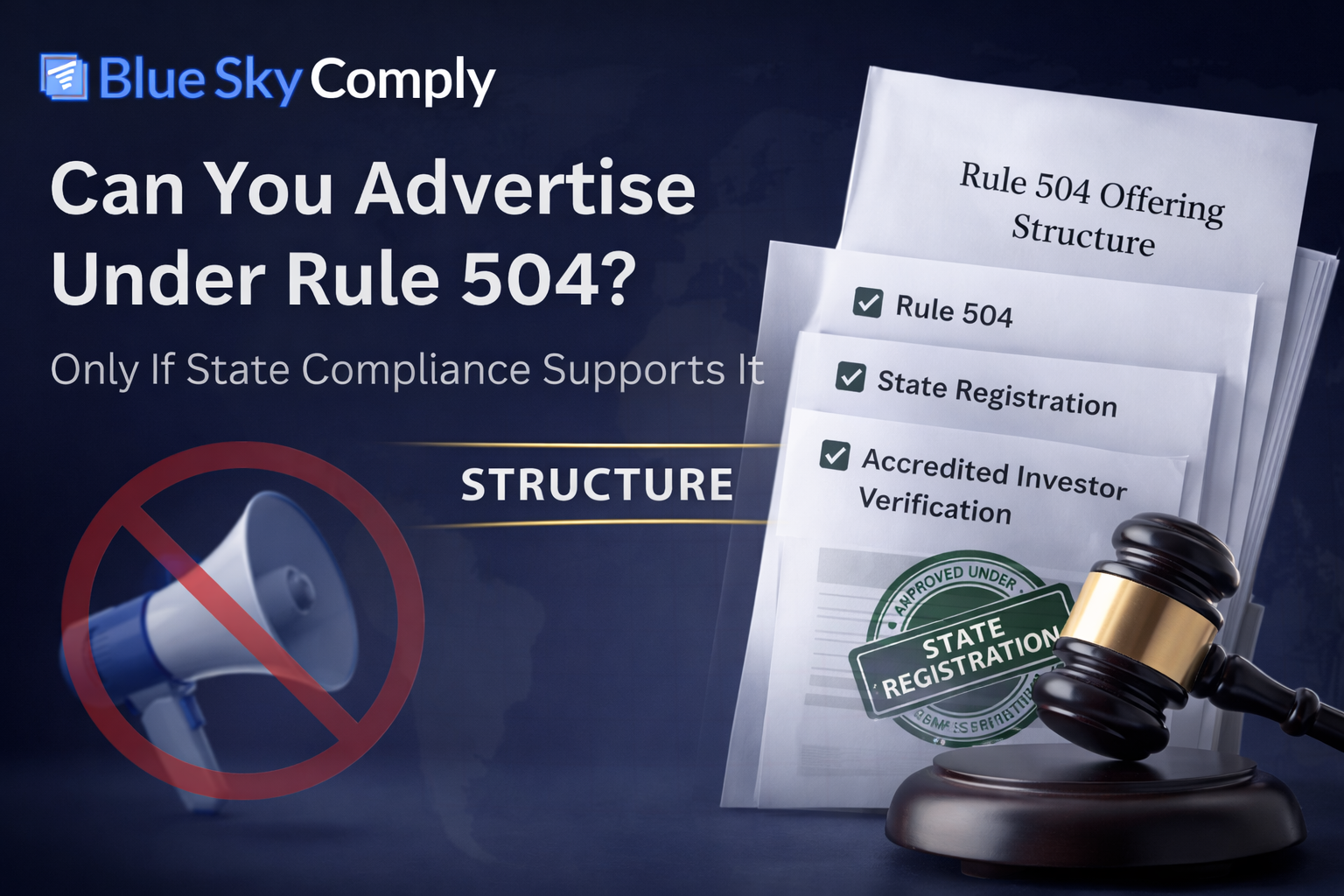
Are you a foreign company looking to raise capital in the U.S.? In 2026, understanding whether you can do a Reg A offering is crucial to unlocking new investment opportunities. This guide will walk you through the essentials of Reg A offerings for foreign entities and what steps to take.
Understanding Reg A Offerings in 2026
The Regulation A (Reg A) is a popular exemption from the registration requirements of the U.S. Securities and Exchange Commission (SEC), designed to help smaller companies raise capital from the public with less regulatory burden. Also known as a mini-IPO, Reg A allows companies to offer securities to investors nationwide without the extensive disclosure process required for a full public offering. In 2026, Reg A has gained even more traction, partly due to the rise of international companies seeking to enter the U.S. market and diversify their funding sources. The SEC has continuously updated the rules to streamline processes and make offerings more accessible, which is especially beneficial for foreign companies aiming to tap into the robust U.S. investor base.Can Foreign Companies Do a Reg A Offering?
Historically, there was uncertainty about whether foreign companies could leverage Reg A to raise capital in the United States. In 2026, this question has been largely settled in favor of allowing foreign companies to participate under certain conditions. The SEC's current rules specify that foreign companies are eligible to conduct Reg A offerings, provided they meet certain criteria. This includes complying with U.S. securities laws and ensuring that their securities are not restricted or barred from trading in the U.S. Regulation A falls under Rule 251(b)(1), which states: “an entity organized under the laws of the United States or Canada, or any State, Province, Territory or possession thereof, or the District of Columbia, with its principal place of business in the United States or Canada.” In essence, Regulation A is available only to companies formed under U.S. or Canadian law and with their main place of business in the United States or Canada. Alternatively, for Regulation Crowdfunding, Rule 100(b) sets a different but related constraint. Under this rule, a Reg CF issuer must be formed under, and subject to, the laws of a U.S. state or territory, or the District of Columbia. In other words, entities organized solely under foreign law cannot directly rely on Reg CF. Taken together, these provisions suggest at first glance that foreign companies are shut out of using U.S. crowdfunding exemptions, and more broadly may face significant hurdles in accessing U.S. investors. However, that conclusion is too narrow. With proper structuring—such as using a U.S. entity as the issuer—there are compliant pathways available for non-U.S. businesses to raise capital in the United States.Eligibility Requirements for Foreign Companies
While foreign companies are generally eligible to do a Reg A offering in 2026, they must satisfy specific eligibility criteria to qualify. These include:- Jurisdiction of Organization: The company must be organized or incorporated in the United States or Canada, with its principal business operations located in either country.
- No Disqualification: The company must not fall under any disqualifying conditions outlined in SEC Rule 262, such as certain criminal convictions or regulatory violations.
- Compliance with U.S. Laws: The company must comply with applicable U.S. securities laws during the offering process.
- SEC Filing: A Form 1-A must be filed with the SEC, including financial statements prepared in accordance with U.S. GAAP or IFRS, translated if necessary.
- Investor Limits: Under Tier 2 of Reg A, which most foreign companies opt for, there are limits on the amount of securities that can be sold annually (up to $75 million in 2026), and the company must meet certain ongoing reporting requirements.
Strategies for Foreign Companies to Comply with Reg A Requirements
Foreign companies aren’t entirely shut out of Regulation A, but they do need to structure their U.S. presence carefully to fit within the rules. Below are several common approaches that can allow a non-U.S. business to access Reg A while staying within the regulatory guardrails.- Redomiciling to the United States: One path is to shift the company’s place of incorporation to the U.S. This can open the door to using Regulation A, but it’s a major step with significant tax and corporate implications, especially when relocating substantial assets across borders. In addition, the company will generally need at least two years of audited financial statements prepared in accordance with U.S. GAAP to satisfy Reg A requirements.
- Forming a U.S. Holding Company: In some cases, a U.S. holding company can be created to serve as the crowdfunding vehicle. But for a Reg A offering, the issuer’s principal place of business must still be in the United States, which reintroduces many of the same structural and operational challenges described above.
- Use of Subsidiary Structure: International companies commonly establish a U.S. subsidiary to serve as the issuer for the offering, ensuring alignment with jurisdictional and regulatory requirements.
- Creating a New U.S. Operating Company That Licenses the Foreign Business or Product: A potentially flexible alternative is to form a new U.S. company that licenses the foreign company’s intellectual property, technology, or products. The new U.S. entity then conducts the offering and must use the proceeds in its own operations, not simply pass them through to the foreign licensor. Depending on the facts, this structure may be used with either Regulation A or Regulation Crowdfunding, but it requires careful planning to align the licensing, cash flows, and investor disclosures.
Steps to File a Reg A Offering as a Foreign Entity
Conducting a Reg A offering as a foreign company involves several critical steps. Blue Sky Comply can help consult through these steps at no cost.- Legal and Regulatory Consultation: Engage with U.S. securities attorneys who understand both U.S. and international law to ensure compliance from the outset.
- Prepare Financials: Compile financial statements according to U.S. GAAP or IFRS standards, translated into English if necessary, dating within the past 12 months.
- Draft the Offering Circular: Prepare a comprehensive offering circular outlining business details, financials, risk factors, and plans for use of proceeds.
- File Form 1-A with the SEC: Submit the offering circular along with required disclosures via Form 1-A, which undergoes review and potential comments from the SEC.
- File Blue Sky Notices to the States: This involves filing Reg A blue sky filings and state fees to each required jurisdiction in the U.S. This must be done before issuers can make sales, and depending on the state, up to 21 days before you make sales.
- Marketing and Investor Outreach: Market the offering within legal boundaries, targeting accredited and non-accredited investors, depending on the Tier.
- Close the Offering: Complete the securities sale, receive funds, and fulfill ongoing reporting obligations as required by SEC rules.
Benefits of Reg A for Foreign Companies
Utilizing Regulation A offers several strategic advantages for foreign companies looking to enter or expand within the U.S. market. It provides access to a large and diverse base of U.S. retail and institutional investors, creating opportunities to build brand awareness and market presence while raising capital. Reg A can also serve as a cost-effective alternative to a traditional IPO, often resulting in lower legal and regulatory expenses and a faster time-to-market. With the ability to raise up to $75 million under Tier 2 in 2026, companies can secure meaningful growth capital without the full burdens of a public offering. In addition, registering securities under Reg A can enhance a company’s credibility with U.S. customers, partners, and other stakeholders, while the exemption's structure facilitates potential follow-on offerings and repeat investments as the business scales.Reg A Offerings: Trends and Predictions for 2026
Looking ahead to 2026, several key trends are shaping the landscape for Regulation A offerings by foreign companies. International participation continues to grow, with more non-U.S. issuers—particularly those in emerging markets and technology sectors—turning to Reg A as a pathway to U.S. capital. At the same time, the SEC has provided clearer guidance and support for international issuers, helping to streamline the offering process and reduce regulatory uncertainty. The rise of digital and tokenized securities is also beginning to influence traditional capital-raising, with some foreign companies exploring tokenized offerings under the Reg A framework. Investor and regulatory expectations around disclosure are increasing, driving higher standards of due diligence, transparency, and governance. Finally, many companies are placing greater emphasis on environmental, social, and governance (ESG) considerations in their Reg A offerings, aligning their messaging and business models with the growing interest among U.S. investors in sustainability and social impact. Overall, the outlook for foreign companies conducting Reg A offerings in 2026 is optimistic, with continued growth driven by regulatory support, technological advancements, and globalization of capital markets.Looking Forward
In the evolving landscape of securities offerings, Reg A remains an attractive and accessible option for foreign companies aiming to raise capital in the U.S. in 2026. With the right strategic planning, legal guidance, and compliance, foreign entities can successfully leverage Reg A to access the lucrative U.S. investment market. Stay informed about current trends, and consider engaging experienced professionals to streamline the process and maximize your fundraising potential in this dynamic environment. Whether you're entering the U.S. market for the first time or expanding your investor base, understanding the opportunities and challenges of Reg A offerings today is crucial for success in 2026 and beyond, and Blue Sky Comply can help you with that journey.
Private companies raise capital at many stages of their lifecycle, often long before public markets are an option. In these early and growth phases, registering securities with the SEC is usually impractical due to cost, timing, and disclosure burdens. Section 4(a)(2) of the Securities Act provides a critical path forward by allowing certain private offerings to proceed without registration.
This exemption is not simply a procedural shortcut. It reflects a core principle of U.S. securities law: full registration is not necessary when securities are offered privately to investors who can protect their own interests. For issuers, Section 4(a)(2) offers flexibility. For regulators, it preserves investor protection by imposing expectations around disclosure, sophistication, and offering conduct.
Understanding how Section 4(a)(2) works is essential for issuers that want to raise capital responsibly while avoiding regulatory exposure that may surface later during diligence, audits, or transactions.
*This does not constitute as legal advice. Please consult your legal counsel for specific guidance.
A defining feature of a valid private placement is the absence of general solicitation. Public advertising, open websites, or broadly disseminated investment materials can undermine the private character of the offering, even if only a small number of investors ultimately participate. Regulators look closely at how investors were approached, not just who invested.
Ultimately, Section 4(a)(2) is less about what an issuer calls an offering and more about how the offering is actually executed. Issuers that align investor selection, disclosure practices, and solicitation methods are far better positioned to rely on the exemption with confidence.
Issuers often rely on Regulation D because it reduces uncertainty. However, the underlying legal foundation remains Section 4(a)(2), and failures in execution can still raise questions even when a safe harbor is claimed.
What Is Section 4(a)(2) and When Does It Apply
Section 4(a)(2) exempts from registration “transactions by an issuer not involving any public offering.” Unlike many SEC rules, it does not contain numeric thresholds or rigid eligibility tests. Instead, it is a principles-based exemption that depends on the facts and circumstances of each offering. At its core, Section 4(a)(2) applies when securities are offered privately rather than to the general public. The exemption focuses on the nature of the offering, the relationship between the issuer and investors, and the level of information made available. If an offering resembles a public solicitation in form or substance, it is unlikely to qualify. Because of this flexibility, Section 4(a)(2) has historically served as the legal foundation for private placements. Many later rules, including Regulation D, were designed to provide safe harbors that clarify how issuers can reliably meet the Section 4(a)(2) standard.What Defines a Valid Section 4(a)(2) Private Placement
Section 4(a)(2) does not operate as a bright-line rule. Courts and regulators evaluate whether an offering qualifies by looking at the overall substance of the transaction rather than any single requirement. The focus is on whether the offering is genuinely private in nature and whether investors are able to protect their own interests without the protections of SEC registration. In practice, issuers rely on Section 4(a)(2) when certain core conditions are met around the investors involved, the information they receive, and how the offering is conducted. These elements work together to establish whether the exemption is available. Here is when issuers can rely on Section 4(a)(2) and what is generally expected to support that reliance:| Key Consideration | When Section 4(a)(2) Can Be Used | What Issuers Are Expected to Do |
| Nature of the offering | The offering is private and not available to the general public | Limit participation to a defined group of investors |
| Investor sophistication | Investors are financially sophisticated or advised by professionals | Evaluate investor experience or access to qualified advisors |
| Access to information | Investors can obtain material information about the issuer | Provide meaningful financial and risk information |
| Solicitation methods | No general solicitation or public advertising is used | Avoid mass marketing, public promotions, or broad outreach |
| Issuer-investor relationship | The issuer has a direct or controlled relationship with investors | Maintain disciplined, documented offering communications |
Investor Qualifications and Disclosure Expectations
Although Section 4(a)(2) does not mandate a specific disclosure document, it does impose a practical disclosure obligation. Investors must be given sufficient information to make an informed investment decision. The level of disclosure required depends on who the investors are and how sophisticated they may be. When investors are accredited and financially experienced, disclosure expectations may be less formal but still substantive. When investors are not accredited, issuers face heightened expectations to provide detailed financial and risk information. In all cases, the information must be accurate, complete, and consistent across investors. This is why private placement memoranda are commonly used even when not legally required. They help demonstrate that investors were given access to material information and that the offering was conducted with appropriate care.Section 4(a)(2) Compared to Regulation D
Although Section 4(a)(2) stands on its own, most issuers encounter it in practice through Regulation D. Regulation D does not replace Section 4(a)(2). Instead, it provides safe harbors that define specific conditions under which a private offering is presumed to satisfy the Section 4(a)(2) standard. To put the relationship in context, the table below highlights how these concepts work together:| Exemption Framework | Purpose |
| Section 4(a)(2) | Statutory exemption for private offerings |
| Regulation D | Safe harbor rules that clarify how to comply |
| Rule 506(b) | Traditional private placement without general solicitation |
| Rule 506(c) | Private placement allowing general solicitation with verification |
What Are Common Section 4(a)(2) Compliance Risks
Compliance issues under Section 4(a)(2) rarely stem from a single mistake. More often, they arise from a series of informal practices that, taken together, undermine the private nature of an offering. Issuers may inadvertently engage in general solicitation through online communications, investor referrals, or inconsistent marketing materials. Others fail to maintain adequate records showing what information was provided and when. In some cases, issuers assume that prior offerings establish a precedent, even though each offering must independently satisfy the exemption. Common risk areas include:- Informal or undocumented investor communications
- Uneven disclosure among investors
- Poor coordination between legal, finance, and fundraising teams
How Section 4(a)(2) Interacts With State Blue Sky Laws
Federal exemption under Section 4(a)(2) does not eliminate state securities law considerations. States retain authority under their Blue Sky laws to regulate securities offerings within their jurisdictions, and private placements may still be subject to notice filings or exemption requirements at the state level. The complexity increases as offerings involve investors in multiple states. Each jurisdiction may apply different standards or procedural requirements under its Blue Sky framework. Ignoring these obligations can delay transactions or trigger enforcement actions, even when the federal exemption is otherwise sound. Federal compliance and state compliance under Blue Sky laws are related but distinct responsibilities. Issuers that address both proactively are better positioned to manage regulatory risk as their investor base expands.How Should Companies Manage Section 4(a)(2) as They Grow
As companies raise capital repeatedly, private placements tend to become more frequent, larger in size, and more complex. What worked for an early seed round may not be sufficient for later growth-stage financings. Effective management of Section 4(a)(2) offerings requires discipline. Issuers benefit from consistent documentation, clear internal processes, and a structured approach to investor communications. Treating private placements as formal securities offerings rather than ad hoc transactions reduces risk and improves transparency. Early attention to compliance also pays dividends during diligence. Investors and acquirers scrutinize prior offerings closely, and clean compliance histories reduce friction at critical moments.Final Thoughts
Section 4(a)(2) remains one of the most important exemptions in U.S. securities law. It gives issuers flexibility to raise capital privately while preserving investor protections through disclosure and offering discipline. Its strength lies in its adaptability, but that same flexibility requires careful judgment. Issuers that understand the principles behind Section 4(a)(2), rather than relying on assumptions or informal practices, are better equipped to raise capital responsibly and sustainably. Blue Sky Comply supports issuers in managing the state-level compliance obligations that often accompany private placements under Section 4(a)(2).
Equity compensation has become one of the most powerful tools private companies use to attract, motivate, and retain talent. Stock options, restricted stock, and other equity awards allow employees to participate in a company’s growth long before a public listing or acquisition. But issuing equity is not just a compensation decision. It is also a securities law event.
Under U.S. securities laws, issuing stock or equity-based compensation is generally considered the sale of a security. Without an available exemption, those issuances could trigger registration requirements that are impractical for most private companies. Rule 701 exists to address this problem. It provides a structured exemption that allows private companies to issue equity to employees and certain service providers without registering those securities with the SEC.
Understanding Rule 701 is essential for founders, legal teams, finance leaders, and HR professionals. Missteps can lead to disclosure violations, rescission rights, and complications during financing rounds or exit transactions. Proper compliance, on the other hand, allows companies to scale equity programs confidently while reducing regulatory risk.
Exceeding these limits does not automatically invalidate Rule 701, but it does trigger enhanced disclosure obligations. Once aggregate issuances exceed $10 million within a 12-month period, the company must provide additional disclosures to recipients before issuing further equity. These disclosures typically include financial statements, a summary of the plan, and a discussion of material risks.
Failure to provide required disclosures on time is one of the most serious Rule 701 violations, and it often surfaces during due diligence rather than at the time of issuance.
What Is Rule 701 and Who Can Use It
Rule 701 is an exemption under the Securities Act of 1933 that permits private companies to issue securities as part of compensatory benefit plans without SEC registration. Its purpose is narrow and intentional. It is designed to support employee and service provider compensation, not capital raising. Only companies that are not subject to SEC reporting requirements can rely on Rule 701. Once a company becomes public or otherwise subject to reporting under the Exchange Act, Rule 701 is no longer available. This makes it particularly relevant for startups, growth-stage companies, and mature private businesses that use equity as a core component of compensation. Eligible recipients under Rule 701 include employees, directors, officers, consultants, and advisors. However, the relationship must be genuinely compensatory. Equity issued in connection with fundraising, investment activity, or promotional services does not qualify. This distinction is critical, as misclassifying recipients is one of the most common compliance errors companies make.What Types of Employee Equity Are Covered Under Rule 701?
Rule 701 is flexible in terms of the equity instruments it covers. It applies to a wide range of compensation structures commonly used by private companies, as long as those awards are issued under a written compensatory plan or agreement. In practice, companies most often rely on Rule 701 when issuing stock options, restricted stock, and restricted stock units. Other equity-based awards that are tied to compensation, rather than investment, may also qualify. The specific structure of the award matters less than its purpose and the eligibility of the recipient. From a compliance perspective, companies should view all equity awards under a single framework rather than as isolated grants. Every issuance contributes to aggregate limits and disclosure thresholds, making centralized tracking essential.What Are the Rule 701 Limits and Disclosure Requirements?
Rule 701 is not unlimited. It imposes clear caps on how much equity can be issued within any rolling 12-month period. Companies must stay within the greatest of three limits, which are based on absolute dollar value, a percentage of total assets, or a percentage of outstanding securities. To make these concepts easier to follow, the table below summarizes the core issuance limits under Rule 701:| Rule 701 Issuance Limits (Rolling 12 Months) | Description |
| Fixed dollar cap | A maximum aggregate sales price of $1 million |
| Asset-based cap | 15 percent of the issuer’s total assets |
| Outstanding securities cap | 15 percent of the outstanding amount of the class being issued |
What Are the Ongoing Rule 701 Compliance Obligations?
Rule 701 compliance is not a one-time checklist item. It is an ongoing responsibility that grows more complex as a company scales. Each new hire, promotion, or equity refresh grant contributes to cumulative issuance totals and disclosure obligations. Many compliance issues arise from operational gaps rather than intentional misconduct. Companies may fail to track grants across departments, rely on outdated valuations, or overlook issuances to consultants in multiple states. Others mistakenly assume that Rule 701 eliminates all securities law obligations, which is not the case. A few recurring problem areas deserve particular attention:- Misclassifying consultants or advisors who do not meet Rule 701 eligibility standards
- Failing to monitor rolling 12-month issuance limits
- Delaying required disclosures until after equity has already been issued
How Does Rule 701 Interact With State Blue Sky Laws?
One of the most misunderstood aspects of Rule 701 is its relationship with state securities laws, commonly referred to as Blue Sky laws. While Rule 701 provides a federal exemption from SEC registration, it does not automatically eliminate all state-level obligations. States may impose Rule 701 notice filings, exemptions, or conditions related to compensatory equity issuances. These requirements vary by jurisdiction and often depend on where recipients are located. As workforces become increasingly distributed, multi-state compliance has become a central challenge for private companies. Companies that assume federal compliance alone is sufficient may find themselves exposed to state enforcement actions or delays during transactional reviews. Rule 701 should be viewed as one layer of compliance, not a complete solution.How Should Growing Companies Manage Rule 701 Compliance?
As companies mature, equity programs tend to expand in size and complexity. Headcount increases, equity refreshes become more frequent, and issuances span multiple jurisdictions. At the same time, the company may be preparing for institutional investment, acquisition, or a public offering. Strong Rule 701 compliance during these growth phases can significantly reduce friction later. Clean records, timely disclosures, and documented processes make diligence reviews smoother and reduce the likelihood of last-minute corrective filings or renegotiated deal terms. Treating equity compliance as part of long-term governance, rather than an administrative task, helps companies scale responsibly while protecting both the business and its employees.Final Thoughts
Rule 701 plays a foundational role in how private companies issue equity to employees and service providers. It allows businesses to reward contributors with ownership while operating within a defined regulatory framework. But the exemption comes with clear limits, disclosure obligations, and ongoing compliance responsibilities. Companies that understand Rule 701 as a living compliance process rather than a static exemption are better positioned to grow, raise capital, and pursue liquidity events without unnecessary risk. A disciplined approach to equity issuance not only supports regulatory compliance but also builds trust with employees and future stakeholders. Blue Sky Comply helps private companies manage the state-level blue sky compliance obligations that often accompany Rule 701 equity programs.
Choosing a path for your early capital raise is less about buzzwords and more about fit. Rule 504 sits inside Regulation D and can be a practical option when you want a lighter lift for a smaller offering, especially if your investor base is close to home. The decision often hinges on a few grounded realities:
- Size of the round
- Who your investors are
- How widely you plan to market
- Whether you can embrace state-level steps.
What Rule 504 Is and How It Works
Rule 504 supports smaller offerings with a comparatively simple structure. Broadly speaking, it can allow certain flexibility when the offering is registered at the state level, and it permits sales to both accredited and non-accredited investors, subject to state rules. Documentation and disclosure/filing requirements for Reg D 504 are simple on the federal-filing side to the SEC, but more complicated on the state level. Further, you will spend most of your energy coordinating state requirements, since federal preemption is not the default advantage. Contact us to learn more. State review and registration are what make 504 feel different in practice. Your marketing leeway often flows from what a specific state has reviewed and allowed. If you plan to sell only in a handful of states, you can right-size the process and move faster. If you plan to market broadly across many states, the complexity can add up. Rule 504 could be fast and flexible for small rounds, but varying state requirements will likely determine your true cost and timeline.When Rule 504 Is a Good Fit
Rule 504 tends to click for companies that already have a defined local or regional audience and want to raise a modest amount without building a national marketing campaign. Imagine a consumer brand with loyal customers in two or three states, or a real estate vehicle focused on one metro area. The practical benefits are speed, familiarity with the investor base, and fewer moving parts than a larger retail pathway. If your investors are not all accredited or you have more than 35 non-accredited investors, a state-registered 504 can offer a compliant on-ramp where 506(c) and (b) would not fit your plan. A founder with a strong email list and in-market events might find 504 especially appealing. The existing relationships compress the marketing cycle, and the alignment between your intended investors and the states you choose to register in keeps the filing work proportional to the raise.When Rule 504 Might Not Be the Best Choice
Rule 504 will struggle to keep pace if your strategy looks national, your investor mix is primarily accredited, and you want to openly advertise online. In that scenario, 506(c) can deliver general solicitation with federal preemption on state law, which simplifies the filing posture and helps you move faster across state lines. If your vision is a truly retail-friendly offering at a larger scale with broad reach, Regulation A Tier 2 is often the correct framework, even though it brings ongoing reporting and audited financials. If you expect to run a platform-based, community-centric campaign, Regulation CF may be a better match than 504. The portal infrastructure can be worth the tradeoffs when your goal is to grow your audience from the crowd. If your plan is to market broadly to accredited investors nationwide, 506(c) is usually more efficient than Rule 504.Rule 504 Compared to 506(b) and 506(c)
The differences between these Reg D routes come down to solicitation, investor eligibility, and how much state-level coordination you want. With 506(b), you can avoid general solicitation and raise funds from accredited investors and up to 35 sophisticated non-accredited investors, leveraging preexisting relationships. It is quiet and controlled. With 506(c), you gain the right to generally solicit, but you must verify accreditation status. In both cases, federal preemption lightens the state burden. With Rule 504, you can gain more flexibility via state registration, but the tradeoff is the filing and review workload that sits with those states. If your raise is concentrated where you already do business, that tradeoff can be worth it.Rule 504 vs Regulation CF
Crowdfunding under Reg CF formalizes the public campaign format. You will work through a registered portal, follow disclosure templates, and accept investment caps and limits that come with the territory. The upside is access to a broad retail audience and platform tools designed for conversion. You can raise from unlimited non-accredited investors up to $5mm. By contrast, Rule 504 is most compelling if you can focus on a few states, tailor your messaging to what those states have reviewed, and lean on existing customer affinity. If your plan already involves a portal and national outreach, you will likely be better served by Regulation CF.Rule 504 vs Regulation A Tier 2
Reg A Tier 2 is the heavyweight retail exemption suitable for larger raises with a wide audience, which allows non-accredited investors and free-trading shares suitable for trading. It introduces audited financials, offering circular review and ongoing reporting, all of which support a durable investor relations posture. That structure brings credibility and reach, but it also brings time and budget commitments. Rule 504 is the smaller, faster option for local raises where the goal is to get to a close efficiently without building the infrastructure of a national retail offering. If your strategy anticipates scaling marketing and investor count significantly, a Reg A Offering deserves a serious look.Can You Advertise a Rule 504 Offering?
The short answer is yes, but only under specific conditions tied to state law. Rule 504 by itself does not grant a blanket right to advertise. Public solicitation is permitted when your offering is registered in the states where you intend to solicit or when you use a state exemption that expressly allows general solicitation and requires a public filing and delivery of a disclosure document. In these situations, your ads and public statements should be consistent with what the state reviewed and permitted. If you are not pursuing a path that allows general solicitation under state law, treat communications like a traditional private placement and avoid public promotion. Many issuers that want broad public outreach choose 506(c) instead, because it permits general solicitation with federal preemption. When in doubt, align your plan with state-reviewed materials and keep copies of everything you publish.State Compliance Realities Under Rule 504
The mechanics of 504 are won or lost in the details of state coordination. Each state may have its own form of review (merit-based or disclosure-based reviews), comment cycles, and timelines. Fees also vary. Because your marketing claims should match the filed terms that a state has approved, you will want your marketing and legal teams to communicate closely. For issuers working across a handful of states, it can help to sequence filings based on expected investor demand and processing speed. Select the states where your investor list is strongest, start there, and avoid overextending your filing footprint until you see conversion. When you need a reference point for what these filings entail, it is useful to look at the broader category of State Reg D filings so you can budget time and resources. The core idea is the same:- Plan for state and legal fees
- Filing documents and paperwork
- Examiner comments
- Align your calendar accordingly
Costs, Timelines, and Documentation
Issuers sometimes underestimate the time and attention required to align marketing with state-reviewed materials. A realistic plan includes a calendar for filing and comment resolution in each state, time for drafting and revising offering documents, and a playbook for what your team can and cannot say during the campaign. It also includes recordkeeping and post-close filings, particularly if you accept investments in tranches. To avoid surprises, map your budget to state fees and core drafting tasks. Documentation usually includes subscription agreements, investor questionnaires, disclosure materials that mirror state filings, and carefully reviewed communication materials. Here is a simple view that helps set expectations without drowning in details:| Topic | What to expect under Rule 504 | Practical tip |
| State reviews | Vary by state, with possible comment cycles | Sequence filings by expected demand and speed |
| Fees | Vary by state and can compound across jurisdictions | Build a per-state fee model and track actuals |
| Marketing | Tied to what has been filed or approved | Keep marketing aligned with filed terms and disclosures |
| Investor mix | Can include non-accredited investors with state registration | Pre-plan investor communications and FAQs |
| Timeline | Often faster for a few states, longer for many | Pilot in core states before expanding |
Marketing and Communications Under Rule 504
Good messaging respects what you have filed. If a state has reviewed and cleared specific claims, lean on that approved language. Do not improvise on terms, and do not make performance promises. Your investor communications should be templated, and your team should know which materials are greenlit and which need legal review before use. A well-run 504 campaign often looks and feels like a focused product launch. You address a known audience with clear, consistent materials, and you measure response state by state. That discipline keeps the raise clean and shortens your path to closing.Case Snapshots: Where Rule 504 Works
Consider a consumer food brand with a devoted regional following. The company has strong sales in two neighboring states and wants to invest in customers who ask about participating. Registering under Rule 504 in those states allows the brand to market within a known footprint. Because the audience already trusts the product, the message lands, and the brand can focus its budget on filings instead of national advertising. Another example is a small business services firm whose clients are concentrated within one metropolitan area. Their investors are primarily customers and partners. A targeted 504 effort allows the firm to share the opportunity ethically and coherently without scaling up a national compliance structure. A third scenario is a community real estate vehicle that aggregates investment into local projects. The value proposition is local knowledge and visibility. That is a natural use case for a state-registered offering that stays close to its base.Common Pitfalls and How to Avoid Them
Even well-prepared teams can stumble if they treat 504 like a generic Reg D raise. The most common missteps include drifting off script in marketing materials, underbudgeting state and filing fees, and assuming every state processes at the same pace. You can avoid those risks by setting internal controls for content, tracking a state-specific calendar, and making sure subscription, disclosure, and investor updates reflect the same set of terms. A short checklist can help you stay on track after you choose Rule 504:- Confirm which states you will file in and why those states align with your investor list.
- Lock approved language for marketing and investor communications and train the team.
- Map state timelines to your campaign calendar and hold to a weekly review cadence.
- Track commitments and funds by state, so post-close filings are complete and timely.
Choosing Rule 504 With Clarity
Rule 504 shines when your raise is modest, your investors are concentrated in a few states, and you can align marketing with state-reviewed materials. If you value speed, simplicity, and access to non-accredited investors in a focused footprint, 506(b) or Reg CF may be a better option. If your plan involves nationwide outreach, general solicitation, or a larger retail audience, you will usually find a better fit in 506(c), Reg CF, or Reg A. Match the exemption to your audience, geography, and timeline to avoid friction and rework. For tailored support with state securities filings and Reg D strategies, Blue Sky Comply can be contacted for related support.
If you’re raising private capital in the U.S., there’s a good chance you’re relying on Regulation D. That’s where SEC Form D comes in, a short notice filing for private offerings conducted by any companies in the United States - yes, this means all companies in the US who sell securities to investors must file a Form D to the SEC with the accompanying Blue Sky filings.
The SEC Form D doesn’t get you “approval,” but it does provide basic disclosure of key details of your exempt offering and starts the 15-day filing window for your state-level “blue sky” obligations. In other words, it’s a notice form with consequences for compliance, investor confidence, and your fundraising momentum.
What Is SEC Form D?
SEC Form D is a notice filing submitted to the SEC for certain exempt offerings of securities, most commonly under Regulation D. It’s a concise disclosure about the issuer, the exemption relied upon, the size of the offering, sales to date, and basic information about investors and sales compensation. Form D is not a merit review or an approval process; it’s a formal notice that you are conducting a private offering under an exemption. Form D is typically associated with:- Rule 506(b) and 506(c) offerings
- Rule 504 offerings (smaller raises with burdensome filing requirements)
Who Must File Form D and When?
Issuers relying on Regulation D generally must file Form D with the SEC. This includes U.S. and foreign issuers selling securities in the United States. The filing deadline is within 15 calendar days after the “date of first sale.” Practically, the “first sale” occurs when an investor becomes irrevocably committed to invest, often when the subscription documents are signed, and funds are not subject to a unilateral right of withdrawal. A few operational points matter:- You need an EDGAR account, which can be obtained through a Form ID filing. That means your company (or the issuing vehicle) needs a CIK number and EDGAR filing codes before submitting. Getting these in place early avoids a deadline crunch.
- The deadline is short. Fifteen calendar days can pass quickly if you close over an SEC federal holiday or don’t have process ownership assigned.
What Information Does Form D Require?
Form D collects high-level offering and issuer details. Expect to provide:- Issuer identity and principal place of business, plus related persons (executive officers, directors, promoters).
- The exemption relied upon (e.g., 506(b), 506(c), or 504).
- Offering size: total amount, amount sold, minimum investment accepted.
- Investor mix: number of investors, and how many are accredited versus non-accredited (if applicable for your exemption).
- Sales compensation: whether you are paying placement agents, brokers, or finders, including names and CRD numbers where relevant.
- Offering jurisdictions: the states (and sometimes territories) where securities are being offered or sold.
How to File Form D on EDGAR (Step-by-Step)
The process is straightforward but benefits from preparation:- Obtain/confirm EDGAR credentials: Secure your CIK, CCC, and create appropriate filing roles in your system.
- Prepare the form: You can complete Form D directly on your blueskycomply.com account.
- Validate and submit: After completing the form with our validation checks and instructions providing guidance, you can submit a test filing to ensure you don’t have validation errors. You can then live file the document. If you prefer, we can handle all of this for you.
- Align the data: Make sure the data on your Form D matches your private placement memorandum, subscription documents, and investor list. Inconsistencies or inaccurate data could result in State or SEC fines.
Form D Amendments: When Are Updates Required?
You must amend Form D to correct material mistakes or reflect significant changes as the offering progresses. There’s also an annual amendment requirement if your offering is still ongoing on the first anniversary of the original filing. Common amendment triggers include:- A change in executive officers or directors
- A significant change in offering size or amount sold
- New sales compensation arrangements
- A change to issuer identity details or industry group - Additional selling jurisdictions that materially alter the picture
Blue Sky 101: State Notice Filings After Form D
Form D is federal. Most states still require notice filings and fees if you sell in their jurisdiction. While many states follow a similar structure, specifics vary—deadlines can be 15 days after the first sale in that state, and fee schedules can differ widely. States typically ask for multiple documents, including a copy of the Form D and payment of state fees. For multi-state raises, complexity ramps up quickly. You’re juggling deadlines, annual renewals, amendments, and changing requirements. If you’re getting oriented, our overview of the key requirements for Reg D offerings can help you understand where state notice filings fit into the broader compliance process.Common Mistakes and How to Avoid Them
Even seasoned teams can stumble on logistics. The most frequent issues include:- Missing the 15-day SEC deadline or state notice deadlines
- Starting the Form ID application process too late
- Inconsistencies between PPMs/sub docs, Form D, and state filings
- Forgetting to file or renew state notices in every jurisdiction where you’re selling
- Not amending Form D after material changes (or failing to update states accordingly)
- Overlooking disclosures about sales compensation or finders
Consequences of Non-Compliance
While a late or missing Form D won’t usually blow up your exemption by itself, it can create real problems. States may impose penalties, issue stop orders, assess additional late fees, or ask for corrective filings. You can heighten rescission risk if investors argue the offering wasn’t properly conducted, and you can create roadblocks during future diligence. **Non-compliance is costly, not just in fees, but also in lost time and possible legal trouble.**FAQs
- Do SPVs and funds need to file? Typically, yes, if relying on Reg D, the issuer (whether an SPV, fund, or operating company) is responsible for Form D and subsequent state notices.
- 506(b) vs. 506(c) vs. 504 506(b) doesn’t allow general solicitation and permits up to 35 non-accredited investors (with information requirements); 506(c) allows general solicitation but requires accredited investor verification; 504 is capped and subject to additional state considerations.
- If no sales occur, do you need to file? No first sale = no SEC Form D filing. But check any state-specific triggers if you conducted pre-filing activities or paid fees.
- How public is the information? EDGAR is public. Be thoughtful about what’s disclosed within the form’s structure and coordinate with counsel on investor optics.
Quick Comparison of Reg D Pathways
Before we jump into specifics, it helps to frame how the main Regulation D pathways differ in practice. Rule 506(b) is the traditional private placement; no general solicitation, with room for a limited number of non‑accredited investors if you provide robust disclosures. Rule 506(c) opens the door to public marketing, but only if every investor is verified as accredited. Rule 504 is typically used for smaller raises and involves more state‑level variation. The table below highlights the operational trade‑offs so you can choose the route that best fits your fundraising strategy.| Requirement | Rule 506(b) | Rule 506(c) | Rule 504 |
| General Solicitation | Not permitted | Permitted | Not permitted (with limited exceptions) |
| Investor Eligibility | Unlimited accredited; up to 35 non-accredited (with disclosures) | Accredited investors only (verification required) | Varies; generally open to non-accredited, subject to caps |
| Verification Requirement | Not required | Required (reasonable steps to verify) | Not required |
| Offering Cap | No SEC cap | No SEC cap | SEC cap applies (subject to change by rule) |
| Form D + State Notices | Yes + state notices as applicable | Yes + state notices as applicable | Yes + state notices as applicable, with more state variation |
Checklist: Getting Form D and Blue Sky Right
Pre-raise:- Secure your CIK and EDGAR codes.
- Confirm your exemption (e.g., 506(b) vs. 506(c)), align on investor eligibility and marketing plan.
- Draft PPM and other offering documents
- Calendar the 15-day SEC deadline and all state deadlines per jurisdiction.
- Ensure Form D data matches offering documents and internal records.
- Confirm EDGAR acceptance, save the filing receipt, and use it to support state Form D filings.
- Track amendments, renewals, and state responses until the offering is closed and all states are fully compliant.
How Blue Sky Comply Streamlines Form D and State Filings
Coordinating SEC and state filings for Reg D can be a full-time job, especially when your offering spans multiple closings, annual renewals, or several jurisdictions. Blue Sky Comply centralizes the data and timelines so you don’t have to chase scattered spreadsheets or emails.- Centralized workflow: We maintain a single source of truth for offering details, jurisdictions, deadlines, and fee schedules, and mirror these across federal and state requirements.
- Deadline and amendment tracking: Automated reminders help ensure your annual amendments and state renewals aren’t missed.
- Full-service support: From aligning sale dates and investor data with filings, our team supports counsel, funds, SPVs, and operating companies. For a deeper dive on the Reg D landscape, see our overview of a Reg D offering.
- Cost clarity: If you’re figuring out costs, our breakdown of Reg D State fees can help avoid surprises.
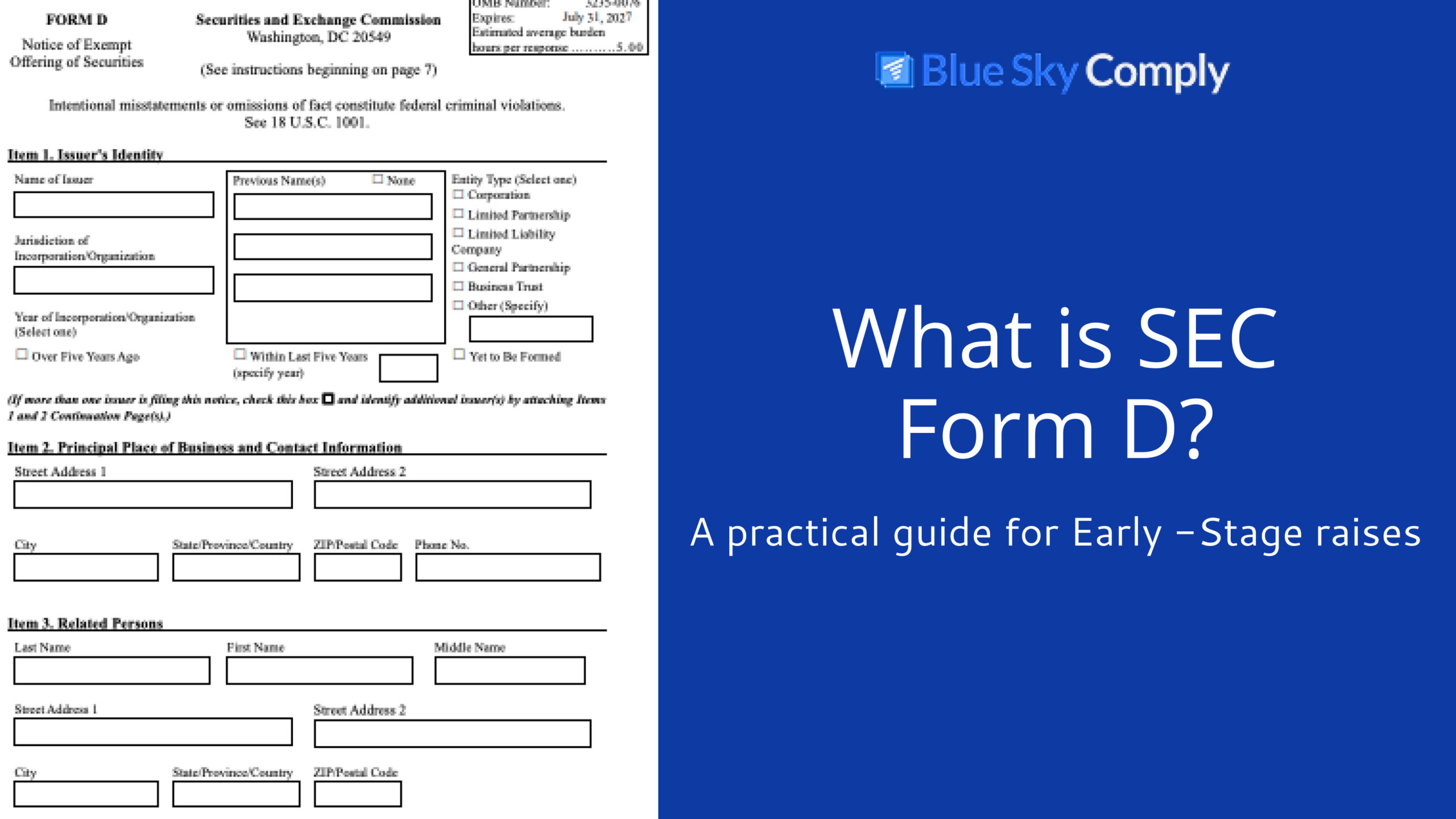
Getting the SEC Form D filing right isn’t about memorizing acronyms; it’s about entering the simple components to conducting a Reg D private offering.
In this article, we provide a field-by-field walkthrough that is designed for company executives/founders, CFOs, in-house counsel, and fund managers who want practical “how to complete Form D” guidance without the sales fluff. We’ll cover what you need before you start, how to move through each section with confidence, and the timing rules that trip teams up.
Form D is brief by SEC standards, but it touches on all critical points of your offering. Small inconsistencies can cascade into state-level issues later, such as:
- The wrong industry
- Investor count totals and amount sold discrepancies
- Incomplete related persons
- Inadequate commissions and finder's fees disclosures
- Proper Use of Proceeds disclosure.
What Form D Is, and When It’s Required
Form D is a notice filing with the SEC for certain private offerings. It makes basic details public: issuer identity, exemption claimed, offering size, and limited sales data. If you’re raising under the Regulation D framework, you should file within 15 days of the first sale. For a refresher on the exemption details and requirements, see Regulation D. Because Form D is public, coordinate your investor messaging and website language. You don’t need to over-share in the form, but everything must be accurate, consistent, and timely across federal and state submissions.How Companies Use Form D in Practice
Real-world filings make the mechanics tangible. The companies below illustrate common Form D patterns you will likely encounter, including rolling closes that require timely amendments, disciplined tracking of investor counts and jurisdictions, and tight alignment between issuer identity, related persons, and any sales compensation. Use these as mental models to pressure test your own process before and after each close.- SpaceX: Amending as Large Rounds Progress: SpaceX has filed multiple Form Ds across successive equity rounds. As funds accumulate through rolling closes, filings reflect updated “amount sold” and added jurisdictions. The practical takeaway: for staged capital collection, build a rhythm of checking amendment triggers after each close so federal and state records stay aligned.
- Stripe: Rolling Closes and Timing Discipline: Stripe’s Form D history illustrates how high-demand raises can proceed in increments. Investor counts and amounts sold change as allocations settle, driving timely amendments. The takeaway: pair your closing calendar with a 48-hour “amend-or-not” review to keep the public record current.
- Epic Games: Clean Issuer Identity and Compensation Alignment: Epic Games filings are a straightforward model for issuer identity, related persons, and sales compensation entries. The takeaway: match titles to your board resolutions, and ensure any cash, warrants, or success-fee equity given for placement activity is consistently reflected across agreements, the cap table, and Form D.
- Early-Stage Startups: First-Sale Date and Jurisdiction Nuance: Many seed and Series A companies trigger their first-sale date when the first wire lands under executed subscription agreements, not when soft commits arrive. The takeaway: track investor legal residence at subscription, not after funds clear; that’s what drives state notice filings and related fees.
Potential Pitfalls of the Form D (and Form ID)
Before you can file Form D, you need EDGAR access. That starts with Form ID—your application to obtain or update EDGAR credentials (CIK/CCC and related access). Since EDGAR Next changes, the SEC has frequently taken several days to approve new Form ID submissions, which can push your Form D timing if you wait until the last minute. Build this lag into your deal calendar and kick off Form ID well before first close.Why Form ID matters
- Form ID is the gatekeeper. Without it, you can’t file Form D. Approvals often take several days post–EDGAR Next, especially for first-time issuers and new signers.
- Notarized signatures are required. Plan for a notarized, correctly executed signature page. We can help coordinate notarization and submission so the package is accepted the first time.
- Waiting until the week of first close: Start Form ID 2–3 weeks before your expected first sale date. Have a backup signatory ready with a notarized page in case your primary signer is unavailable.
- Signature/notary defects: Name/title mismatch with corporate records, missing notary seal, or date issues are common rejection reasons. Align titles with board resolutions and ensure the notary block is complete and legible.
- Identity and document mismatches: The legal name on Form ID must match formation documents exactly. Avoid using DBAs. If you’re updating credentials for a new executive signer, align with your Related Persons details.
- File format and submission errors: Follow the SEC’s file type and size specs. Incorrect PDFs or corrupt attachments can trigger rejections and restart the clock.
- Role confusion: Don’t use a personal EDGAR account to file for the issuer. Establish issuer credentials and assign the proper roles so the authorized officer can sign Form D.
- Contact details that don’t resolve: Use monitored email and phone numbers; SEC confirmations and queries arrive via those channels, and timing matters.
Before You Start: Prerequisites and Setup
Before you dive into the form, set your foundation. Decide which exemption actually matches how you marketed the raise, secure EDGAR access by submitting Form ID early (approvals can take several days after EDGAR Next and require a notarized signature), assign clear internal owners for data, and pull a single, current set of records for issuer details, officers, industry/NAICS, offering terms, investor counts, jurisdictions, and any sales compensation. With that groundwork in place, you’ll file faster and avoid amendment churn. Here are the prerequisites:Confirm Your Exemption and Offering Structure
Most private issuers rely on Rule 506(b) or 506(c). The key differences affect both how you market and what you must validate for investors.- 506(b) prohibits general solicitation but allows up to 35 non-accredited investors (with disclosure requirements).
- 506(c) permits general solicitation if you take reasonable steps to verify accredited status.
- Scenario 1: You posted your deck publicly after a conference. That’s general solicitation, use 506(c), and verify accreditation before accepting funds.
- Scenario 2: You quietly raised from a known network with no public marketing. 506(b) may fit—track any non-accredited investors and deliver required disclosures.
Get Your EDGAR Credentials in Order
First, file Form D through EDGAR. Make sure you have:- CIK, CCC, and related EDGAR access codes
- Authorized personnel identified (and available on filing day)
- A secure process for sharing credentials
Gather Required Information (Working Checklist)
Form D pulls from multiple systems, including legal, finance, HR, and investor relations. Centralize:- Issuer details (legal name, entity type, jurisdiction, addresses, EIN, year of incorporation)
- Related persons (executive officers, directors, promoters; names, titles)
- Industry
- Issuer size and revenue range
- Exemption claimed (e.g., Rule 506(b), 506(c), 504)
- Offering details (total offering amount, minimum investment, date of first sale)
- Sales data (amount sold, number of investors; accredited vs. non-accredited where applicable)
- Sales compensation (agents, brokers, finders, and associated fees)
- Use of proceeds
- Jurisdictions of sales (this drives state notice filings)
- Authorized signatory for submission
The Form D Instructions: Field-by-Field Guide
Before you open EDGAR, pull up your latest corporate records, board resolutions, subscription trackers, and cap table. This field-by-field guide explains what each Form D item is asking for, how to enter it correctly the first time, and which details commonly trigger corrections. Keep names, titles, NAICS, offering amounts, investor counts, jurisdictions, and any sales compensation aligned to the same single source of truth; when facts change during rolling closes, amend promptly so your federal and state records stay in sync.- Issuer Information: Enter the issuer’s full legal name exactly as it appears in formation documents. Specify the entity type and jurisdiction of incorporation/organization. The primary business address should reflect where the company operates; the mailing address can differ. Include your EIN if requested. This section sets the identity anchor for everything else. Mismatches here can ripple into state systems.
- Related Persons (Executive Officers, Directors, Promoters): List each relevant individual with full name and title. Title accuracy matters; use official titles that match your corporate records and any prior disclosures. If leadership changes during the raise, you may trigger an amendment to keep Form D current.
- Industry Group and NAICS: Pick the most accurate industry possible that aligns with your NAICS code. Don’t guess. Cross-check with your tax and payroll records. When in doubt, select the industry that best reflects primary revenue generation, not a future roadmap. A mismatched industry can cause follow-up questions from states and investors.
- Revenue Range and Size of Issuer: Choose the category that best reflects your most recent fiscal-year figures or current state, per the form’s instructions. Be consistent with what you disclose elsewhere (offering materials, investor communications, and state filings). Note that you can decline to disclose.
- Exemption/Exclusion Claimed: Select Rule 506(b) or 506(c) based on your actual marketing and verification practices (we recommend avoiding Rule 504). If you generally solicit, 506(c) is the typical path, and you must verify accredited status. If you didn’t solicit, 506(b) is common, with limits and disclosure obligations for any non-accredited investors. This field influences what you must track and how states may review your filing.
- Offering Details: Report the total offering amount (even if you don’t intend to sell every dollar immediately). If the amount is open-ended, follow the form’s “indeterminate” conventions. Enter the amount sold to date, the minimum investment (if any), and the date of first sale. This date starts your federal and state due date requirements of filings being done within 15 days of the first sale.
- Sales Commissions and Finder’s Fees: Disclose compensation to placement agents, broker-dealers, finders or anyone receiving sales commission of any kind, including amounts or ranges. Identify the recipients where required. If you have success fees or warrants for intermediaries, ensure they’re reflected accurately. Underreporting here is a common audit and regulator sore spot.
- Use of Proceeds: Describe the general categories, working capital, product development, acquisitions, debt repayment, etc. Keep it aligned with your offering materials. If any proceeds compensate executive officers or directors, follow the form’s instructions on disclosure.
- Investor and Sales Data: Enter the number of investors admitted to date. For 506(b) offerings, the count of non-accredited investors (if any) must be tracked with care. For 506(c), ensure your accreditation verification records are in order, even if you don’t upload them here. If you’re doing rolling closes, you may need to amend investor counts and amounts sold as the raise progresses.
- Jurisdictions: If you are paying commissions (from above), please list the states (and, if applicable, territories) where sales occurred. This section is pivotal for your state notice filings. Many states require notice filings and fees shortly after the first sale in that state, independent of the SEC clock.
- Signatures and Submission: Form D should be signed by an authorized person, typically an executive officer. Double-check name/title alignment with the Related Persons section. Once filed, EDGAR will time-stamp the submission and make it publicly accessible.
Form D Deadlines: Initial Filing, Amendments, and Closing Out
Your initial Form D is due within 15 calendar days after the date of first sale, which generally means the date you have a binding investment commitment and receive consideration (or are irrevocably committed to receive it). If your first sale happens on a weekend or holiday, count forward; the 15-day clock doesn’t pause. You must amend Form D for certain material changes, such as:- A significant change in the offering amount or the amount sold
- A change in the exemption claimed (e.g., switching 506(b) to 506(c))
- Changes to issuer identity details or related persons
- New jurisdictions where sales occur
- Other possible changes that we can guide you through at Blue Sky Comply.
After You File: State Notice Filings and Fees
Filing Form D federally doesn’t complete your compliance. Most states require their own notice filings and fees when you sell to investors in that state, often tied to the first sale date in that jurisdiction. The data you enter on Form D (issuer details, exemption, offering size, sales) should match what you submit to the states. Inconsistency can create back-and-forth and late fees. If you’re budgeting your raise, scan typical costs with Reg D state fees and plan submissions by jurisdiction. For the broader landscape of what states expect, see state securities filings. Keeping a single source of truth for amounts sold, investor counts, and dates will make multi-state maintenance much smoother.FAQ: Practical Questions About Form D Instructions
- Do I need a Form D before accepting soft commitments? No. The Form D can be filed after the first sale, when the investor has signed the purchase or subscription agreement, the clock is typically started.
- Can I pre-file the Form D to the SEC and States before I make any sales? Yes, you can pre-file to the SEC before making any sales, and to the states as well to ensure you are cleared and ready in advance.
- Do I have to do a Renewal filing after 1 year to keep my offering open? Yes, you have to file a Form D renewal filing each year before the 12-month mark. State filings may be required depending on the state, which we can help with.
- What if my offering amount changes mid-raise? If the total offering amount shifts materially, amend the Form D and align state notices. Keep your offering documents synchronized.
- How public is my Form D? Very. It’s accessible on the SEC EDGAR Search. Plan investor communications and PR with that visibility in mind.
Bottom Line
Form D is straightforward when you prepare your inputs and keep your records reconciled. The flow is simple: assemble clean issuer and offering data, complete the fields carefully, file on time, amend when facts change, and finish strong with state notices. Your raise moves faster when your filings tell a single, consistent story. And, lastly, don’t forget annual renewal obligations. Blue Sky Comply can help you with Form D filings and Reg D blue Sky filings.


