
Regulation D
Regulation D offerings
Category: Regulation D
If you’re raising a $5M seed from angels and early funds, your private placement memorandum is more than paperwork; it’s the spine of your story and the evidence behind it. The best PPMs read like disciplined business plans with legal guardrails. The worst look like marketing decks with disclaimers slapped on.
A private placement memorandum (PPM) is the difference between a clean diligence sprint and a month of back-and-forth over mismatched claims, vague “use of proceeds,” and missing risks. Think of it as your single source of truth, what investors rely on when they wire. Done right, it keeps your story consistent, your risks transparent, and your compliance path on track at both the federal and state levels.
What Is a Private Placement Memorandum?
A private placement memorandum is a comprehensive disclosure document used in private securities offerings. It outlines the company’s business, the securities being offered, key terms, financials, management background, risk factors, and the subscription process. Unlike a public prospectus, a PPM supports offerings made under exemptions such as Regulation D (through a Form D filing to the SEC). These offerings are designed to give investors a full and fair picture of what they’re buying. Think of the PPM as a transparent conversation with investors, captured in writing. It doesn’t try to “sell” the deal the way a pitch deck might; instead, it focuses on material facts, realistic assumptions, and candid risk disclosures. Done well, it balances clarity and completeness, helping investors evaluate the opportunity while keeping your story consistent across all documents and touchpoints.When Do You Need a Private Placement Memorandum?
You’ll most often prepare a PPM when raising capital privately, such as under Reg D Rule 506(b) or 506(c), launching a fund, or running a larger friends-and-family round that is stepping up in sophistication. While the law does not mandate a PPM in every scenario, the practical benefits are significant: it streamlines communication, documents disclosures, and can demonstrate that you approached the raise with care and discipline. A PPM is particularly useful when your investor base includes individuals who may not know your business intimately, when your offering has nuanced terms, or when multiple jurisdictions are involved. In these cases, the PPM sets expectations around use of proceeds, governance, timelines, and transfer restrictions, reducing the likelihood of misunderstandings later.Core Components of a PPM
- Executive Summary and Offering Terms: This section frames the investment in a clear, concise way. Describe the business, the problem you solve, and your differentiator. Then set out deal terms: security type (equity, debt, SAFE, convertible), price, minimum investment, offering size, use of proceeds, rights and preferences, and any deadlines or closing mechanics.
- Management Team and Cap Table: Investors invest in people. Provide bios with relevant track records, highlight domain expertise, and be transparent about the current capitalization. Show pre‑ and post‑money ownership and how the round impacts dilution. If there are key advisors, note their roles and contributions.
- Risk Factors: Spell out your material risks plainly: market adoption risk, execution risk, financing risk, regulatory risk, reliance on key personnel, supplier or platform dependencies, concentration risk, and liquidity constraints. Tailor risks to your business—generic boilerplate won’t cut it. Bold clarity beats vague legalese. PPMs protect issuers by documenting risks and disclosures. That protection is strongest when risks are specific and consistent with the rest of the document.
- Business Model, Market, and Competition: Explain how you make money and what drives unit economics. Provide a concise view of the addressable market and your target segment. Identify competitors and substitutes, as well as your moat, technology, distribution, partnerships, cost advantage, or team.
- Financials and Projections: Include historical financials (if any) and forward-looking projections with assumptions. Show revenue drivers, gross margins, operating expenses, and cash runway. If applicable, include sensitivity cases around key variables (growth rate, pricing, churn, cost of capital) so investors can see how outcomes shift.
- Legal and Compliance Disclosures: Cover securities law disclaimers, transfer restrictions, resale limitations, investor suitability, and any existing liens or litigation. Keep language accurate and consistent with your subscription agreements.
- Subscription Documents and Process: Describe how investors subscribe, what documents they sign, required verification steps (e.g., for 506(c), accredited investor verification), funding instructions, and anticipated timelines for closings and any minimum contingencies. Generic, copy‑paste risk factors can undermine credibility. Precision shows you understand your business and your obligations.
PPM vs. Term Sheet vs. Prospectus
A term sheet summarizes key deal terms, price, security, and rights, but it’s intentionally brief and non-exhaustive. It helps align issuer and investor on the commercial essence of a deal, yet it does not provide the disclosure foundation required for informed consent. A PPM goes much deeper, presenting the business, risks, and financial assumptions in a structured, balanced way that supports a private offering. By contrast, a prospectus is used in public offerings and is subject to a different regulatory review and disclosure regime. While all three documents address an investment opportunity, they differ in purpose, depth, and legal context. Understanding those distinctions helps you match the right document to the right stage of fundraising and avoid gaps that could create compliance or reputational risks.Reg D, Reg A, and Reg CF: How the PPM Fits
In a Reg D raise, a private placement memorandum is common practice. It organizes disclosures and aligns with the exemption you’re relying on. If you’re exploring a reg d offering, the PPM becomes the central narrative and compliance backbone. For Reg A, the offering circular serves a similar purpose and is qualified by the SEC; your PPM-style content should remain consistent with that circular and any marketing materials. In Reg CF, the Form C and portal-based disclosures carry the statutory load, but a PPM-style narrative can still be valuable, especially for more complex businesses or instruments. It helps ensure that your claims are consistent across the portal, your website, your deck, and your subscription process. The constant across all pathways is alignment: what you say, what you file, and what investors sign should match.Blue Sky Laws and State Filings: Don’t Overlook This Step
Federal exemptions don’t eliminate state-level responsibilities. Issuers still need to consider state notice filings, fees, and deadlines that attach to their offering. Understanding blue sky laws early helps you plan timelines and budgets realistically, avoid last-minute scrambles, and maintain credibility with investors and regulators. For Reg D offerings, the mechanics often include making state Form D filings in each jurisdiction where investors reside. These filings vary in timing, fee schedules, and documentation nuances. A thorough PPM supports accurate, efficient state submissions by clearly capturing the offering terms, investor eligibility, and risk disclosures you’ve communicated.How to Draft a Strong Private Placement Memorandum
Start with specificity. Tailor every section to your model—real risks, real assumptions, real constraints. Map dollars to milestones and quantify allocations so investors can see how capital translates into progress. Keep assumptions transparent: explain pricing, conversion, churn, margins, hiring, and how these feed into runway. Example “use of proceeds” for a $5,000,000 raise:- 40% product and engineering (12 hires; v2 roadmap over 18 months)
- 30% go‑to‑market (2 AEs, 1 CSM, demand gen; CAC payback target under 14 months)
- 20% working capital and runway buffer (target 18–20 months)
- 10% legal, compliance, audits, and blue sky filings
- Do: Quantify assumptions and show sensitivities. Not that: “We will scale rapidly” with no drivers.
- Do: Reconcile the cap table (SAFEs, notes, options). Not that: “We’ll true it up post‑close.”
PPM Examples: How Different Deals Look in the Real-World
Venture SaaS (Stripe/Databricks‑style dynamics)
In a venture SaaS raise, investors care most about the engine behind recurring revenue. A strong PPM quantifies unit economics, gross margin drivers (hosting, support), logo, and dollar‑based net retention, CAC payback, and sales efficiency, then ties use of proceeds to specific pipeline and product milestones. If paid acquisition plays a role, acknowledge privacy changes (e.g., iOS updates) and show how you adapted through creative testing, channel mix, or LTV expansion. Risks should move beyond boilerplate: concentration in a few enterprise customers, platform dependencies (e.g., cloud vendors), and assumptions embedded in your expansion model.Marketplaces and Hospitality (Airbnb‑style exposure)
Marketplaces live and die by liquidity and trust. In these offerings, the PPM should explain the supply/demand flywheel, seasonality, cancellation policies, and dispute resolution, then disclose city‑level or category‑specific regulatory exposure. Show a sensitivity to demand shocks and regulatory changes, and map proceeds to initiatives that harden the network (supply acquisition, insurance/guarantees, review integrity) rather than only “growth.” Credibility comes from acknowledging concentration risks, two‑sided take‑rate pressures, and the operational steps you’ll take during peak season volatility.Space, Aviation, and Hardware (SpaceX‑style capital intensity)
Hardware timelines slip; great PPMs say when and why, and how you’ll mitigate. Tie the use of proceeds to milestone gates (prototype, environmental tests, regulatory approvals, initial production) and show contingency buffers. Name supply chain and certification dependencies, and be explicit about revenue recognition and payment schedules (deposits vs. delivery). Where possible, include third‑party validation (MOUs, LOIs with credible partners) and make transfer restrictions and liquidity expectations crystal clear, given long development cycles.Healthtech and Regulated Software
Healthtech brings sticky adoption, but only with careful compliance and integration. The PPM should explain data flows, security posture, and how changes in reimbursement or coding (e.g., CMS updates) affect pricing and demand. Map capital to integration work with major EHRs, security certifications, and go‑to‑market in specific provider types. Risks should move beyond “regulatory risk” into concrete exposures like HIPAA breach obligations, vendor audits, or dependence on a single EHR partner.Real Estate Syndications
Real estate PPMs win or lose on assumptions. Spell out underwriting: rent growth, vacancy, capex, financing terms, and exit cap rate. Include DSCR and LTV/LTC ranges and show what happens if rates move 100–200 bps or if lease‑up lags by a quarter. Use of proceeds should be precisely allocated to acquisition, renovation, reserves, and fees, with clear waterfall and promotion mechanics. Risks should name location‑specific regulatory issues (rent control, permitting timelines) and interest rate/refinance exposure rather than generic “market risk.”Energy and Infrastructure
These deals hinge on permitting, interconnection, commodity prices, and counterparties. A robust PPM details offtake agreements (tenor, pricing, counterparties), EPC timelines, and interconnect queues, then ties proceeds to de‑risking milestones like site control and long‑lead equipment. Disclose exposure to regulatory shifts and tax credit eligibility. Offer sensitivity cases on capacity factors and pricing so investors see how returns behave through real‑world variability. Throughline across examples: the best PPMs replace generic labels with the actual levers, dependencies, and milestones that define your business, then show how new capital moves those levers in time-bound, measurable ways.Common Mistakes Issuers Make with PPMs
One common mistake is relying on boilerplate risk factors that don’t reflect the company’s actual operating realities. Investors notice when risks feel generic; credibility rises when risks are specific, prioritized, and tied to mitigations you control. Another pitfall is presenting aggressive projections without sensitivity analysis, which can make even strong opportunities feel speculative. Issuers also stumble when “use of proceeds” is vague or inconsistent with milestones elsewhere in the document. Mismatched numbers across the PPM, term sheet, and deck create unnecessary doubt. Finally, many teams underestimate state-level requirements and filing timelines, resulting in compliance scrambles that distract from investor engagement. Here’s a list of the most common mistakes issuers make while preparing a PPM:- Boilerplate risks; vague “use of proceeds”
- Overly optimistic projections without assumptions or sensitivities
- Inconsistent numbers across PPM, deck, term sheet, and subs
- Missing related‑party, lien, or litigation disclosures
- Sloppy cap table reconciliation and dilution math
- Misaligned marketing claims vs. PPM statements
- Ignoring 506(b) vs. 506(c) nuances
- Neglecting state notices, fees, and deadlines
What Investors Look For in a PPM
Investors seek clarity, completeness, and candor. They want to understand how the company plans to deploy capital, the milestones tied to those dollars, and the assumptions that underpin growth. Realistic projections, grounded in data, benchmarks, or traction, signal discipline and help investors evaluate risk-reward tradeoffs. They also look for governance that supports accountability and a clean capitalization structure without hidden surprises. Transfer restrictions and resale limitations should be clearly explained. Above all, investors appreciate when a PPM anticipates tough questions and addresses them head-on. That transparency accelerates diligence and builds trust.PPM Assembly Checklist
Before drafting, assemble the building blocks: a precise description of your offering terms, a current and pro forma cap table, a tailored risk inventory, and a clear set of financial assumptions. Having these materials upfront reduces iteration cycles and keeps your narrative crisp. As you write, maintain a running cross-check against your subscription package and any marketing materials to ensure perfect consistency. After drafting, review the document for specificity, internal consistency, and readability. Confirm that risks align with your operating plan, that “use of proceeds” maps to milestones, and that numbers match across every artifact. Organize your closing mechanics and investor communication plan so the PPM doesn’t just inform, it guides a smooth subscription experience. A thorough, well‑organized private placement memorandum builds investor trust and reduces legal risk. Use the following checklist to turn your draft into a disciplined, investor-ready private placement memorandum. It maps each section to owners, source docs, and QA checks so nothing falls through the cracks.| PPM Section | What to Prepare | Owner | Source Docs | QA Checks |
| Executive Summary & Terms | Business overview, security type, price, min investment, offering size, use of proceeds | Founder/Finance | Term sheet, board notes | Numbers match across all docs; use of proceeds totals correctly |
| Company & Market | Model description, market sizing, competition, differentiation | Founder/Strategy | Deck, market research | Claims sourced; no contradictions with deck or site |
| Management & Cap Table | Team bios, current cap table, pro forma post‑raise | CFO/Legal | Cap table spreadsheet, option plan | Ownership totals 100%; instruments (SAFEs/notes/options) reconciled |
| Risk Factors | Tailored risks (market, execution, regulatory, liquidity, key persons) | Legal/Founder | Prior counsel memos, industry notes | Specific to business; mitigations not overstated |
| Financials & Projections | Historicals (if any), forecasts, assumptions, sensitivities | Finance | P&L, cash flow, model | Assumptions documented; ties to runway and milestones |
| Legal & Compliance | Disclaimers, transfer restrictions, investor suitability | Legal | Prior filings, counsel templates | Consistent with exemption (e.g., Reg D 506(b)/(c)) |
| Subscription Package | Subscription agreement, investor questionnaire, instructions | Legal/Ops | Doc templates, escrow/wire details | Names, terms, and signatures align with PPM |
| Verification & Closing | Accredited verification (if 506(c)), closing mechanics, timeline | Ops/Legal | Portal/provider agreements | Clear roles, deadlines, and conditions to close |
| State (Blue Sky) Filings | Notice filings, fees, deadlines per investor state | Compliance | State portals, Form D, fee schedules | Jurisdiction list accurate; filing calendar set |
| Final Consistency Review | Cross‑check against deck, site, press, and data room | Founder/Legal | Latest versions of all materials | No conflicting figures, claims, or timelines |
Bottom Line
A private placement memorandum is more than a formalities checklist; it’s the authoritative reference for your raise. It keeps your story consistent, your risks transparent, and your compliance path on track at both the federal and state levels. When investors see a polished, candid PPM, they understand they’re engaging with a team that respects the process. Treat the PPM as a living, precise record of your offer. Update it as facts change, enforce consistency across all materials, and align it to the mechanics of your subscription and state filings. Do that well and your PPM becomes a strategic asset, elevating credibility, protecting your company, and smoothing the path to a successful capital raise.FAQ
- Is a PPM legally required under Rule 506? Not always, but it’s standard practice and often expected by serious investors.
- How long should a PPM be? Substance beats length, but 20–60+ pages is common depending on complexity.
- Do I need different PPMs for 506(b) vs 506(c)? Core disclosures are similar; what changes is verification and what you can say publicly. Keep public claims aligned with the PPM.
- How do blue sky laws affect the timeline? Even with federal preemption, you’ll file state notices and fees tied to investor locations. Plan these early to avoid closing delays.
- Where should I start if I’m new to Reg D? Align your PPM and workflows with your chosen reg d offering path, and calendar state notices early.

If you’re deciding between 506(c) and 506(b), it really comes down to how you plan to market and how your investors will prove accreditation. Rule 506(c) allows general solicitation but requires verified accredited investors. Rule 506(b) prohibits general solicitation but permits up to 35 sophisticated non-accredited investors (with enhanced disclosures). If you have a strong, pre-existing LP network and want minimal friction, 506(b) is straightforward. If you need to publicly market to grow your top of funnel, 506(c) is your path, just be ready for verification workflows.
You can pivot from 506(b) to 506(c) midstream if you later choose to advertise, but you generally can’t go back to 506(b) after you’ve publicly solicited.
This table is for informational purposes only and is not legal or financial advice. If you need more details or have questions about specific scenarios, consult a qualified professional like an attorney or financial advisor.
Practically, that means 506(b) favors managers with warm networks who prioritize speed and privacy, while 506(c) suits teams that need public marketing and can operationalize verification.
What is Regulation D?
Most private funds choose Regulation D because it’s the fastest, most flexible route to raise capital without full SEC registration. If you’re new to these exemptions, it helps to understand the broader framework of a Reg D offering and how Regulation D streamlines private placements for venture, private equity, real estate, and private credit. In short, Reg D is the umbrella, and Rules 506(b) and 506(c) are the two main paths. Your choice shapes how (and where) you can talk about your raise and what you’ll need from investors to onboard them.What is Rule 506(b)?
Under 506(b), you can’t generally solicit, so no public ads, open social posts, or press campaigns inviting investments. Instead, outreach happens within substantive, pre-existing relationships. You can accept an unlimited number of accredited investors and up to 35 sophisticated non-accredited investors, but if you include any non-accredited investors, be prepared to provide more robust disclosures and handle additional suitability considerations. Operationally, 506(b) tends to be smoother: investors commonly self-certify accreditation through your subscription documents (you should still keep consistent records). Don’t forget the filing logistics: submit Form D to the SEC within 15 days after your first sale and handle state notice obligations. Best fit: repeat funds and managers with deep LP networks who prioritize speed and privacy.What is Rule 506(c)?
Rule 506(c) lets you market publicly, webpages, podcasts, events, PR, social media, and even paid ads are in play. There’s one big trade-off: all investors must be accredited, and you must take “reasonable steps to verify” that status. That could mean reviewing income documentation (W-2s/1040s), net-worth evidence (statements plus liability attestations), or obtaining a verification letter from a CPA, attorney, RIA, or broker-dealer. 506(c) is a strong fit if your strategy depends on audience-building and content-led demand. Just ensure compliance, IR, and data-handling workflows are ready.General solicitation vs. “quiet marketing”
Put simply, 506(c) permits general solicitation; 506(b) does not. Public webpages with investment CTAs, open webinars, press, and social posts are common under 506(c). For 506(b), keep communications one-to-one within pre-existing relationships, and gate investment content behind logins or password-protected data rooms.- Safer 506(b) behaviors: vetted one-to-one emails, closed-door LP meetings, and gated data rooms.
- 506(c) freedoms: public web pages, podcasts, press, social posts, and paid media used to attract accredited investors.
Who Can Invest in Reg D Offerings?
Eligibility depends on the rule and investor status. 506(b) supports private outreach to accredited investors and up to 35 sophisticated non-accredited investors. 506(c) enables public marketing but admits accredited investors only, with verified accreditation.Domestic vs. Foreign Investors
U.S. (domestic) investors can participate under either 506(b) or 506(c), subject to the specific eligibility and solicitation rules of each. Non‑U.S. (foreign) investors can also invest in a Reg D offering, provided they satisfy the exemption’s requirements (e.g., accredited and verified for 506(c)) and complete standard KYC/AML and sanctions checks. State blue sky notices generally follow the investor’s U.S. state of residence; if the investor has no U.S. state residency, a state notice is typically not triggered by that subscription. Note: Some issuers run a parallel offshore tranche under Reg S for non‑U.S. persons, keeping processes separate to avoid integration issues. That’s optional and outside the core Reg D path, but it’s common in cross‑border raises.Accredited vs. Non‑Accredited Investors – Regulation D Rules 506(b) & 506(c)
| Rule | Investor Type Allowed | Max Number of Investors | Verification Requirement | Other Considerations |
| Rule 506(b) | Unlimited accredited investors plus up to 35 sophisticated non‑accredited investors | Unlimited accredited investors; up to 35 non‑accredited | Accredited: typically via self‑certification (keep consistent records) | If non‑accredited investors participate, enhanced disclosures and suitability diligence are required |
| Rule 506(c) | Accredited investors only | Unlimited accredited investors; no non‑accredited investors allowed | Must take “reasonable steps to verify” accreditation (e.g., documentation or third‑party letter from CPA, attorney, RIA, or broker‑dealer) | More stringent verification; excludes non‑accredited investors entirely |
Real‑World Scenarios
Scenario A — VC Fund IV (506(b)): An established VC targets existing LPs. The team runs quiet outreach, hosts closed LP updates, and closes 70% of commitments before any public activity. Investors self‑certify; Form D is filed within 15 days of first sale; state notices are filed for CA, NY, and MA. No public page mentions a live raise. Scenario B — National real estate sponsor (506(c)): A sponsor markets property summaries on a public page and runs paid social. Investors complete verification via CPA letters; ad creative and targeting are archived; rolling closes run monthly. Public pages clearly state “for accredited investors.” Scenario C — Emerging manager pivot (506(b) → 506(c)): A first‑time manager starts under 506(b), then pivots to 506(c) to broaden reach. They scrub earlier materials, publish 506(c) pages, document the switch date, and verify all new investors admitted after the pivot.506(b) vs. 506(c) Comparison
Choosing between Rule 506(b) and Rule 506(c) is as much an operational decision as it is strategic. 506(b) keeps outreach private and can speed first close with a warm network, while 506(c) unlocks public marketing in exchange for verified accreditation and tighter controls. If your pipeline is relationship-driven and privacy‑sensitive, 506(b) often wins on simplicity; if you need top‑of‑funnel growth and brand exposure, 506(c) gives you the reach, provided you’re ready to verify. With that in mind, the table below lays out the side‑by‑side differences so you can see where the tradeoffs truly land.Reg D 506(b) vs 506(c) Requirements
| Requirement | Rule 506(b) | Rule 506(c) |
| General solicitation | Not permitted (no public ads, open social posts, press invites to invest). | Permitted (public websites, social, PR, events, podcasts, paid media). |
| Investor eligibility | Unlimited accredited investors; up to 35 sophisticated non‑accrediteds (with enhanced disclosures). | Accredited investors only. |
| Accreditation process | Self-certification typically accepted (maintain consistent subscription/suitability records). | Verification required (reasonable steps: documents or third‑party letters from CPA/attorney/RIA/broker‑dealer). |
| Disclosure burden | Higher if non‑accredited investors participate; otherwise, standard private placement docs. | Standard private placement docs; verification evidence adds operational rigor. |
| Marketing channels | Quiet, relationship-based outreach (pre‑existing, substantive relationships). | Broad, public marketing allowed to build top‑of‑funnel. |
| Speed to first close | Often faster with warm networks and minimal accreditation friction. | May add time for verification education, document collection, and review. |
| Investor privacy sentiment | Generally favored by LPs who prefer not to share sensitive documents. | Requires comfort with sharing financials or obtaining third‑party letters. |
| Blue sky/state notices | Federal preemption from merit review, but state notices/fees still apply. | Same: federal preemption with ongoing state notice/fee obligations. |
| Form D timing | File within 15 calendar days after the first sale; amend as facts change. | Same requirement and amendment expectations. |
| Recordkeeping focus | Prove absence of general solicitation; track investor suitability and relationship substantiation. | Prove “reasonable steps to verify”; archive public marketing, targeting, and verification evidence. |
| Typical use cases | Repeat funds, deep LP networks, speed, and privacy prioritized. | Emerging managers, niche strategies, audience building via public content/events. |
| Common risks | Accidental general solicitation (public posts or site content leaking terms). | Inadequate verification or weak documentation of verification steps. |
| Switching flexibility | Can convert to 506(c) if you later decide to advertise (going forward). | Cannot revert to 506(b) after any general solicitation for the offering. |
Blue Sky and Form D: What Many Issuers Overlook
Rules 506(b) and 506(c) benefit from federal preemption (no state merit review), but that doesn’t eliminate state notice obligations. After your first sale in a state, you typically owe a notice filing and a fee, and you’ll need to amend as facts change. For a foundation on the topic, see blue sky laws. Here are a few things you should be mindful of:- Timely Filings: Track first sale dates and ensure you submit state Form D filings within 15 days.
- Budgeting: Learn about reg d state fees and decide if you don’t want to offer investments for sale in certain states.
- Tooling: Streamline blue sky notice filing requirements, fees, and amendments using blue sky filing software as part of their fundraising stack.
Choosing your path: a practical decision framework
Start with your pipeline: do you have a deep bench of LPs who prefer discretion and are ready to move? If yes, 506(b) often gets you to a first close faster. If you’re building a brand and need the widest possible top-of-funnel, 506(c) lets you market publicly, so your content, PR, and event plans have space to work. Also, weigh investor privacy expectations and your team’s operational capacity. Verification under 506(c) is manageable with planning, but it does add coordination, especially for first-time LPs. Meanwhile, 506(b) demands strict solicitation hygiene. A simple view:- Strong network + speed + privacy → likely 506(b).
- Public marketing + audience growth + content strategy → likely 506(c).
Switching midstream: 506(b) to 506(c) (and not the other way)
You can start under 506(b) and later pivot to 506(c) if you decide to advertise. When you switch, archive your 506(b) materials, stand up new 506(c)-compliant materials, and verify accreditation for all investors admitted post-switch. Maintain a clean timeline showing when public solicitation began. Generally, you cannot revert to 506(b) after any general solicitation; once you advertise, the offering can no longer rely on 506(b).Compliance, recordkeeping, and audit readiness
Treat your marketing and investor onboarding like regulated workflows. Keep a log of public posts, ads, and campaign dates; store accreditation documentation and third-party letters with timestamps; version offering documents and track updates. On the state side, centralize deadlines and fees for state securities filings and stay current on blue sky filings.Costs, timelines, and operational impacts
Legal reviews, investor verification (for 506(c)), and state notices/fees are the main cost drivers. Timelines vary by pipeline: 506(b) is often quicker for warm networks; 506(c) adds verification education and coordination. To speed things up, pre-brief LPs on verification options, use a secure portal, and batch reviews near closing windows. Don’t forget to budget for blue sky fees and amend notices as facts change.Alternatives to Reg D (for select use cases)
While funds typically default to Reg D, certain issuers consider Reg A or Reg CF:- For consumer-facing or broad retail campaigns, a Reg A offering may be relevant
- For community-driven or early-stage public raises, explore Regulation CF
FAQs
- 506c vs 506b: Can I include non-accredited investors under 506(c)? Under 506(c), all investors must be accredited and verified.
- Do I have to re-verify existing LPs for each fund under 506(c)? Often, you can rely on recent verification and “no material change” attestations, but set a clear policy on recency and evidence.
- Can I talk publicly about performance under 506(c)? You can advertise, but ensure claims are fair, balanced, and substantiated. Archive materials and footnote methodologies.
- Do 506(b)/(c) offerings avoid state requirements entirely? No, federal preemption removes merit review, but you still owe notices and fees.
- Can foreign investors invest in Reg D offerings? Yes, non-U.S. investors can participate if they satisfy Reg D requirements (e.g., accredited status under 506(c)), pass KYC/AML, and comply with sanctions rules. Form D is still filed after the first sale; state notices generally follow the investor’s U.S. state of residence (no U.S. state, typically no state notice)
- What is the difference between Reg D and Reg S? Reg D exempts private offerings in the U.S. (including to U.S. persons), while Reg S is a safe harbor for offshore offers/sales to non-U.S. persons with no directed selling into the U.S. They’re often run in parallel—Reg D for U.S. investors and Reg S for foreign, maintaining process separation to avoid integration issues
- What counts as a “pre‑existing, substantive relationship” under 506(b)? Evidence of a real, two‑way relationship formed before the offering (e.g., documented conversations, CRM notes, prior investor updates), showing you know the prospect’s financial sophistication and objectives—not just a cold email sign‑up.
- What are “reasonable steps to verify” under 506(c), and how long is verification valid? Common paths include income docs (W‑2s/1040s), net‑worth statements plus liabilities attestations, or third‑party letters from a CPA/attorney/RIA/broker‑dealer; many issuers apply a 90–120 day “freshness” standard before re‑verification.
- If we accidentally generally solicit under 506(b), what should we do? Treat it as a pivot point: cease 506(b) marketing, stand up 506(c) materials, and admit any new investors only after verified accreditation—while documenting the switch and maintaining a clean audit trail.
- How do state blue sky notices work when investors are in multiple states or we have rolling closes? File notices and pay fees in each state of sale, keyed to the investor’s state of residence and the date of first sale; update/amend for new states and material changes, and calendar renewals where required to stay current.
Key takeaways
Choose 506(b) when trusted relationships, speed to first close, and privacy matter most. Choose 506(c) when public marketing and audience growth are strategic priorities, and you’re prepared for verified accreditation. Either way, be deliberate about filings and timelines: incorporate blue sky compliance, state notices, and fee planning into your project plan from day one.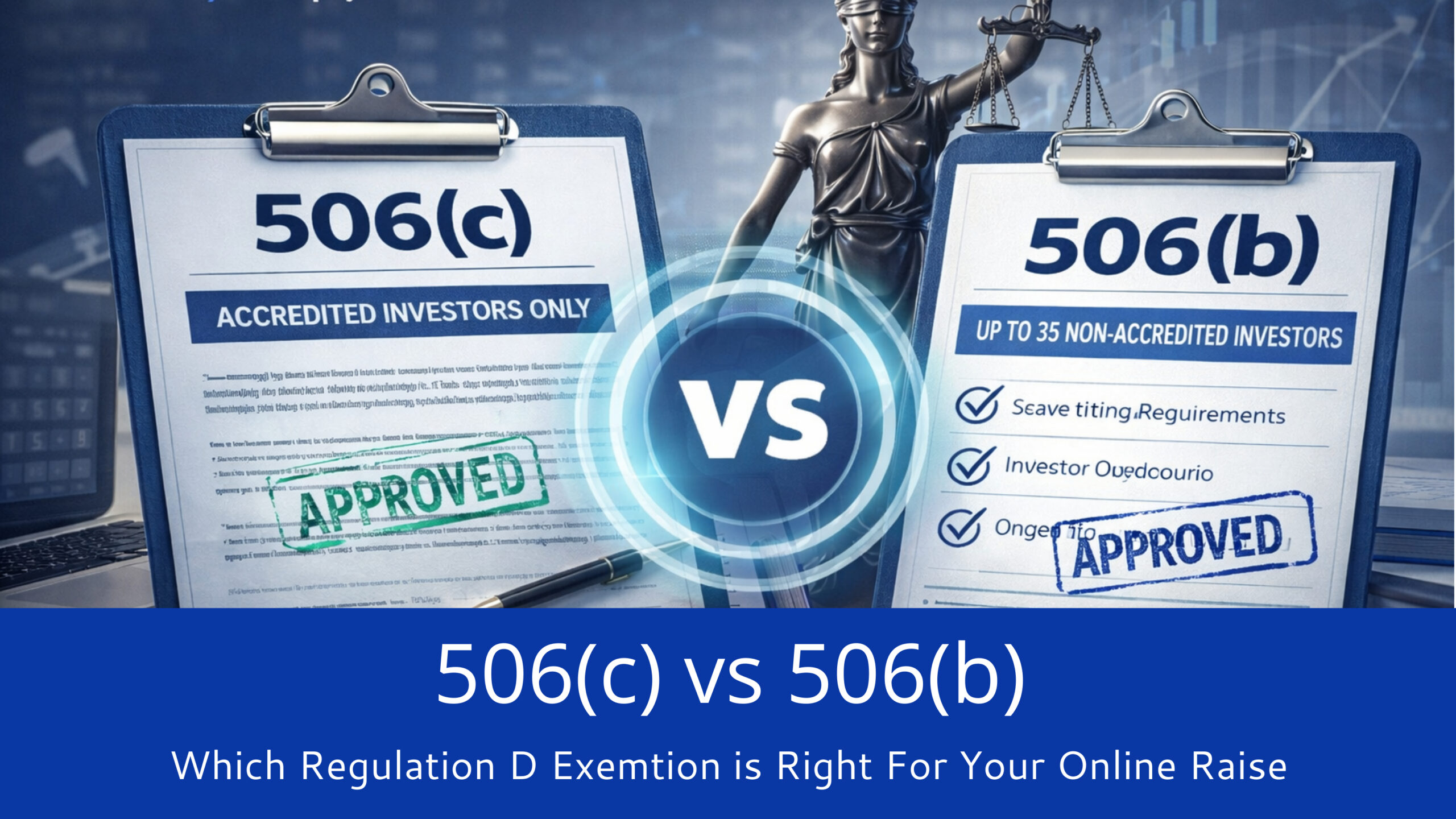
Filing Form D is a critical step for many companies raising capital under Regulation D of the Securities Act of 1933. While Regulation D private offerings allow businesses to raise money without registering their securities with the SEC, Form D acts as a required notice of the exempt offering and must be filed electronically through the SEC’s EDGAR system.
This article explains who is required to file Form D, when it must be filed, and what it includes.
What Is Form D?
Form D is a brief notice filed with the SEC to claim an exemption from full registration under Regulation D. It includes basic information about the issuer, the type and amount of securities offered, and the identity of certain individuals involved in the offering. Importantly, Form D is not an application for exemption approval—it is a notification that the issuer is relying on one of the exemptions under Regulation D.What Entities Are Required to File Form D?
The following parties are required to file Form D with the SEC:Companies Offering Securities Under Rule 504
- Can raise up to $10 million in a 12-month period.
- No federal preemption: issuers must also comply with state-level Blue Sky registration or exemption requirements.
- Form D is required to notify the SEC of the exempt offering.
Companies Offering Securities Under Rule 506(b)
- Can raise an unlimited amount of capital.
- Can sell to an unlimited number of accredited investors and up to 35 non-accredited (but sophisticated) investors.
- Offers are not publicly advertised.
- Federal preemption applies, but Form D is still required as a notification filing.
Companies Offering Securities Under Rule 506(c)
- Allows general solicitation and advertising of the offering.
- All investors must be accredited and verified.
- No limit on the amount of capital raised.
- Like 506(b), Form D is required and federal preemption applies, though state notice filings are still mandatory in most jurisdictions.
Any Domestic or Foreign Private Issuer Using a Reg D Exemption
- Whether a U.S. company or a foreign issuer, if they are offering securities under Reg D to U.S. investors, Form D must be filed with the SEC.
Investment Funds and Private Equity Firms
- Hedge funds, venture capital funds, and private equity firms frequently rely on Rule 506 exemptions and are required to file Form D when raising capital from investors.
Startups and Early-Stage Companies
- Most early-stage companies raising capital through friends, family, angel investors, or venture capital under Reg D are legally obligated to file Form D with the SEC to remain in compliance.
When Must Form D Be Filed?
Form D must be filed within 15 calendar days after the first sale of securities in the offering.- A “sale” occurs when an investor is legally obligated to invest, not necessarily when funds are received.
- If the 15th day falls on a weekend or federal holiday, the deadline is extended to the next business day.
What Happens If You Don’t File Form D?
- Loss of exemption: Issuers that fail to file Form D may lose their Reg D exemption and be forced to register the offering or return investor funds.
- State enforcement: Many states also require notice filings that depend on timely SEC Form D submission.
- Reputational risk: Noncompliance can harm investor confidence and damage relationships with future backers or partners.
- Future fundraising limitations: Issuers may be barred from relying on Regulation D for future offerings.
What’s Included in Form D?
- Basic company information (name, address, jurisdiction)
- Offering size and amount already sold
- Type of security being offered
- Minimum investment accepted
- Use of proceeds
- Details about executive officers, promoters, and related parties
- Exemption rule being relied upon (504, 506(b), or 506(c))
Best Practices
- Track offering dates and file Form D before the 15-day deadline
- Coordinate state Blue Sky notice filings alongside your federal Form D
- Work with a compliance professional to ensure accuracy and timely filing
- Amend Form D if material information changes (e.g., increase in offering size)
Conclusion
Any company raising capital under Regulation D Rules 504, 506(b), or 506(c) must file Form D with the SEC. Filing is mandatory, not optional—even if you're a private company, foreign issuer, or raising from accredited investors only. Need Help? Blue Sky Comply offers turnkey support for Form D preparation, SEC submission, and state-level Blue Sky filings to help you stay compliant and focused on raising capital.
Navigating federal securities law is complex—but it becomes even more challenging when layered with individual state securities regulations, known as Blue Sky laws. While certain SEC filings benefit from federal preemption, many still trigger state-level notice, exemption, or registration requirements. Skipping these steps can result in costly fines, cease and desist orders, or enforcement actions.
What Are Blue Sky Filings?
Blue Sky laws are state-level securities laws designed to protect investors from fraud. Even if an offering is exempt from federal registration, the issuer often must submit a notice filing with each state where the securities are offered or sold. These filings frequently include a copy of the SEC form (such as Form D), a consent to service of process (typically Form U-2), and a filing fee.SEC Filings That Trigger Blue Sky Filings
Below is a detailed breakdown of the most common SEC filings and how they interact with Blue Sky law obligations at the state level.Form D (Regulation D: Rules 504, 506(b), 506(c))
- Triggers Blue Sky filings in all states where securities are sold.
- Rule 504: No federal preemption. Issuers must register or file for exemption in each state.
- Rules 506(b) and 506(c): Federal preemption applies under the National Securities Markets Improvement Act (NSMIA), but issuers must still file notice filings and fees with each applicable state.
Form 1-A (Regulation A: Tier 1 and Tier 2 Offerings)
- Tier 1 (up to $20M): No federal preemption. Full Blue Sky registration is required in every state where securities are offered.
- Tier 2 (up to $75M): Federal preemption of registration, but most states still require notice filings and fees, including Form 1-A, U-2, and filing fees.
- Some states require issuer-dealer registration for direct sales to investors.
Form C (Regulation Crowdfunding - Reg CF)
Although Reg CF enjoys federal preemption, some states still require a Blue Sky notice filing for crowdfunding offerings. Required filings often include:- A notice filing of the Reg CF offering
- A filing fee
- Any applicable state-specific forms
- Investor Residency Concentration: Individuals who purchase 50% or more of the total securities sold (via dollar amount) in the Reg CF offering are residents of the corresponding state.
- State of Principal Place of Business: If your principal place of business is located in a U.S. State that mandates state filings, you may need to comply with these requirements.
Form S-1 (Initial Public Offerings and Direct Listings)
- Used for public offerings of securities.
- If securities are not listed on a national securities exchange (like NASDAQ or NYSE), Blue Sky registration may be required in states where the securities are sold.
- Some states require issuer-dealer or agent registration for direct-to-investor IPOs.
Forms S-3, S-4, S-8, F-1, F-3, F-4
- Used for follow-on offerings, mergers, employee stock compensation, and foreign issuer registrations.
- If securities are NMS-listed (traded on a national securities exchange), Blue Sky laws are typically preempted.
- However, resale of securities or direct offerings to employees (e.g., via S-8) may still trigger notice filings in specific states.
Form 10 / Form 8-A
These forms are used for registering securities under the Securities Exchange Act of 1934.- If the issuer’s securities are not listed on a national exchange, Blue Sky registration or exemption may still be required for secondary sales in some states.
Rule 147 / Rule 147A (Intrastate Offerings)
- These rules allow for intrastate offerings exempt from federal registration.
- Issuers must comply fully with the Blue Sky registration or exemption process in the offering state.
Regulation S (Offshore Offerings)
- Reg S allows offerings made outside the U.S. to foreign investors.
- Generally does not require Blue Sky filings, unless securities are later resold in U.S. states. In such cases, state-level compliance may be required for secondary market activity.
Rule 701 (Employee Compensation Plans for Private Companies)
- Allows companies to issue equity as compensation to employees without federal registration.
- Several states require a Blue Sky notice filing if employees reside in their jurisdiction and receive equity under Rule 701.
Regulation E (Closed-End Investment Companies)
- Applies to small business investment companies or BDCs (business development companies).
- Triggers Blue Sky filings in each state where securities are sold.
Regulation CE (Rule 1001 – California-Only Exemption)
- Applies only to California-based offerings under federal exemption.
- Still requires compliance with California Blue Sky laws.
What Happens If You Don’t File?
Failure to comply with Blue Sky laws may result in:- Fines from $100 to $5,000+ per violation
- Cease and desist orders
- Rescission rights for investors
- Barred ability to raise capital in noncompliant states
- Reputational harm
Best Practices for Issuers
- Determine investor locations early in the offering process
- Track and meet all filing deadlines (e.g., 15-day window post-sale for Form D)
- Budget for state fees (ranging from $100 to over $2,500 per state)
- Use an experienced Blue Sky compliance partner to ensure filings are timely, complete, and cost-effective
Need Help?
At Blue Sky Comply, we monitor all 50 states and D.C. for compliance rules, filing requirements, and deadlines. Whether you're raising under Reg D, Reg A, Reg CF, or another exemption or offering, we provide expert filing services and cost-saving compliance management.
Raising capital through Regulation D (Reg D) offerings can be a strategic and efficient way for private companies to secure funding without undergoing a full SEC registration. However, many issuers often wonder: Are Blue Sky filings required under Reg D? The answer is nuanced and depends on the type of exemption used under Reg D and the state in which the securities are offered. Below, we break down what Blue Sky laws are, how they apply to Reg D offerings, and why compliance is critical for issuers.
In short:
What Is a Blue Sky Filing?
Blue Sky laws refer to individual state securities laws designed to protect investors against fraud. These laws require that companies making securities offerings either register those securities or file for an exemption in each state where they are selling them. A Blue Sky filing is the documentation submitted to a state securities regulator to comply with that state’s laws. While Reg D offerings are exempt from federal registration under the Securities Act of 1933, they are not automatically exempt from state-level notice requirements. This is where Blue Sky filings come into play.Regulation D Overview: Rule 504, 506(b), and 506(c)
Reg D includes several exemptions, each with its own compliance obligations:- Rule 504: Allows companies to raise up to $10 million within a 12-month period. State registration or notice filings are required, and federal preemption does not apply.
- Rule 506(b): Allows raising an unlimited amount from accredited investors (and up to 35 non-accredited investors who meet sophistication requirements). Offers a federal preemption, but notice filings (Form D) are still required in each state where securities are sold.
- Rule 506(c): Also permits raising an unlimited amount but allows general solicitation, provided all investors are verified accredited investors. Like 506(b), federal preemption applies, but state notice filings are still mandatory.
Are Blue Sky Filings Required Under Reg D?
| Rule | Federal Preemption | State Registration Required? | State Notice Filing Required? | State Fees Required? |
| 504 | ❌ No | ✅ Yes (in most states) | ❌ No | ✅ Yes |
| 506(b) | ✅ Yes | ❌ No | ✅ Yes | ✅ Yes |
| 506(c) | ✅ Yes | ❌ No | ✅ Yes | ✅ Yes |
- Rule 504 does not enjoy federal preemption. You must register or file for exemption in each state.
- Rules 506(b) and 506(c) allow for federal preemption, but Form D must be filed federally and with each state where securities are sold, usually within 15 days of the first sale in that state.
When Are Blue Sky Filings Required Under Reg D?
Blue Sky filings are required to be filed within 15 days of the first sale within each state, typically. See our full list of state filing deadlines and fees.What is a Form D?
Form D is a brief notice that includes information about the offering, such as:- The names and addresses of the company’s executive officers and directors
- The type and amount of securities offered
- The identities of promoters and offering agents
- Exemption being relied on (506(b), 506(c), etc.)
- A notice filing and copy of the Form D
- Consent to service of process (U-2 form)
- Other filing requirements based on state (Form 99, etc.)
- Filing fee (varies by state)
What Happens If You Don’t File?
Failing to comply with Blue Sky laws can lead to:- State-level enforcement actions
- Civil penalties or fines
- Loss of exemption status, exposing the issuer to full SEC registration requirements
- Restrictions on future fundraising
- Reputational damage
Why Blue Sky Compliance Still Matters Under Reg D
Even with federal preemption under Rules 506(b) and 506(c), state-level notice filings remain a legal requirement. Issuers who assume that a federal exemption means they can skip state filings often end up in violation. Furthermore, many states require annual renewal filings, fee payments, or amendments if offering details change (e.g., the amount raised, change in company officers).How Blue Sky Comply Helps
Blue Sky Comply offers a full-service platform and support team to ensure that Reg D issuers:- File Form D with both the SEC and each required state on time
- Submit Blue sky notice filings, where necessary
- Calculate and pay state filing fees (some states charge up to $2,500)
- Track annual renewals and amendments to maintain good standing
- Manage state regulator inquiries and responses
Conclusion
While federal law may preempt full state registration under Rules 506(b) and 506(c), notice filings and state-specific forms are still mandatory. Noncompliance can result in serious financial and legal repercussions. Companies using Rule 504 have even more obligations, as they lack federal preemption entirely. For a smooth, compliant capital raise, consider working with experts like Blue Sky Comply, who offer tailored solutions for all Reg D filings across the country.
Issuers must comply with federal and state securities laws when raising capital through private or public securities offerings. While SEC regulations play a central role in governing these transactions, state-level Blue Sky Laws also impose additional requirements to protect investors from fraudulent practices.
Blue Sky Compliance refers to the process of adhering to these state securities regulations, ensuring that issuers meet filing, disclosure, and registration requirements. Failure to comply with Blue Sky laws can result in penalties, restrictions on securities sales, and regulatory enforcement actions. In this guide, we explore the importance of Blue Sky Compliance, state-specific filing requirements, and best practices to ensure issuers remain fully compliant when conducting securities offerings.
Understanding Blue Sky Laws Blue Sky Laws are state-level securities regulations designed to protect investors from fraudulent or misleading investment schemes. These laws require companies selling securities within a particular state to register or file exemptions before offering securities to investors. Each state has its own set of Blue Sky Laws, which typically require:
- Registration of securities or exemption filings before securities can be sold in that state.
- Disclosure of offering details, including financial statements and investor protections.
- Filing fees and periodic renewals to maintain compliance.
- Issuer-dealer and broker-dealer registration if the company is selling securities directly.
Who Needs Blue Sky Compliance?
Any company conducting a securities offering—whether private placements under Regulation D public offerings under Regulation A or traditional IPOs—must ensure they comply with Blue Sky Laws in every state where their securities are sold.Blue Sky Offering Types
Here are some common types of offerings requiring Blue Sky Compliance:- Regulation D Offerings (Rule 506(b) and 506(c)) – Most states require notice filings for Form D submissions.
- Regulation A Offerings (Tier 1 and Tier 2) – Tier 1 issuers must comply with full state registration, while Tier 2 issuers must file notice filings in certain states.
- Initial Public Offerings (IPOs) – Full registration is required in every state where securities are offered.
- Secondary Trading – Some states require ongoing compliance for publicly traded securities.
Key Elements of Blue Sky Compliance
Ensuring Blue Sky Compliance involves several critical steps that vary by state. The primary areas of focus include state notice filings, registration for non-exempt offerings, and issuer-dealer and broker-dealer registration. For exempt offerings like Regulation D Rule 506(b) and 506(c), issuers must file a Form D notice filing with each state where securities are sold. This typically includes:- A copy of Form D as filed with the SEC.
- State-specific filing forms.
- A filing fee varies by state (ranging from $100 to $2,500 per filing).
- Filing deadlines, usually within 15 days of the first sale.
- A detailed disclosure of financials.
- Business plans and risk disclosures.
- Underwriter agreements.
- State regulator approval before sales begin.
- Tier 1 Offerings (Up to $20M) – State registration is required in every state where securities are sold.
- Tier 2 Offerings (Up to $75M) – State registration is preempted, but some states require notice filings and fees.
- State-level registration forms.
- Licensing of officers or agents engaging in sales.
- Compliance with record-keeping and reporting obligations.
Common Blue Sky Compliance Mistakes
- Failing to File State Notice Filings – Even if an offering is federally exempt, missing state-level filings can result in fines and sales restrictions.
- Missing Filing Deadlines – Most states require notice filings within 15 days of the first sale; missing these can lead to late fees.
- Ignoring Renewal Requirements – Some states require annual renewals for ongoing offerings.
- Not Registering as an Issuer-Dealer – Selling securities directly without proper registration in certain states can lead to enforcement actions.
- Review State-Specific Requirements – Each state has unique Blue Sky Laws. Research filing deadlines, fees, and exemptions.
- Track Filing Deadlines and Renewals – Use a compliance calendar to ensure timely filings.
- Work with Compliance Professionals – Blue Sky Compliance firms help issuers manage filings across multiple states.
- Maintain Proper Documentation – Keep records of all filings, investor communications, and regulatory correspondence.
- State-imposed fines range from $100 to $10,000 per violation.
- Restrictions on securities sales in non-compliant states.
- Legal actions from state regulators.
- Investor lawsuits for non-disclosure of required filings.
Regulation D (Reg D) is one of the most commonly used exemptions under the Securities Act of 1933, allowing companies to raise capital through private offerings without undergoing the burdensome registration process required for public offerings. However, while Reg D provides significant advantages, it also comes with specific compliance requirements that issuers must follow to avoid regulatory penalties and maintain investor confidence.
This guide explores the key compliance obligations associated with Reg D, including Form D filings, Blue Sky laws, investor verification, and ongoing reporting requirements. By understanding and adhering to these rules, issuers can successfully navigate the complexities of private placements and ensure legal compliance.
What is Regulation D?
Regulation D is an exemption from SEC registration requirements, designed to facilitate capital raising for startups, small businesses, and private companies. It enables companies to sell securities to accredited and, in some cases, non-accredited investors without the need for a full public offering. The two primary rules under Reg D include:- Rule 506(b) – Allows issuers to raise an unlimited amount of capital but restricts general solicitation. Offers can include up to 35 non-accredited investors, but they must receive disclosure documents similar to a registered offering.
- Rule 506(c) – Allows general solicitation and advertising but limits investors to accredited individuals only. Issuers must take reasonable steps to verify accredited status, such as reviewing tax returns or bank statements.
Form D Filing Requirements
One of the most critical compliance obligations for Reg D offerings is the Form D filing. Form D is a notice filed with the SEC that provides key information about the offering and must be submitted within 15 days after the first sale of securities. Key Information Required in Form D:- Issuer details (company name, location, industry classification)
- Offering type and exemption relied upon (Rule 504, 506(b), or 506(c))
- Total amount of securities offered and sold
- Number of investors participating in the offering
- Issuer executive details
- Late Filings – Missing the 15-day deadline can result in penalties and loss of the Reg D exemption.
- Inaccurate Information – Any misrepresentation in the filing can trigger SEC investigations.
- Failure to Amend—If the offering significantly changes (e.g., increased capital raised, changes in executive officers), issuers must file an amended Form D promptly.
Blue Sky Laws and State Filing Requirements
While Reg D is a federal exemption, issuers must also comply with state-level securities laws, commonly referred to as Blue Sky Laws. Each state has its regulations regarding notice filings, fees, and disclosure requirements. Key Blue Sky Compliance Obligations:- Notice Filings – Many states require a separate filing in addition to Form D.
- Filing Fees – States impose fees that vary based on the amount raised and the number of investors.
- Renewals – Some states require annual renewals for ongoing offerings.
- Issuer-Dealer Registration – Certain states require issuers to register as a dealer if selling directly to investors.
Investor Verification and Compliance
Under Rule 506(c) of Reg D, issuers must take reasonable steps to verify that all investors meet the accredited investor criteria. This requirement is intended to protect non-accredited investors from high-risk private placements. Accepted Methods of Investor Verification:- Tax Returns & W-2 Forms – Confirming annual income of at least $200,000 ($300,000 for joint income).
- Bank Statements & Brokerage Reports – Showing assets exceeding $1 million (excluding primary residence).
- Third-Party Verification – Letters from CPAs, attorneys, or investment advisors confirming accreditation status.
Ongoing Compliance and Recordkeeping
Even after an offering is completed, issuers must adhere to ongoing compliance requirements to maintain Reg D eligibility and investor trust. Best Practices for Ongoing Compliance:- Maintain Records of Investor Accreditation – Store verification documents for at least five years.
- Monitor Blue Sky Renewals – Track state-level filing deadlines and renewal requirements.
- Keep Investors Informed – Provide updates on the offering and financial performance to ensure transparency.
- Prepare for Audits – Maintain accurate records in case of SEC or state regulatory audits.
Conclusion: Ensuring Full Compliance with Blue Sky Compliance
Successfully conducting a Regulation D offering requires meticulous adherence to federal and state-level regulations. From filing Form D on time to ensuring Blue Sky compliance and investor verification, issuers must take proactive steps to remain compliant. At Blue Sky Compliance, we specialize in helping issuers navigate the complexities of Reg D filings, Blue Sky laws, and ongoing reporting obligations. By working with compliance experts, issuers can avoid costly mistakes, reduce regulatory risks, and ensure a smooth capital-raising process. If you're preparing for a Reg D offering, contact Blue Sky Compliance today to ensure full regulatory compliance and seamless execution.
The Securities and Exchange Commission (SEC) continues to escalate enforcement actions against companies that fail to comply with federal securities laws, particularly regarding required filings. In recent months, the SEC has taken action against multiple firms for failing to meet deadlines for essential filings, including Form D for Regulation D offerings and Blue Sky notice filings required by various states. These enforcement actions highlight the growing emphasis on regulatory compliance and the consequences for issuers who fail to follow the rules.
For companies raising capital through exempt offerings under Regulation A or Regulation D, compliance filings are not optional—they are a legal requirement. The SEC's recent enforcement initiatives serve as a stark reminder that even seemingly minor compliance oversights can lead to significant penalties. According to SEC records, non-compliance with required filings has resulted in millions of dollars in cumulative fines, impacting both small and large issuers alike.
SEC Enforcement Actions: A Renewed Focus on Compliance
Recently, the SEC has charged multiple firms for failing to submit timely Form D filings, an essential requirement for issuers conducting private offerings under Regulation D. Form D is a short disclosure form that provides the SEC with basic information about an offering, including the amount raised and the types of investors participating. While Regulation D offerings provide an exemption from full SEC registration, issuers must still submit Form D within 15 days of the first sale of securities. Additionally, many states require Blue Sky filings, which notify state securities regulators of the offering and ensure compliance with local laws. Failure to meet these deadlines can result in the following penalties:- SEC enforcement actions and financial penalties
- State-level fines and the inability to offer securities in certain jurisdictions
- Reputational damage, which can impact investor confidence
- Re-Envision Wealth: In December 2024, the Securities and Exchange Commission (SEC) charged Re-Envision Wealth for failing to file a Form D in connection with an exempt offering under Regulation D. The company agreed to a settlement that included a civil penalty of $60,000.
- Pipe Technologies: In the same enforcement action, Pipe Technologies was charged for not complying with the Form D filing requirements. They settled with the SEC, agreeing to pay a civil penalty of $195,000.
- Underdog Sports Holdings: In December 2024, Underdog Sports Holdings was also charged with failing to file Form D as required under Regulation D. The company reached a settlement with the SEC, which included a financial penalty of $175,000.
The Impact of Non-Compliance on Issuers
Companies that fail to file Form D or required state notices put their fundraising efforts at risk. A missed filing deadline can trigger regulatory scrutiny, leading to legal action, fines, and even restrictions on future offerings. For companies relying on private placements to secure capital, these consequences can be devastating. Here’s what can happen when issuers fail to comply:1. Hefty Fines & Regulatory Actions
- The SEC has the authority to impose significant fines on companies that fail to meet filing requirements.
- State securities regulators may deny exemptions for issuers who do not submit required Blue Sky filings.
- Failure to comply with Form D requirements can lead to cease-and-desist orders, preventing companies from conducting further offerings.
2. Loss of Investor Confidence
- Investors expect issuers to follow legal and regulatory guidelines.
- A lack of compliance may signal financial instability, poor management, and potentially deceitful business practices, which can discourage future investment and trust.
- Institutional investors and venture capital firms often conduct due diligence, and compliance failures can be a red flag.
- Companies with consistent regulatory infractions may face long-term reputational damage, leading to decreased funding opportunities.
3. Operational Delays & Legal Costs
- Non-compliance can lead to prolonged investigations by regulators.
- The costs of defending against SEC or state enforcement actions can be substantial, often exceeding $50,000 per case.
- Companies may be required to resubmit filings, pay additional fees, or rectify compliance failures, causing unnecessary delays in capital-raising efforts.
- In extreme cases, issuers may be prohibited from raising capital under exemptions until all compliance issues are resolved.
The SEC’s Message: Compliance is Not Optional
The SEC’s latest enforcement actions reinforce the importance of timely and accurate compliance filings. Regulatory agencies are sending a clear message: issuers who fail to meet legal obligations will face consequences. Compliance should be a top priority for businesses seeking to raise capital through private placements or exempt offerings. Companies can protect their fundraising efforts by proactively managing Form D filings, Blue Sky notices, and issuer-dealer registrations and maintaining investor confidence. At Blue Sky Comply, we take the burden of compliance off your shoulders so you can focus on growing your business. Our comprehensive filing services, regulatory monitoring, and expert compliance support ensure your company meets all SEC and state-level requirements.Stay Ahead of SEC Enforcement with Blue Sky Comply
As the SEC intensifies its enforcement actions, issuers cannot afford to overlook compliance obligations. Partner with Blue Sky Comply to avoid fines, protect your reputation, and ensure seamless capital raising. Don’t wait until it’s too late. Contact Blue Sky Comply today to ensure full compliance with Form D, Blue Sky Laws, and all regulatory requirements.


Let Us Simplify Compliance for You
Partner with Blue Sky Comply to unlock seamless compliance, efficient filings, and access to expertise that lets you focus on your growth.
Schedule A Free Demo