
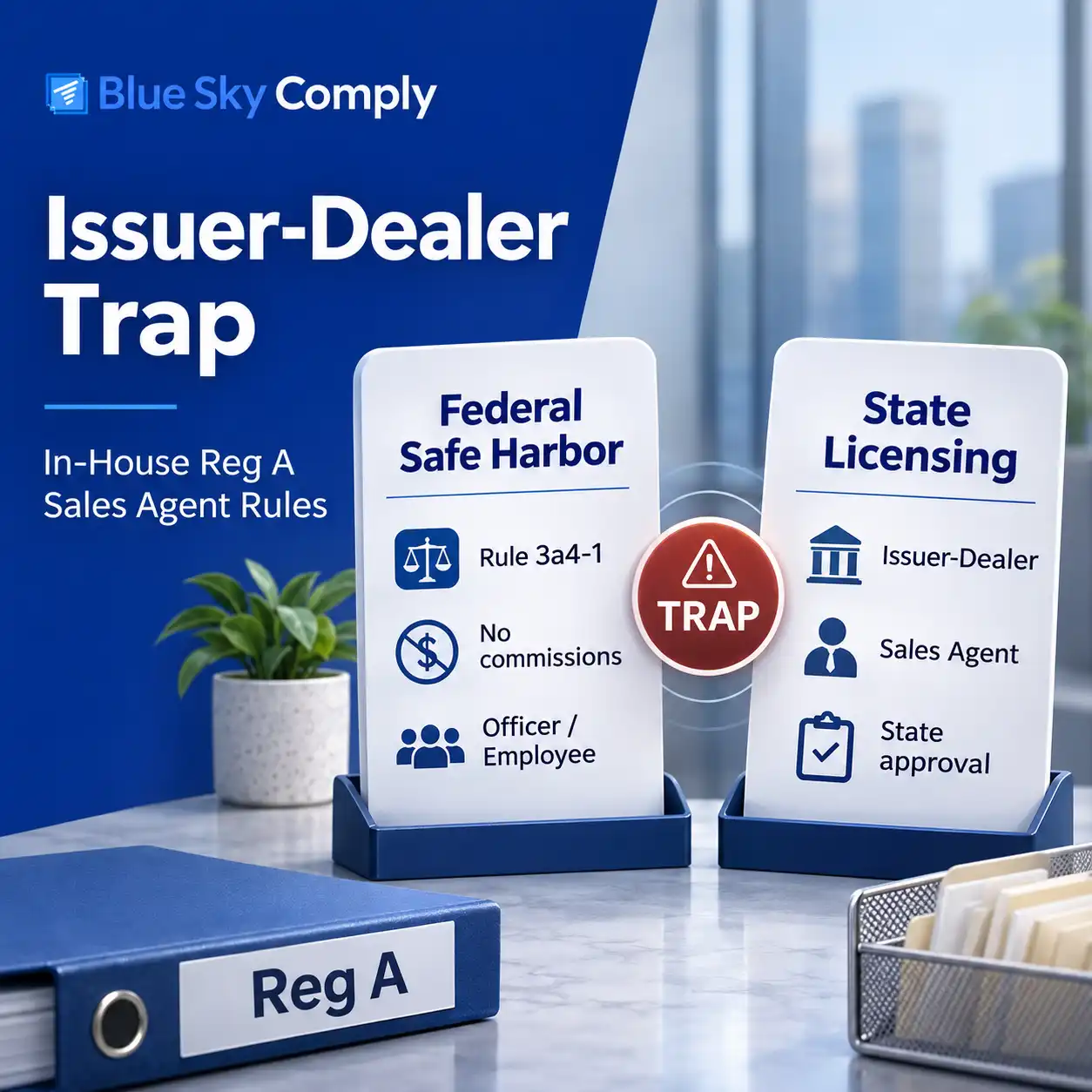
Using an in-house sales agent for a Regulation A offering can seem straightforward: designate someone inside the company, introduce investors, and avoid outside brokerage fees. However, federal broker registration rules and state Blue Sky laws create separate obligations. The issuer-dealer trap arises when a company assumes its federal exemption also resolves state licensing requirements for Reg A sales agents and issuers.
Does the Sales Agent Need to Be an Owner?
To answer the question directly: no, this person does not need to be an owner, and SEC Rule 3a4-1 does not require every owner to participate in fundraising.
The rule covers qualifying partners, officers, directors, and employees. It does not expressly require employees to be full-time. However, a title alone does not establish eligibility. Ownership disclosures are also a separate matter: required filings may still request information about certain owners and control persons.
Limiting sales activity to a single designated officer can be an excellent internal policy to control compliance. Whoever is chosen must meet the applicable federal safe-harbor conditions and any state licensing requirements.
Federal Issuer Exemption: Compensation Rules Matter
The federal “issuer exemption” is commonly used shorthand for the nonexclusive safe harbor under SEC Rule 3a4-1. A qualifying individual who satisfies its conditions is not considered a broker solely because of participation in selling the company’s securities.
One central requirement is clear: the individual cannot receive commissions, transaction-based bonuses, or any percentage of the capital raised while relying on this safe harbor. Compensation cannot depend directly or indirectly on securities transactions.
Their pay may include a standard salary or a bonus genuinely disconnected from fundraising success. Calling compensation a “flat bonus” does not solve the problem if payment depends on closing the financing.
The individual must also satisfy the rule’s disqualification and broker-dealer association restrictions. The SEC’s broker-dealer registration guide explains these baseline requirements.
Federal Exemption Does Not Eliminate State Sales Agent Licensing
We also need to clarify a common misconception regarding the paperwork. An Issuer Dealer Sales Agent can qualify for the federal safe harbor and still require a state-level sales agent license in certain jurisdictions.
Where the state requires both registrations, the company’s issuer-dealer application and the officer’s sales agent application should be coordinated. The officer is registered to act for that issuer in that state. Submitting company paperwork alone does not automatically license the individual.
For example, the Texas State Securities Board’s registration guidance explains that self-distribution may require registering the company, an officer, and additional individuals selling securities. Texas identifies Form BD for dealer registration and Form U4 for individual agent registration in its dealer application instructions.
A designated officer and a selling agent are not necessarily interchangeable roles. Confirm that the selected person holds every registration required for their actual responsibilities before regulated sales activity begins.
Can an Officer Also Be Affiliated With a Broker-Dealer?
An officer’s affiliation with a broker-dealer does not automatically prohibit participation in the company’s Regulation A offering. However, current broker-dealer association generally prevents reliance on the Rule 3a4-1 safe harbor. Because that safe harbor is nonexclusive, participation may still be permissible under another compliant arrangement. See Rule 3a4-1(a)(3) and (b).
A FINRA-associated individual must also address applicable outside securities transaction requirements, including advance notice and, where selling compensation is involved, firm approval and supervision. State sales agent licensing is a separate requirement. See FINRA Rule 3280.
How the 12-Month Safe-Harbor Conditions Work
For an individual relying on Rule 3a4-1(a)(4)(ii), two separate 12-month conditions apply:
- Prior brokerage affiliation: The individual must not have been a broker, dealer, or associated person of one during the preceding 12 months, as defined in the rule.
- Offering participation: The individual generally cannot participate in selling an offering for any issuer more than once every 12 months, subject to the rule’s stated exceptions.
These conditions concern the individual—not whether the company previously hired an outside broker-dealer. They also do not create a company-wide prohibition on continuous fundraising or successive offerings. The company must evaluate the individual’s participation and the legal basis supporting it. See Rule 3a4-1(a)(4)(ii)(B)–(C).
Reg A Tier 2 Does Not Resolve Every State Requirement
Regulation A Tier 1 generally requires state offering registration or an available exemption. Tier 2 preempts state registration and qualification of the offering, but that does not automatically eliminate sales agent licensing.
The New Jersey Bureau of Securities, for example, addresses agent registration for individuals offering or selling Regulation A Tier 2 securities. Requirements and exemptions vary by jurisdiction.
Investor locations are central to this review, but they are not the only consideration. Where offers originate, where sales activities occur, the offering structure, and applicable exemptions can also affect the analysis.
Plan Reg A Compliance Before Investor Outreach
Before launching outreach, document the officer’s duties, compensation, prior affiliations, offering participation, and permitted communications. Map relevant states and confirm company registration, individual licensing, offering filings, and renewal obligations separately.
Keep application approvals, sales materials, investor communications, and compensation records together. If another employee starts answering investment questions or soliciting purchases, review that person’s role before expanding their responsibilities. Registering one designated officer does not automatically authorize every employee to sell securities on the company’s behalf in that state.
Blue Sky Comply’s Reg A services help companies coordinate state filings, fees, and deadlines for Tier 1 and Tier 2 offerings. Establish the sales arrangement with securities counsel, then organize the required filings before entering additional states.
*Disclaimer: This article is provided for general informational and educational purposes only and does not constitute legal, investment, or other professional advice. Securities laws and regulatory requirements vary by jurisdiction and may change. Reading this article or contacting Blue Sky Comply does not create an attorney-client relationship. Consult qualified securities counsel about your specific offering, licensing requirements, and compliance obligations.


