Raising capital involves more than complying with federal securities laws. While many companies focus on SEC requirements, state securities laws continue to have a greater impact on compliance, state fee exposure risks, and the timeliness of raising capital. These regulations, commonly known as Blue Sky Laws, exist alongside federal rules and often require additional filings, fees, or registrations before securities can be sold within a state.
For issuers conducting private placements, Regulation A offerings, or other exempt transactions, overlooking state requirements can lead to missed deadlines, regulatory penalties, and unnecessary delays. Understanding how Blue Sky Laws work is essential to planning a successful securities offering.
This guide explains what Blue Sky Laws are, how they interact with federal securities regulations, which offerings they affect, and why companies raising capital should pay close attention to state-level compliance.
What Are Blue Sky Laws?
Blue Sky Laws are state securities laws that regulate the offer and sale of securities within individual states, and require issuers to make certain disclosures to states whenever conducting capital raises or primary offerings. Their primary purpose is to protect investors by requiring companies to meet certain disclosure, filing, or registration requirements before offering securities to residents of a particular jurisdiction.
Although every state has its own securities regulator and laws, the overall objective remains consistent: promoting transparency and reducing fraudulent investment activity.
Why Are They Called Blue Sky Laws?
The phrase “Blue Sky Laws” dates back to the early twentieth century. It originated from efforts to stop speculative investment schemes that were said to have “no more substance than the blue sky.”
While securities markets have evolved significantly since then, the underlying purpose of these laws has remained largely unchanged. Today, they continue to provide an additional layer of investor protection alongside federal securities regulation.
What Do Blue Sky Laws Regulate?
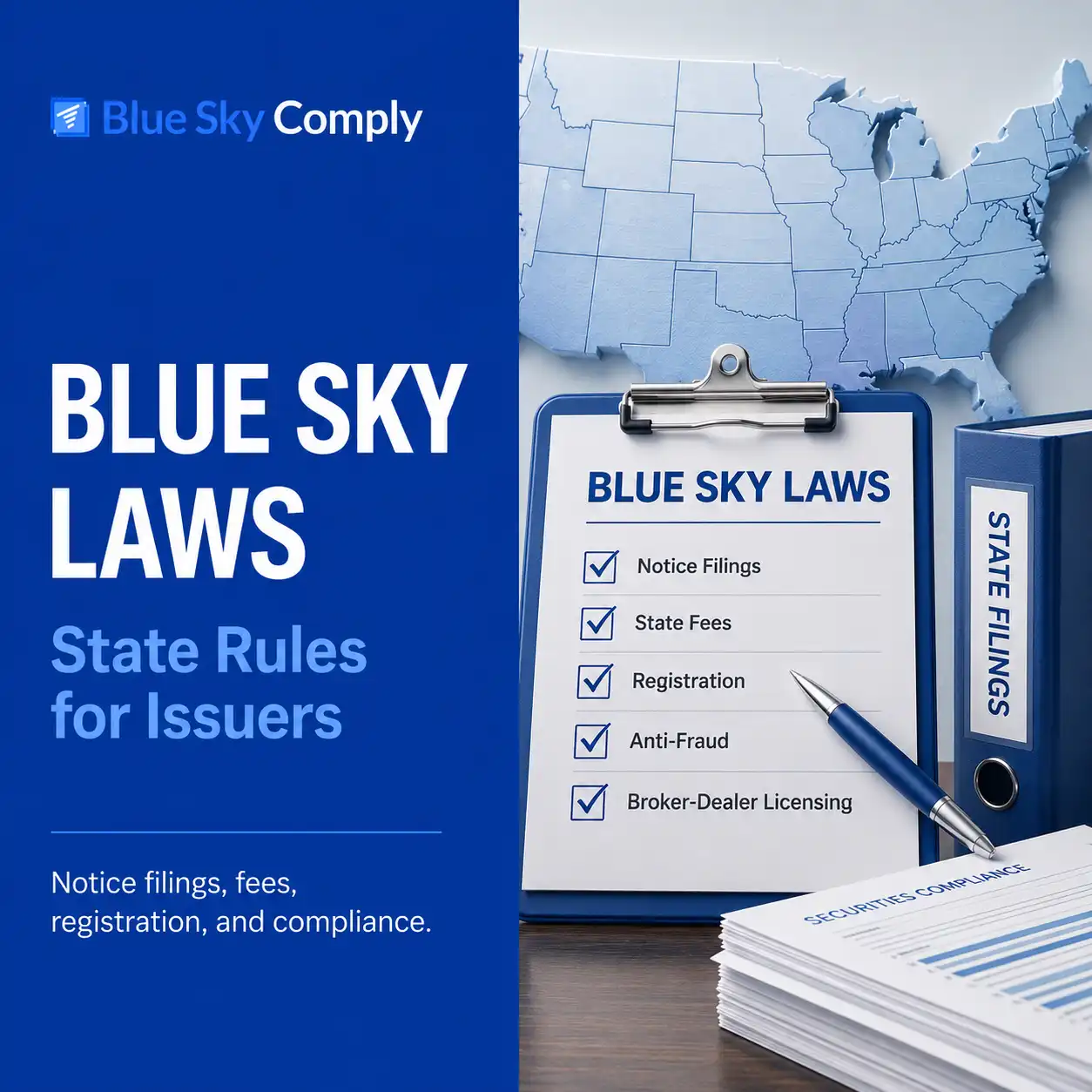
Blue Sky Laws cover far more than the registration of securities offerings. Depending on the state and the type of offering, they may also govern:
- Notice filings
- Sales commissions
- Registration requirements
- State filing fees
- Broker-dealer licensing
- Other required documentation from officers
- Enforcement against securities fraud
For companies raising capital, these laws determine whether additional compliance steps are required before accepting investments from residents of a particular state.
How Blue Sky Laws Work Alongside Federal Securities Laws
One of the biggest misconceptions among first-time issuers is that complying with SEC rules automatically satisfies every legal requirement. In reality, securities offerings are often subject to both federal and state oversight.
The SEC establishes nationwide rules governing securities offerings and exemptions, while each state maintains its own securities authority responsible for enforcing state-specific requirements.
The relationship between the two can be summarized as follows:
| Federal Securities Laws | Blue Sky Laws |
| Administered by the SEC | Administered by individual state regulators |
| Apply nationwide | Apply within each state |
| Govern federal exemptions such as Regulation D, Regulation A, and Regulation Crowdfunding | Govern state registration, notice filings, and other state-specific requirements |
| Establish federal disclosure rules | Establish state compliance obligations |
Meeting federal SEC requirements does not necessarily eliminate state compliance obligations. Depending on the exemption used and where investors are located, issuers may still need to file and pay fees with the states.
Which Securities Offerings Are Affected by Blue Sky Laws?
Blue Sky Laws apply differently depending on the type of securities offering. Some offerings receive substantial federal preemption, while others remain subject to extensive state review.
Regulation D Offerings
Most private companies raising capital rely on Regulation D exemptions, particularly Rule 506(b) and Rule 506(c).
Although these offerings are exempt from state registration requirements under federal law, they still require state notice filings wherever investors reside. Companies must also comply with each state’s filing deadlines and applicable filing fees.
For issuers raising money from investors in multiple states, managing these filings can quickly become one of the most time-consuming parts of the offering.
Regulation A Offerings
Regulation A offerings are divided into two tiers, and each receives different treatment under Blue Sky Laws.
- Tier 1 offerings remain subject to state securities review, meaning companies may need to register or qualify their offering separately in every state where securities will be sold.
- Tier 2 offerings benefit from federal preemption, eliminating full state registration requirements. However, many states still require state filings and fees, making state compliance an ongoing consideration even after SEC qualification, with heavy penalties for not complying.
Regulation Crowdfunding
Regulation Crowdfunding, often referred to as Reg CF, receives broader federal preemption than many other exemptions.
In most situations, issuers are not required to complete state registration. However, certain states continue to require notice filings under specific circumstances, particularly when the issuer’s principal place of business or investor concentration meets defined thresholds.
Although the state burden is much smaller than under other exemptions, companies should still confirm whether additional state filings are required before launching an offering.
Why Blue Sky Laws Vary by State
Blue Sky Laws are a state-by-state system, not a single national rulebook. While federal securities laws create an overarching framework, each state has the authority to adopt and enforce its own securities requirements. The result is a patchwork of rules that can differ meaningfully from one jurisdiction to the next.
What works in one state may not be enough in another. A filing accepted without issue in one jurisdiction might trigger additional notice requirements, supplemental documents, different fee structures, or separate licensing obligations elsewhere. Even the mechanics of compliance—such as deadlines, renewal periods, and filing procedures—can change from state to state.
For companies offering securities across multiple jurisdictions, that variation creates more than just administrative work. It introduces a layer of compliance planning that requires close attention to each state’s specific rules.
As the number of states involved increases, so does the complexity. Multi-state offerings often require a coordinated approach to avoid missed filings, inconsistent submissions, or unnecessary regulatory risk.
How Companies Stay Compliant With Blue Sky Laws
Effective Blue Sky compliance starts well before an offering reaches investors. Companies that handle state compliance successfully usually do so by building it into the offering process from the outset – not by scrambling to address it after federal documents have already been prepared or sales activity has begun.
In practice, Blue Sky compliance works best when it is treated as part of the overall transaction strategy. That means identifying state-level obligations early, tracking deadlines carefully, and creating a repeatable process for filings, fees, renewals, and recordkeeping.
A practical compliance process often includes:
- Identifying the federal exemption relied upon for the offering
- Determining which states have jurisdiction over the transaction
- Preparing the required notice filings and supporting documents for each applicable state
- Submitting filings within each state’s deadline
- Paying the applicable filing fees
- Tracking renewal, amendment, and ongoing filing obligations
- Maintaining organized records throughout the life of the offering
A consistent process does more than reduce the risk of missed filings. It also makes future amendments, renewals, and additional offerings far easier to manage.
When Professional Blue Sky Compliance Support Makes Sense
Not every offering requires the same level of Blue Sky compliance support. A smaller raise limited to one or two states may be fairly manageable. But once an offering expands across multiple jurisdictions, the compliance demands often become more time-consuming, more technical, and more difficult to track internally.
That is typically the point when outside support becomes especially valuable. Professional Blue Sky compliance assistance is often used when companies:
- Conduct offerings in multiple states
- Launch a first-time securities offering
- Manage ongoing filings and amendments
- Complete offerings with multiple state notice requirements
- Need to track renewals and jurisdiction-specific filing deadlines
Bringing in experienced compliance support can help reduce administrative strain while improving consistency across filings. It also allows legal teams, company leadership, and other stakeholders to stay focused on the transaction itself rather than the moving parts of multi-state securities compliance.
Frequently Asked Questions About Blue Sky Laws
What are Blue Sky Laws?
Blue Sky Laws are state securities laws that govern how securities offerings are conducted within a state. They are designed to protect investors from fraud and misleading investment activity, while also giving states the authority to impose compliance and disclosure/filing requirements on companies raising capital.
Do all states have Blue Sky Laws?
Yes. Every state has its own securities laws and regulatory authority, although the specific requirements vary considerably from one jurisdiction to another.
Are Blue Sky Laws the same in every state?
No. Each state establishes its own filing procedures, fees, deadlines, and registration requirements.
Do Regulation D offerings require Blue Sky filings?
In most cases, yes. Although Rule 506 offerings are exempt from state registration, they still require notice filings and applicable filing fees in states where investors purchase securities, and often in the state of incorporation.
Does Regulation A Tier 2 eliminate Blue Sky compliance?
Not entirely. Tier 2 offerings benefit from federal preemption of state registration requirements, but many states continue to require notice filings and filing fees.
What happens if a company violates Blue Sky Laws?
Depending on the state and the nature of the violation, consequences may include late fees, administrative penalties, restrictions on future securities sales, enforcement actions, or investor claims.
Blue Sky Laws Are a Core Part of Securities Compliance
Blue Sky Laws remain an important part of securities compliance in the United States. Even when federal exemptions apply, companies often still need to meet state-level requirements.
For issuers, that means understanding where filings are required, what each state expects, and when deadlines apply. Taking a proactive approach can help reduce delays, limit regulatory risk, and keep an offering moving smoothly.
As offerings expand across multiple states, compliance can quickly become more complex. Blue Sky Comply helps issuers manage state filings, fees, renewals, amendments, deficiency inquiries, and filing requirements with confidence.