
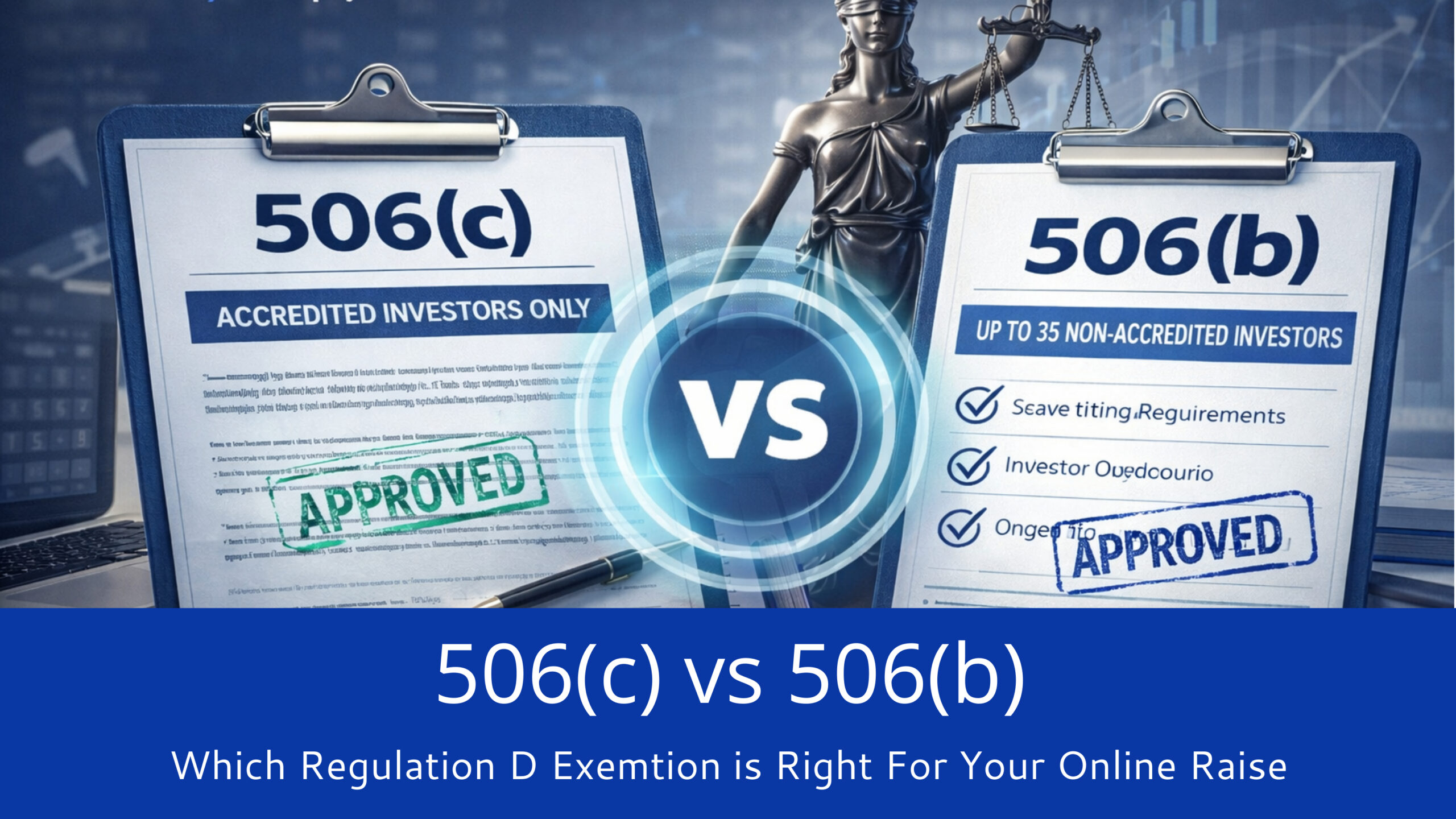
If you’re deciding between 506(c) and 506(b), it really comes down to how you plan to market and how your investors will prove accreditation. Rule 506(c) allows general solicitation but requires verified accredited investors. Rule 506(b) prohibits general solicitation but permits up to 35 sophisticated non-accredited investors (with enhanced disclosures). If you have a strong, pre-existing LP network and want minimal friction, 506(b) is straightforward. If you need to publicly market to grow your top of funnel, 506(c) is your path, just be ready for verification workflows.
You can pivot from 506(b) to 506(c) midstream if you later choose to advertise, but you generally can’t go back to 506(b) after you’ve publicly solicited.
What is Regulation D?
Most private funds choose Regulation D because it’s the fastest, most flexible route to raise capital without full SEC registration. If you’re new to these exemptions, it helps to understand the broader framework of a Reg D offering and how Regulation D streamlines private placements for venture, private equity, real estate, and private credit.
In short, Reg D is the umbrella, and Rules 506(b) and 506(c) are the two main paths. Your choice shapes how (and where) you can talk about your raise and what you’ll need from investors to onboard them.
What is Rule 506(b)?
Under 506(b), you can’t generally solicit, so no public ads, open social posts, or press campaigns inviting investments. Instead, outreach happens within substantive, pre-existing relationships. You can accept an unlimited number of accredited investors and up to 35 sophisticated non-accredited investors, but if you include any non-accredited investors, be prepared to provide more robust disclosures and handle additional suitability considerations.
Operationally, 506(b) tends to be smoother: investors commonly self-certify accreditation through your subscription documents (you should still keep consistent records). Don’t forget the filing logistics: submit Form D to the SEC within 15 days after your first sale and handle state notice obligations.
Best fit: repeat funds and managers with deep LP networks who prioritize speed and privacy.
What is Rule 506(c)?
Rule 506(c) lets you market publicly, webpages, podcasts, events, PR, social media, and even paid ads are in play. There’s one big trade-off: all investors must be accredited, and you must take “reasonable steps to verify” that status. That could mean reviewing income documentation (W-2s/1040s), net-worth evidence (statements plus liability attestations), or obtaining a verification letter from a CPA, attorney, RIA, or broker-dealer.
506(c) is a strong fit if your strategy depends on audience-building and content-led demand. Just ensure compliance, IR, and data-handling workflows are ready.
General solicitation vs. “quiet marketing”
Put simply, 506(c) permits general solicitation; 506(b) does not. Public webpages with investment CTAs, open webinars, press, and social posts are common under 506(c). For 506(b), keep communications one-to-one within pre-existing relationships, and gate investment content behind logins or password-protected data rooms.
- Safer 506(b) behaviors: vetted one-to-one emails, closed-door LP meetings, and gated data rooms.
- 506(c) freedoms: public web pages, podcasts, press, social posts, and paid media used to attract accredited investors.
Who Can Invest in Reg D Offerings?
Eligibility depends on the rule and investor status. 506(b) supports private outreach to accredited investors and up to 35 sophisticated non-accredited investors. 506(c) enables public marketing but admits accredited investors only, with verified accreditation.
Domestic vs. Foreign Investors
U.S. (domestic) investors can participate under either 506(b) or 506(c), subject to the specific eligibility and solicitation rules of each. Non‑U.S. (foreign) investors can also invest in a Reg D offering, provided they satisfy the exemption’s requirements (e.g., accredited and verified for 506(c)) and complete standard KYC/AML and sanctions checks.
State blue sky notices generally follow the investor’s U.S. state of residence; if the investor has no U.S. state residency, a state notice is typically not triggered by that subscription.
Note: Some issuers run a parallel offshore tranche under Reg S for non‑U.S. persons, keeping processes separate to avoid integration issues. That’s optional and outside the core Reg D path, but it’s common in cross‑border raises.
Accredited vs. Non‑Accredited Investors – Regulation D Rules 506(b) & 506(c)
| Rule | Investor Type Allowed | Max Number of Investors | Verification Requirement | Other Considerations |
| Rule 506(b) | Unlimited accredited investors plus up to 35 sophisticated non‑accredited investors | Unlimited accredited investors; up to 35 non‑accredited | Accredited: typically via self‑certification (keep consistent records) | If non‑accredited investors participate, enhanced disclosures and suitability diligence are required |
| Rule 506(c) | Accredited investors only | Unlimited accredited investors; no non‑accredited investors allowed | Must take “reasonable steps to verify” accreditation (e.g., documentation or third‑party letter from CPA, attorney, RIA, or broker‑dealer) | More stringent verification; excludes non‑accredited investors entirely |
This table is for informational purposes only and is not legal or financial advice. If you need more details or have questions about specific scenarios, consult a qualified professional like an attorney or financial advisor.
Practically, that means 506(b) favors managers with warm networks who prioritize speed and privacy, while 506(c) suits teams that need public marketing and can operationalize verification.
Real‑World Scenarios
Scenario A — VC Fund IV (506(b)): An established VC targets existing LPs. The team runs quiet outreach, hosts closed LP updates, and closes 70% of commitments before any public activity. Investors self‑certify; Form D is filed within 15 days of first sale; state notices are filed for CA, NY, and MA. No public page mentions a live raise.
Scenario B — National real estate sponsor (506(c)): A sponsor markets property summaries on a public page and runs paid social. Investors complete verification via CPA letters; ad creative and targeting are archived; rolling closes run monthly. Public pages clearly state “for accredited investors.”
Scenario C — Emerging manager pivot (506(b) → 506(c)): A first‑time manager starts under 506(b), then pivots to 506(c) to broaden reach. They scrub earlier materials, publish 506(c) pages, document the switch date, and verify all new investors admitted after the pivot.
506(b) vs. 506(c) Comparison
Choosing between Rule 506(b) and Rule 506(c) is as much an operational decision as it is strategic. 506(b) keeps outreach private and can speed first close with a warm network, while 506(c) unlocks public marketing in exchange for verified accreditation and tighter controls. If your pipeline is relationship-driven and privacy‑sensitive, 506(b) often wins on simplicity; if you need top‑of‑funnel growth and brand exposure, 506(c) gives you the reach, provided you’re ready to verify.
With that in mind, the table below lays out the side‑by‑side differences so you can see where the tradeoffs truly land.
Reg D 506(b) vs 506(c) Requirements
| Requirement | Rule 506(b) | Rule 506(c) |
| General solicitation | Not permitted (no public ads, open social posts, press invites to invest). | Permitted (public websites, social, PR, events, podcasts, paid media). |
| Investor eligibility | Unlimited accredited investors; up to 35 sophisticated non‑accrediteds (with enhanced disclosures). | Accredited investors only. |
| Accreditation process | Self-certification typically accepted (maintain consistent subscription/suitability records). | Verification required (reasonable steps: documents or third‑party letters from CPA/attorney/RIA/broker‑dealer). |
| Disclosure burden | Higher if non‑accredited investors participate; otherwise, standard private placement docs. | Standard private placement docs; verification evidence adds operational rigor. |
| Marketing channels | Quiet, relationship-based outreach (pre‑existing, substantive relationships). | Broad, public marketing allowed to build top‑of‑funnel. |
| Speed to first close | Often faster with warm networks and minimal accreditation friction. | May add time for verification education, document collection, and review. |
| Investor privacy sentiment | Generally favored by LPs who prefer not to share sensitive documents. | Requires comfort with sharing financials or obtaining third‑party letters. |
| Blue sky/state notices | Federal preemption from merit review, but state notices/fees still apply. | Same: federal preemption with ongoing state notice/fee obligations. |
| Form D timing | File within 15 calendar days after the first sale; amend as facts change. | Same requirement and amendment expectations. |
| Recordkeeping focus | Prove absence of general solicitation; track investor suitability and relationship substantiation. | Prove “reasonable steps to verify”; archive public marketing, targeting, and verification evidence. |
| Typical use cases | Repeat funds, deep LP networks, speed, and privacy prioritized. | Emerging managers, niche strategies, audience building via public content/events. |
| Common risks | Accidental general solicitation (public posts or site content leaking terms). | Inadequate verification or weak documentation of verification steps. |
| Switching flexibility | Can convert to 506(c) if you later decide to advertise (going forward). | Cannot revert to 506(b) after any general solicitation for the offering. |
Blue Sky and Form D: What Many Issuers Overlook
Rules 506(b) and 506(c) benefit from federal preemption (no state merit review), but that doesn’t eliminate state notice obligations. After your first sale in a state, you typically owe a notice filing and a fee, and you’ll need to amend as facts change. For a foundation on the topic, see blue sky laws. Here are a few things you should be mindful of:
- Timely Filings: Track first sale dates and ensure you submit state Form D filings within 15 days.
- Budgeting: Learn about reg d state fees and decide if you don’t want to offer investments for sale in certain states.
- Tooling: Streamline blue sky notice filing requirements, fees, and amendments using blue sky filing software as part of their fundraising stack.
Even with federal preemption, state notices and fees still apply—missed filings can create avoidable risk.
Choosing your path: a practical decision framework
Start with your pipeline: do you have a deep bench of LPs who prefer discretion and are ready to move? If yes, 506(b) often gets you to a first close faster. If you’re building a brand and need the widest possible top-of-funnel, 506(c) lets you market publicly, so your content, PR, and event plans have space to work.
Also, weigh investor privacy expectations and your team’s operational capacity. Verification under 506(c) is manageable with planning, but it does add coordination, especially for first-time LPs. Meanwhile, 506(b) demands strict solicitation hygiene.
A simple view:
- Strong network + speed + privacy → likely 506(b).
- Public marketing + audience growth + content strategy → likely 506(c).
Switching midstream: 506(b) to 506(c) (and not the other way)
You can start under 506(b) and later pivot to 506(c) if you decide to advertise. When you switch, archive your 506(b) materials, stand up new 506(c)-compliant materials, and verify accreditation for all investors admitted post-switch. Maintain a clean timeline showing when public solicitation began.
Generally, you cannot revert to 506(b) after any general solicitation; once you advertise, the offering can no longer rely on 506(b).
Compliance, recordkeeping, and audit readiness
Treat your marketing and investor onboarding like regulated workflows. Keep a log of public posts, ads, and campaign dates; store accreditation documentation and third-party letters with timestamps; version offering documents and track updates. On the state side, centralize deadlines and fees for state securities filings and stay current on blue sky filings.
Costs, timelines, and operational impacts
Legal reviews, investor verification (for 506(c)), and state notices/fees are the main cost drivers. Timelines vary by pipeline: 506(b) is often quicker for warm networks; 506(c) adds verification education and coordination. To speed things up, pre-brief LPs on verification options, use a secure portal, and batch reviews near closing windows. Don’t forget to budget for blue sky fees and amend notices as facts change.
Alternatives to Reg D (for select use cases)
While funds typically default to Reg D, certain issuers consider Reg A or Reg CF:
- For consumer-facing or broad retail campaigns, a Reg A offering may be relevant
- For community-driven or early-stage public raises, explore Regulation CF
These don’t replace 506(b)/(c) for traditional institutional LPs but can fit specific issuer profiles.
FAQs
- 506c vs 506b: Can I include non-accredited investors under 506(c)?
Under 506(c), all investors must be accredited and verified. - Do I have to re-verify existing LPs for each fund under 506(c)?
Often, you can rely on recent verification and “no material change” attestations, but set a clear policy on recency and evidence. - Can I talk publicly about performance under 506(c)?
You can advertise, but ensure claims are fair, balanced, and substantiated. Archive materials and footnote methodologies. - Do 506(b)/(c) offerings avoid state requirements entirely?
No, federal preemption removes merit review, but you still owe notices and fees. - Can foreign investors invest in Reg D offerings?
Yes, non-U.S. investors can participate if they satisfy Reg D requirements (e.g., accredited status under 506(c)), pass KYC/AML, and comply with sanctions rules. Form D is still filed after the first sale; state notices generally follow the investor’s U.S. state of residence (no U.S. state, typically no state notice) - What is the difference between Reg D and Reg S?
Reg D exempts private offerings in the U.S. (including to U.S. persons), while Reg S is a safe harbor for offshore offers/sales to non-U.S. persons with no directed selling into the U.S. They’re often run in parallel—Reg D for U.S. investors and Reg S for foreign, maintaining process separation to avoid integration issues - What counts as a “pre‑existing, substantive relationship” under 506(b)?
Evidence of a real, two‑way relationship formed before the offering (e.g., documented conversations, CRM notes, prior investor updates), showing you know the prospect’s financial sophistication and objectives—not just a cold email sign‑up. - What are “reasonable steps to verify” under 506(c), and how long is verification valid?
Common paths include income docs (W‑2s/1040s), net‑worth statements plus liabilities attestations, or third‑party letters from a CPA/attorney/RIA/broker‑dealer; many issuers apply a 90–120 day “freshness” standard before re‑verification. - If we accidentally generally solicit under 506(b), what should we do?
Treat it as a pivot point: cease 506(b) marketing, stand up 506(c) materials, and admit any new investors only after verified accreditation—while documenting the switch and maintaining a clean audit trail. - How do state blue sky notices work when investors are in multiple states or we have rolling closes?
File notices and pay fees in each state of sale, keyed to the investor’s state of residence and the date of first sale; update/amend for new states and material changes, and calendar renewals where required to stay current.
Key takeaways
Choose 506(b) when trusted relationships, speed to first close, and privacy matter most. Choose 506(c) when public marketing and audience growth are strategic priorities, and you’re prepared for verified accreditation. Either way, be deliberate about filings and timelines: incorporate blue sky compliance, state notices, and fee planning into your project plan from day one.